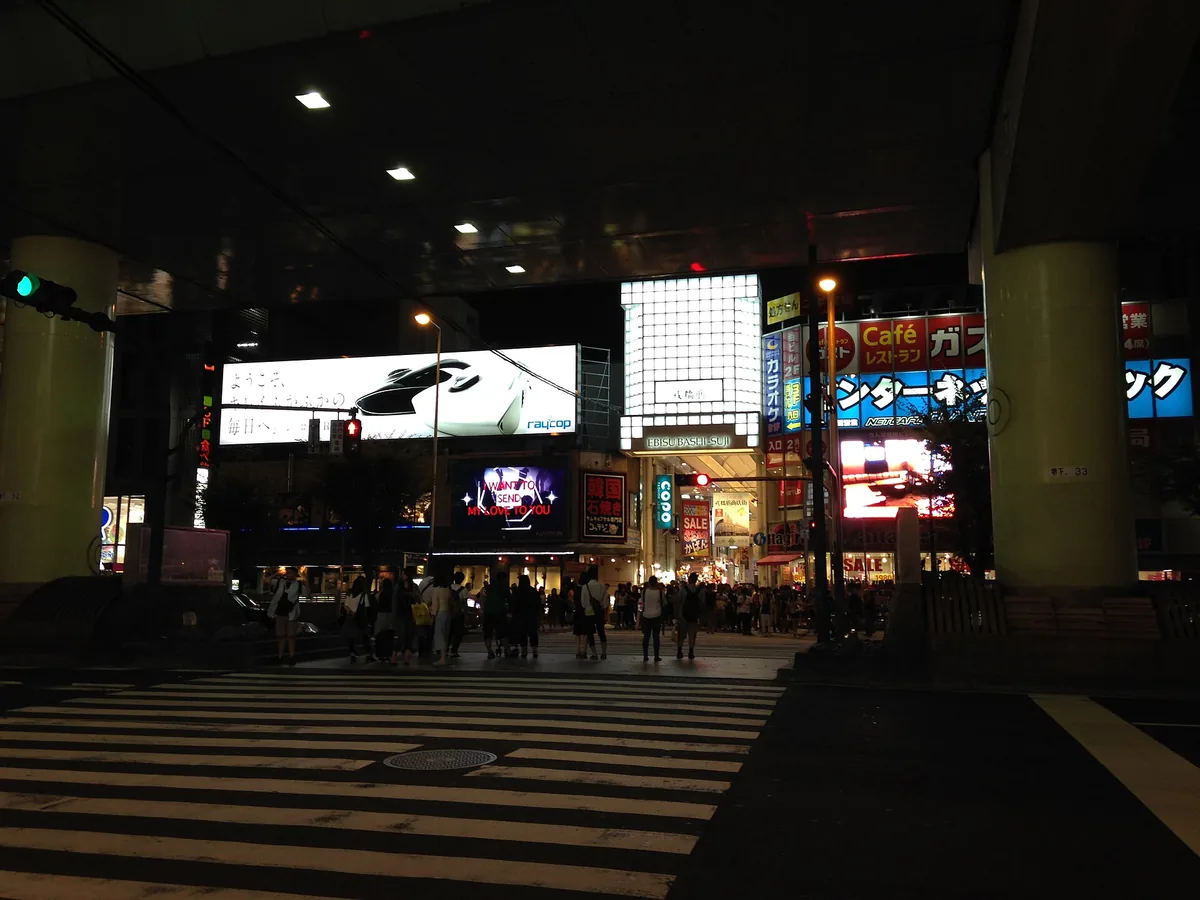
Namba and Dotonbori

Writes the autumn colour pages and follows the forecasts as they are issued, which is more than one forecast.
UpdatedOsaka splits into Kita, the office and station district around Umeda, and Minami, the older southern half around Namba. Minami is the one people mean when they picture Osaka: the Dotonbori canal with its signboards, a kilometre of covered arcade, and behind both a grid of narrow lanes where the actual city lives.
There is one rule that decides whether you eat well here. Walk three streets off the canal. The frontage on Dotonbori is the most expensive and least discerning ground in Osaka; three minutes’ walk in any direction the prices halve and the queues are locals.
At a glance
- What it is
- Minami, the southern centre: Dotonbori canal, Shinsaibashi arcade, Hozenji Yokocho, Namba and Kuromon market
- Stations
- Namba served by Osaka Metro, Nankai, Kintetsu and JR – four different companies, four different Nambas
- Best hours
- Before 10:00 and after 21:00. The middle of the afternoon is the worst of it
- Budget
- Street food from ¥500; a good okonomiyaki dinner ¥1,500–¥2,500
In this guide
The geography, which is not obvious
North to south: Shinsaibashi-suji is a covered arcade running down from Nagahoribashi, nearly a kilometre of it, chain shops at the top and older businesses lower down. It crosses the canal at Ebisubashi, the bridge facing the Glico sign. South of the canal the same arcade becomes Ebisubashi-suji and runs on to Namba.
Parallel and one street west is Amerikamura, Osaka’s vintage-clothing and skate quarter since the 1970s, with a small triangular park that is the city’s reliable place to sit and watch teenagers. East of Shinsaibashi is Soemoncho, which is nightlife of the hostess-club variety, and further east again Kuromon Ichiba, the covered food market – now heavily tourist-facing, expensive, and best before nine in the morning when it still serves the restaurant trade it was built for.
Tucked behind the canal’s south side is Hozenji Yokocho, two flagstoned lanes of small bars and old restaurants with a moss-covered stone Fudo Myoo at the end. It is twenty metres from the noise and it is silent, and it is the best thing in Minami.
Eating: the three-street rule in practice
Okonomiyaki is the dish to prioritise here, and the Osaka version is mixed, not layered – everything stirred into the batter and cooked as one mass, with no noodles unless you ask for modan-yaki. Mizuno, a ten-minute walk from Ebisubashi, holds a Michelin Bib Gourmand, opens 11:00 to 22:00, and dropped its old Thursday closure in February 2026. Expect to queue.
Takoyaki from the canal stalls is the classic tourist error – often undercooked so it survives a long queue, when the whole point of the dish is a centre that stays liquid by design rather than by accident. Wanaka sells eight for ¥500 and is the honest option.
For sushi, Harukoma in Tenjinbashi is worth the trip north; closed Tuesdays. For kushikatsu, the real thing is two stops south in Shinsekai, though Gojoya is the Michelin-listed counter version and it is in Minami. And Tonkatsu Minato, a 2026 Bib Gourmand with ten seats, is the best-value serious meal in the area at ¥3,000 to ¥3,999.
Four Nambas, four companies
“Namba” is not one station. Osaka Metro has Namba on three lines. Nankai has its own Namba terminal, which is the one you want for Kansai Airport and for Koyasan. Kintetsu and Hanshin share Osaka Namba, which is where trains for Nara and Ise leave from. JR has JR Namba, which is a good five minutes’ walk west of all of them and is on the Yamatoji line.
These are different companies with different fares and no through-ticketing. The Enjoy Eco Card at ¥820 on weekdays and ¥620 at weekends covers Osaka Metro and city buses only. The Osaka Amazing Pass at ¥3,500 covers the same network plus some private lines and around forty attractions, but not JR. From Kansai Airport the value route into Minami is the Nankai Airport Express at ¥970, about forty-four minutes to Nankai Namba; the rapi:t is ¥1,670 for the same journey in a nicer train.
If you are walking on from here, the Namba to Shinsekai walk is the natural southward route and takes in Hozenji, Kuromon and Tsutenkaku.
Frequently asked questions
What is the difference between Namba and Dotonbori?
Dotonbori is the canal and the street along it. Namba is the wider southern district around it, including the stations, the arcades, Kuromon market and Amerikamura. Locals call the whole area Minami.
Where should I eat near Dotonbori?
Three streets off it. The canal frontage is the most tourist-priced ground in Osaka. Mizuno for okonomiyaki, Wanaka for takoyaki, Tonkatsu Minato for a proper sit-down meal, and Hozenji Yokocho for small bars.
Which Namba station do I need?
Depends on the operator. Nankai Namba for Kansai Airport and Koyasan, Osaka Namba for Kintetsu trains to Nara, JR Namba for the Yamatoji line, and Osaka Metro Namba for the subway. They are separate companies and separate buildings.
Is Namba worth staying in?
Yes if you want to walk home from dinner, which in Osaka is most of the point. It is louder and later than Umeda, better connected to Kansai Airport, and worse connected to the shinkansen at Shin-Osaka.
When is Dotonbori least crowded?
Before ten in the morning, when the shutters are still down and you can see the street, and after about ten at night when the evening peak has thinned but the signs are still lit.
Further reading
Official sources
- OSAKA-INFO – Namba – Osaka Convention and Tourism Bureau area guide
- OSAKA-INFO – Dotonbori – The canal and its signboards
- Osaka Metro – Enjoy Eco Card – Weekday and weekend one-day fares for the metro network
- How to Osaka (Nankai) – tickets – Nankai fares from Kansai Airport to Namba
- Osaka Amazing Pass (official) – ¥3,500 one-day and ¥5,000 two-day prices