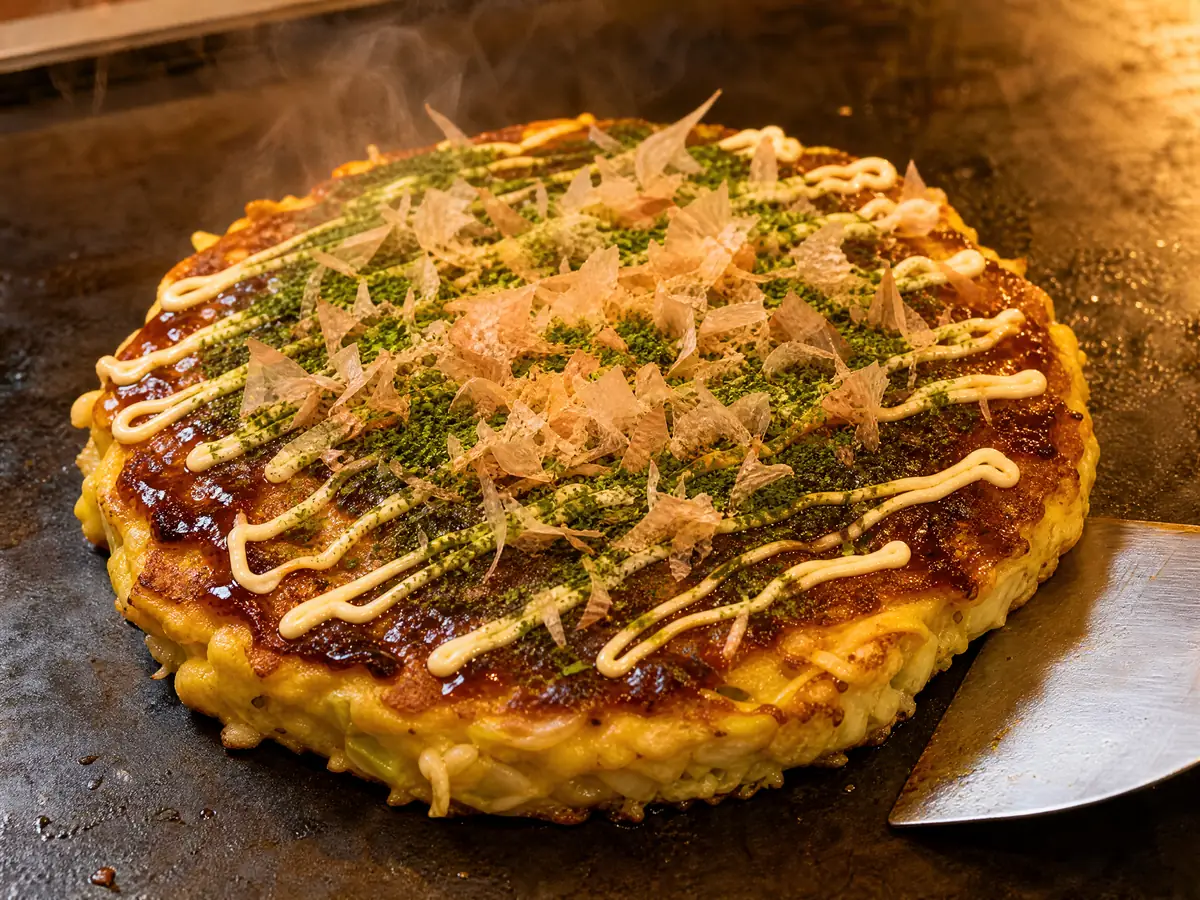
Okonomiyaki

Writes the logistics pages. Works to one rule: a price comes from the company that charges it.
UpdatedThere are two okonomiyaki and they are not variations on each other. Osaka-style is mixed: cabbage, batter, egg and fillings are stirred together in a bowl and poured onto the griddle as a single mass. Hiroshima-style is layered: a thin crepe goes down first, then a mound of cabbage, then pork, then a separate nest of fried noodles, and the whole stack is flipped as a structure.
The consequence that trips people up is the noodles. There are no noodles in a standard Osaka okonomiyaki. Add them and you have ordered modan-yaki, which is a real dish and a good one, but which is a variant rather than the default. Asking an Osaka cook for “the one with the noodles” is ordering something other than what the city is known for.
At a glance
- Osaka style
- Everything stirred together in a bowl, poured onto the griddle and cooked as one mass
- Hiroshima style
- Built in layers: thin crepe, a mound of cabbage, and a separate nest of fried noodles
- Noodles
- NOT in a standard Osaka okonomiyaki. With noodles it becomes modan-yaki, a named variant
- Budget
- ¥1,000–¥2,500 a head at a good counter
In this guide
Why mixed and layered taste different
It is a moisture problem. Cabbage is mostly water, and what you do with that water determines the dish.
In the Osaka method the cabbage is finely chopped and bound into the batter before it hits the iron, so the water it releases is absorbed by the flour and the egg. The result is homogeneous: a dense, custardy, savoury cake with cabbage distributed through it and a crust top and bottom. It holds together, it eats with a spatula, and every mouthful is the same mouthful.
In the Hiroshima method the cabbage is piled loose and steams itself under its own bulk against the crepe, collapsing as it cooks. Nothing binds it. The result is layered in the mouth as well as on the plate – crisp crepe, sweet steamed cabbage, noodles, egg – and it is roughly twice the volume for the same footprint.
Neither is a corruption of the other. They developed separately from the same post-war cheap-flour cooking, and the argument about which is correct is a local sport in both cities.
Ordering it in Osaka
The base is chosen by filling: buta-tama with pork belly, ika-tama with squid, mikkusu with several. Buta-tama is the default and the right first order, because the fat from the pork laid on top renders down through the cake as it cooks.
Yamaimo – grated mountain yam worked into the batter in place of some of the flour – is the upgrade worth looking for. It makes the whole thing lighter and looser, closer to a savoury soufflé. Mizuno, which holds a Michelin Bib Gourmand and now opens 11:00 to 22:00 with no weekly closure, is built around exactly this and it is the reason to queue there.
In most Osaka shops the cook makes it, not you. The DIY table griddle exists but it is more common in Hiroshima and in Tokyo’s monjayaki shops. If you are handed a bowl and left to it, pour once, do not press it down, and flip exactly once.
The finish, and the other Kansai griddle foods
Sauce, mayonnaise, aonori and bonito flakes go on at the counter. Okonomiyaki sauce is thicker and sweeter than the thin Worcestershire-style sauce used for kushikatsu, and the two are not interchangeable. Japanese mayonnaise is more acidic and more egg-yolk-heavy than the Western kind, which is why it works here and why substituting it does not.
Two relatives you will see on the same menus: negiyaki, made with spring onion instead of cabbage and served with soy rather than sauce, which is thinner and much sharper; and takoyaki, which shares the batter family and was invented in the same city in 1935.
Budget ¥1,000 to ¥2,500 a head. Okonomiyaki was Depression and post-war food – flour, cabbage, whatever there was – and it has stayed cheap, which is a large part of why Osaka thinks of it as its own.
Frequently asked questions
What is the difference between Osaka and Hiroshima okonomiyaki?
Osaka-style is mixed: everything is stirred together and cooked as one mass. Hiroshima-style is layered: a thin crepe, a mound of cabbage and a separate nest of fried noodles, built up in sequence and flipped as a structure.
Does Osaka okonomiyaki have noodles?
No, not by default. Adding noodles makes it modan-yaki, which is a named variant rather than the standard dish. The version with a nest of noodles built in is Hiroshima-style.
What should I order?
Buta-tama, the pork belly version, on a first visit. If the shop offers a yamaimo version made with grated mountain yam, order that instead – it is much lighter and it is what the best Osaka shops are known for.
Do I cook it myself?
Usually not in Osaka. Most shops have the cook make it on the counter griddle in front of you. Self-cooking tables are more common in Hiroshima and in Tokyo monjayaki restaurants.
How much does okonomiyaki cost?
¥1,000 to ¥2,500 a head at a good counter, including a drink. It began as cheap post-war flour cooking and has never become expensive, which is part of why Osaka claims it.
Further reading
Official sources
- Mizuno – MICHELIN Guide – Bib Gourmand okonomiyaki listing and current hours
- Mizuno (official) – Menu, including the yamaimo version
- OSAKA-INFO (Osaka Convention and Tourism Bureau) – Official city food information