How koyo timing works

Writes the autumn colour pages and follows the forecasts as they are issued, which is more than one forecast.
UpdatedAutumn colour is triggered by cold, so it arrives where the cold arrives first: in the north, and high up. The front takes about three months to cross Japan, starting in the mountains of Hokkaidō in mid September and reaching Tokyo and Kyoto in the second half of November.
That single sentence is most of what you need. The rest of this page is what it means in practice, which is that “when does Japan turn” is not a question with an answer – it depends entirely on how high you are standing and how far north.
At a glance
- The front moves
- North to south, and high to low
- Time to cross Japan
- About three months
- One mountain's spread
- Daisetsuzan holds six weeks on its own
- Latitude effect
- About five weeks from Asahikawa to Tokyo
In this guide
Elevation does more than you think
Hold latitude still and just go up, and you find weeks of difference inside a single place.
Daisetsuzan, one mountain, about six weeks. Ginsendai high on the alpine shoulder typically turns mid to late September. Asahidake, lower, late September into early October. Sōunkyō on the valley floor, early to mid October. Sapporo, a lowland city a hundred and fifty kilometres south, late October into early November.
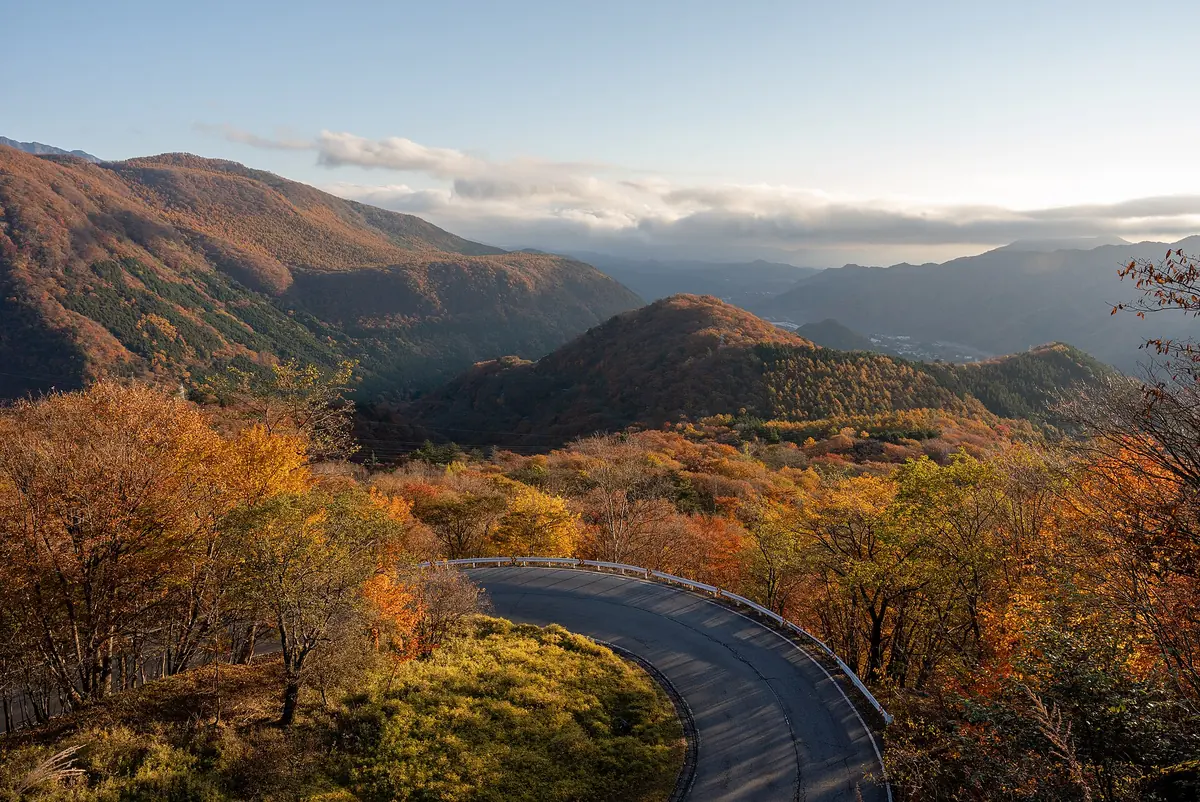
Nikkō, one town, about a month. Lake Yunoko up on the plateau is early to mid October. Ryūzu Falls early to late October. The Irohazaka switchbacks, which physically climb between them, mid October to early November – and you can watch the band move down the road as you drive it. Nikkō town at the bottom is last.
Tokyo, one city. Mount Mitake out in the Okutama hills, late October to mid November. Mount Takao, six hundred metres, mid November to early December. The central gardens, last of all, late November into December.
Then latitude adds the rest
Compare two low-lying cities and the north–south effect shows up cleanly. The Meteorological Agency's maple normals put Asahikawa around 23 October and Tokyo around 28 November – about five weeks for roughly ten degrees of latitude at comparable elevation.
Stack the two effects and you get the whole season: high and north in September, low and south in December.
What the forecasts are, and are not
Three organisations publish and they are not interchangeable.
Weathernews and the Japan Meteorological Corporation both issue numbered forecasts through the autumn, spot by spot, and both published their first 2026 forecast in early September. The Japan Weather Association, whose tenki.jp site is the one most Japanese aggregators quote, had not issued a 2026 forecast as of mid September.
Separately, the Meteorological Agency is not forecasting at all. It records when a single sample tree at each weather station has turned. That is a climate record, not a travel tool, and it is why its Kyoto maple normal sits in early December while the temple gardens peak in late November – the sample tree stands in the warm city centre.
Practical consequence: a first forecast issued in early September is a starting position, not a booking. Second and third forecasts land in October and November and move the dates. Use the typical window to choose your fortnight and the live forecast to choose your day.
How to actually use this
Pick your dates first, then pick your altitude. If you are locked to late October, you are looking at Nikkō, Takayama, the Alps or Hokkaidō, and Kyoto will be green. If you are locked to early December, the mountains are bare and Kyoto is perfect.
And if you have one fixed week in the middle of November, the honest answer is that you are between seasons in both directions, and the thing to do is gain a few hundred metres rather than hope.
Frequently asked questions
When do autumn leaves peak in Japan?
There is no single date. The front crosses the country over about three months – mid September in the high mountains of Hokkaidō, the second half of November in Tokyo and Kyoto, early December at the southern lowland end.
Why do different parts of Japan turn at different times?
Colour is triggered by cold, which arrives first in the north and at altitude. Daisetsuzan alone spans six weeks from its alpine shoulder to the valley floor, and Asahikawa runs about five weeks ahead of Tokyo at similar elevation.
Which Japan autumn forecast should I trust?
Weathernews and the Japan Meteorological Corporation both issue spot-level forecasts and both published for 2026 in early September. tenki.jp had not issued a 2026 forecast by mid September, so anything citing it for this year is quoting last year's page.
Can I see autumn colour in Japan in October?
Yes, but not in Kyoto or Tokyo. October is the month for Hokkaidō, Nikkō, Kamikōchi and the Alps. The cities are three to six weeks behind.
Further reading
Official sources
- Japan Guide – when to see autumn colour – The three-month north-to-south progression
- Weathernews – Kyoto foliage calendar – Typical windows computed from 2004-2025 observations
- JMA – ginkgo yellowing observations – Station sample-tree records and deviations
- JMA – maple colouring observations – Station sample-tree records and deviations