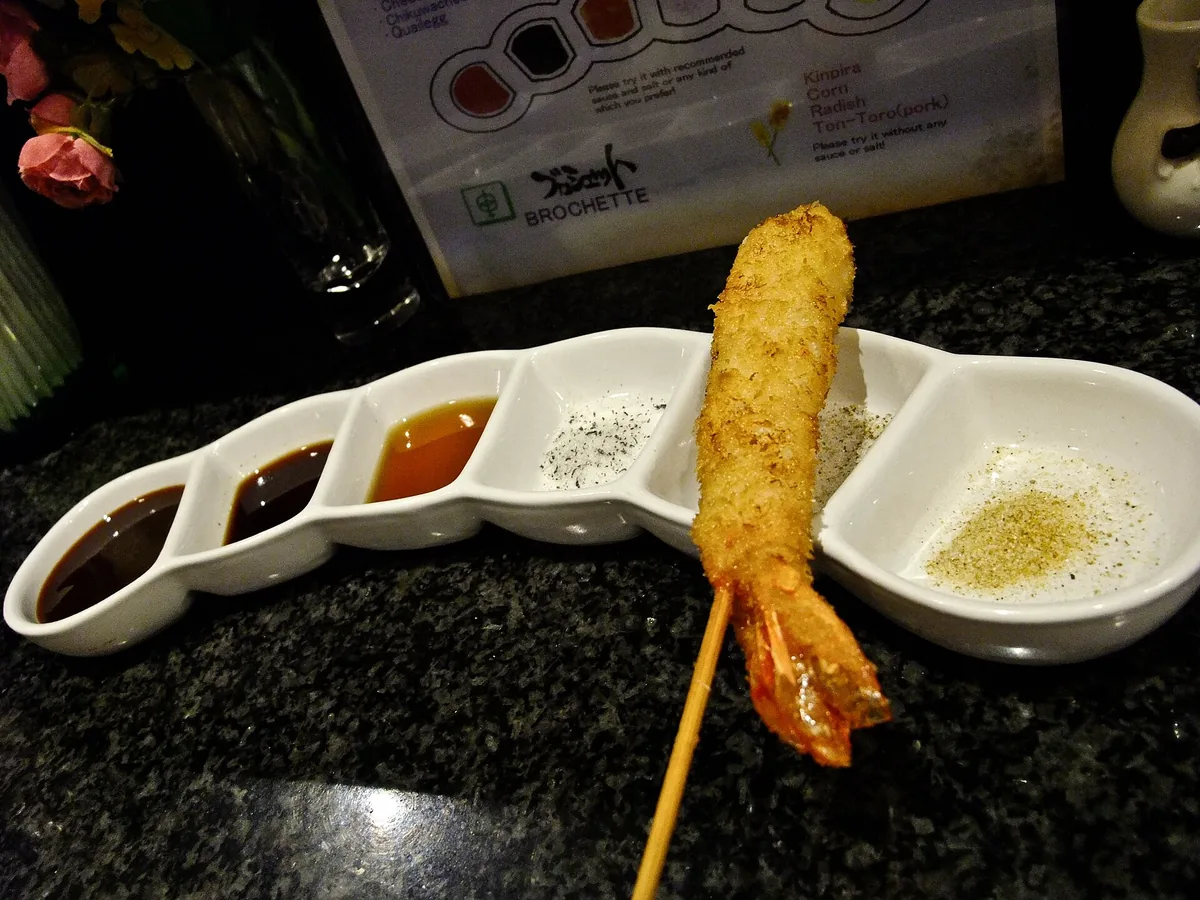
Kushikatsu

Writes the logistics pages. Works to one rule: a price comes from the company that charges it.
UpdatedKushikatsu is skewered food in fine panko, deep-fried to order, eaten a few pieces at a time at a counter. Skewers run about ¥143 to ¥396 each, which makes a proper dinner ¥2,000 to ¥3,000 with a beer, and there is nothing else in urban Japan that eats this well for that money.
It comes with one rule, and it is not a quirk for tourists. Every shop keeps a communal stainless tray of thin Worcestershire-style sauce on the counter, used by everybody sitting at it. You dip each skewer once, before the first bite. After that the skewer has been in your mouth and the tray belongs to the room.
At a glance
- What it is
- Small skewers of meat, seafood and vegetables in fine panko, deep-fried to order
- The rule
- One dip per skewer from the shared tray, before the first bite. Never twice
- The cabbage
- Free, refillable, and a tool – use a leaf to scoop more sauce
- Cost
- ¥143–¥396 a skewer. A full meal with beer is ¥2,000–¥3,000
In this guide
The rule, and the cabbage that solves it
Every shop in Shinsekai has a sign reading nido-zuke kinshi – no second dipping. It is not decoration. The tray is refilled through the evening rather than between customers, and it is the one piece of etiquette in Japan that people will actually say something about.
Which leaves the obvious problem: one dip is not much sauce for a skewer you are going to eat in four bites. The solution is on the counter and it is free. The bowl of raw cabbage is a tool. You take a leaf, use it as a scoop to lift sauce out of the tray, and pour it over the skewer. It is refillable, it is unlimited, and it is there for exactly this purpose. Eating it as a side salad is not wrong, but it is missing the point of why every shop puts it in front of you before you order anything.
Some of the newer and more refined counters, such as Gojoya, season each skewer individually and have no communal tray at all, in which case none of this applies. If there is no tray, there is no rule.
What to order
Order three or four at a time and keep going; kushikatsu is a running tab, not a set meal, and the pricing by the piece is the original social contract – this was a labourer’s food and you stopped when your money ran out.
Start with gyu, beef, which is the house skewer everywhere and the one the shop is judged on. Then work outward: uzura, quail egg; renkon, lotus root, which is the best vegetable on any kushikatsu menu; asuparagasu, asparagus; kushi-katsu pork; chizu, cheese, which is either wonderful or an abomination depending on the hour. Finish on something sweet if the shop does a banana or a custard skewer.
The panko is finer than tonkatsu crumb and the batter is thinner, because the pieces are small and need to cook in ninety seconds without the outside burning. A good shop’s skewers are pale gold, not brown, and are not greasy at the stick end.
Where, and the two versions
The home of it is Shinsekai, around Tsutenkaku, where there are perhaps forty shops within three hundred metres. Kushikatsu Daruma has been there since 1929 and the Shinsekai original has twelve counter seats and no reservations, opening 11:00 to 22:30 and 10:30 at weekends. The covered Jan-Jan Yokocho arcade nearby is full of equivalents with seats free.
There is also a refined version: individually seasoned skewers, one at a time, in a small booked room. Gojoya is the Michelin-listed example, open 17:00 to 23:00 Monday to Saturday and closed Sundays and holidays.
Eat the street version first. Everything the refined version is doing is a comment on the standard one, and it does not land in the other order.
Frequently asked questions
Why can't you double dip kushikatsu?
Because the sauce tray on the counter is shared by everybody sitting at it and is refilled through the service rather than between customers. You dip once, before the first bite. Every shop has a sign about it.
What is the cabbage for?
It is a scoop. Use a leaf to lift sauce out of the tray and pour it over the skewer, which is how you get more sauce without dipping twice. It is free and refillable.
How much does kushikatsu cost?
About ¥143 to ¥396 a skewer depending on the ingredient. Ten to fifteen skewers with a beer comes to ¥2,000 to ¥3,000, which makes it the cheapest good dinner in central Osaka.
Where should I eat kushikatsu?
Shinsekai, around Tsutenkaku. Kushikatsu Daruma’s 1929 original is the landmark, with twelve seats and no bookings; the Jan-Jan Yokocho arcade nearby has many equally good counters with seats free.
What should I order first?
Beef, which is the skewer every shop is judged on. Then quail egg, lotus root and asparagus. Order three or four at a time rather than all at once – it is a running tab, not a set meal.
Further reading
Official sources
- Kushikatsu Daruma (official) – Skewer prices, branches and hours
- Kushikatsu Gojoya – MICHELIN Guide – The refined counter version and its hours
- OSAKA-INFO – Shinsekai – The district the dish belongs to