Takoyaki

Writes the logistics pages. Works to one rule: a price comes from the company that charges it.
UpdatedTakoyaki was invented in Osaka in 1935, by Endo Tomekichi at a stall called Aizuya. It is ninety-one years old, it has never been anything other than street food, and it still costs about ¥500 for eight.
The single thing worth knowing about it: the centre is meant to be liquid. Not soft, not moist – liquid, a savoury custard that has never set, inside a shell that has. A takoyaki that is cooked through the middle is not a well-made one, it is one that was made too long ago, and that is the difference between the good and the bad versions in this city.
At a glance
- What it is
- Wheat and dashi batter, octopus, spring onion and pickled ginger, cooked in a plate of hemispherical wells
- Invented
- Osaka, 1935, by Endo Tomekichi at a stall called Aizuya
- Price
- About ¥500 for eight pieces. More than that and you are paying for a location
- The test
- The centre should be molten. If it is set, it was cooked too long ago
In this guide
Why the middle stays molten
The batter is much thinner than a pancake batter: wheat flour, egg and a great deal of dashi, closer to single cream than to a dough. It is poured over a cast-iron plate of hemispherical wells, flooding across the top, with a cube of octopus, spring onion, tenkasu tempura scraps and pickled ginger dropped into each hollow.
Then the technique. As the batter in contact with the iron sets, the cook cuts the sheet between the wells with a metal pick and turns each ball ninety degrees, folding the set edges downward and letting the still-liquid batter run to what is now the bottom. Repeat every thirty seconds or so and the ball builds a shell from the outside inward while the interior never gets hot enough for long enough to coagulate.
The result is a structure, not an accident: a thin crisp sphere containing something with the consistency of hot béchamel, and a piece of octopus in the middle of it. It works for about four minutes. After that the residual heat finishes the job, the inside sets, the shell goes soft, and you have a dumpling.
Where to buy it, and where not to
The rule follows from the physics. Buy from a plate you can see being turned. A stall that is cooking to order can hand you something four minutes old; a stall clearing a forty-person queue on Dotonbori physically cannot, so it cooks in advance and holds trays under a lamp. The product is not dishonest, it is just structurally worse, and it is what most visitors eat.
Wanaka in Sennichimae is the reliable answer at ¥500 for eight, two or three minutes off the canal. Anything charging ¥800 for six pieces on the waterfront is charging you for the sign above it.
Variants worth knowing: akashiyaki, from Akashi in Hyogo, is the ancestor – much more egg, no sauce, dipped in hot dashi, and genuinely different. Negi versions come buried under spring onion and ponzu. Takosen is two of them pressed between prawn crackers.
How to eat it
Standing, immediately, out of the tray, with the picks provided. Bite a small hole in the first one and let the steam out for five seconds before committing, because the inside is considerably hotter than the outside and everybody burns their mouth on the first one anyway.
Do not carry it. Four minutes is the working life of the crust and a walk back to a hotel converts the best ¥500 in Osaka into something you could buy frozen. This is also why takoyaki does not travel as a souvenir and why every attempt to sell it as a sit-down restaurant dish is slightly beside the point.
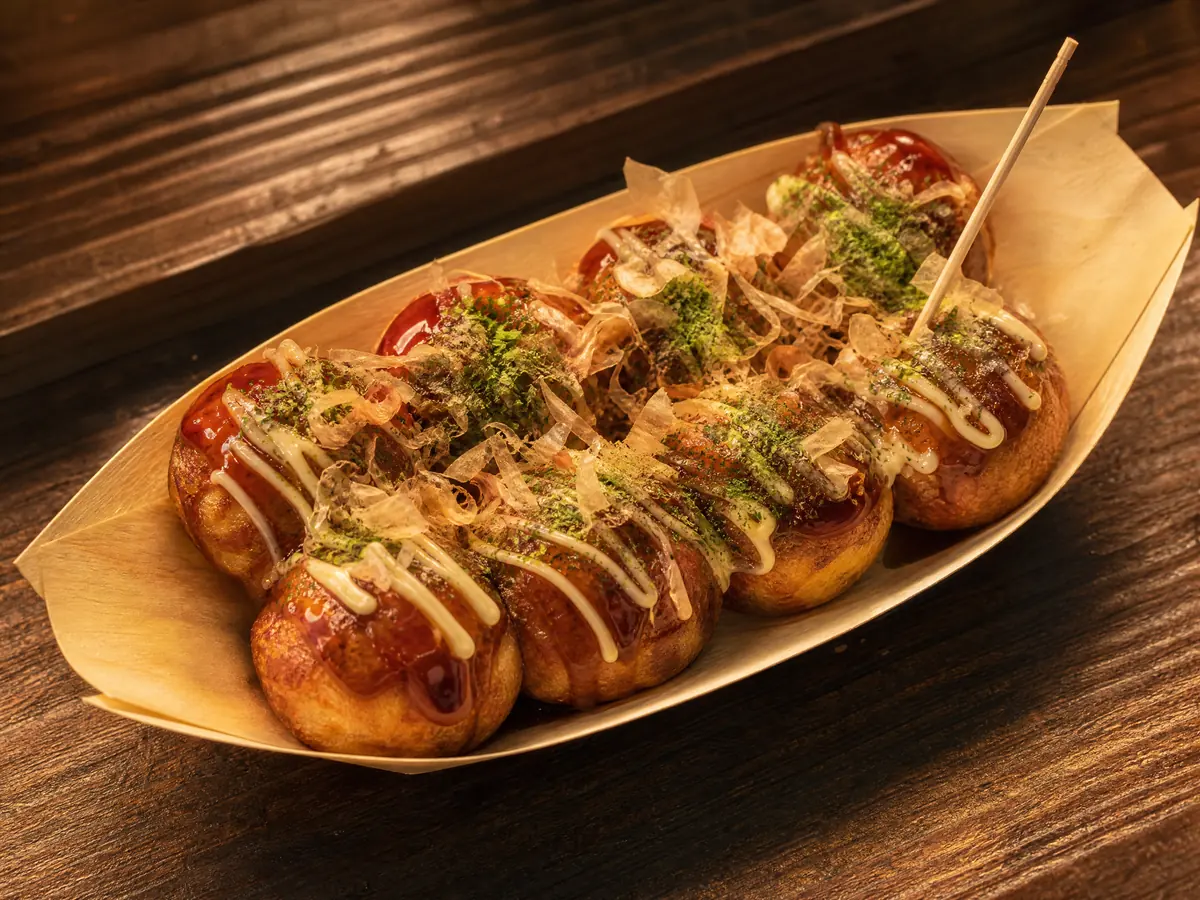
It comes with sauce, mayonnaise, aonori seaweed powder and katsuobushi, and the bonito flakes will appear to move. That is convection lifting shavings a few microns thick in the steam, it happens to every plate, and it is not a sign of anything.
Frequently asked questions
Who invented takoyaki?
Endo Tomekichi, at a stall called Aizuya in Osaka in 1935. He added octopus and dashi to an existing Kansai batter snack, and the dish has been the city’s emblem since.
Why is the inside runny?
Because it is meant to be. The batter is thin and dashi-heavy and the balls are turned repeatedly so a shell forms from the outside while the interior never sets. A takoyaki that is solid through the middle was cooked too long ago.
How much should takoyaki cost?
Around ¥500 for eight pieces. That is the benchmark. Waterfront stalls charging substantially more are charging for the location, and usually serving takoyaki that has been held on a tray.
Where is the best takoyaki in Osaka?
Anywhere you can watch the plate being turned. Wanaka in Sennichimae is the dependable choice at ¥500 for eight. Avoid stalls clearing long queues, because they have to cook in advance.
What is akashiyaki?
The ancestor of takoyaki, from Akashi in Hyogo. It uses far more egg, carries no sauce, and is dipped in hot dashi rather than eaten dry. It is softer and quite a different thing.
Further reading
Official sources
- Takoyaki Doraku Wanaka (official, English) – Portion sizes and current pricing
- OSAKA-INFO – Dotonbori – The street where most visitors buy takoyaki
- OSAKA-INFO (Osaka Convention and Tourism Bureau) – Official city food and culture information