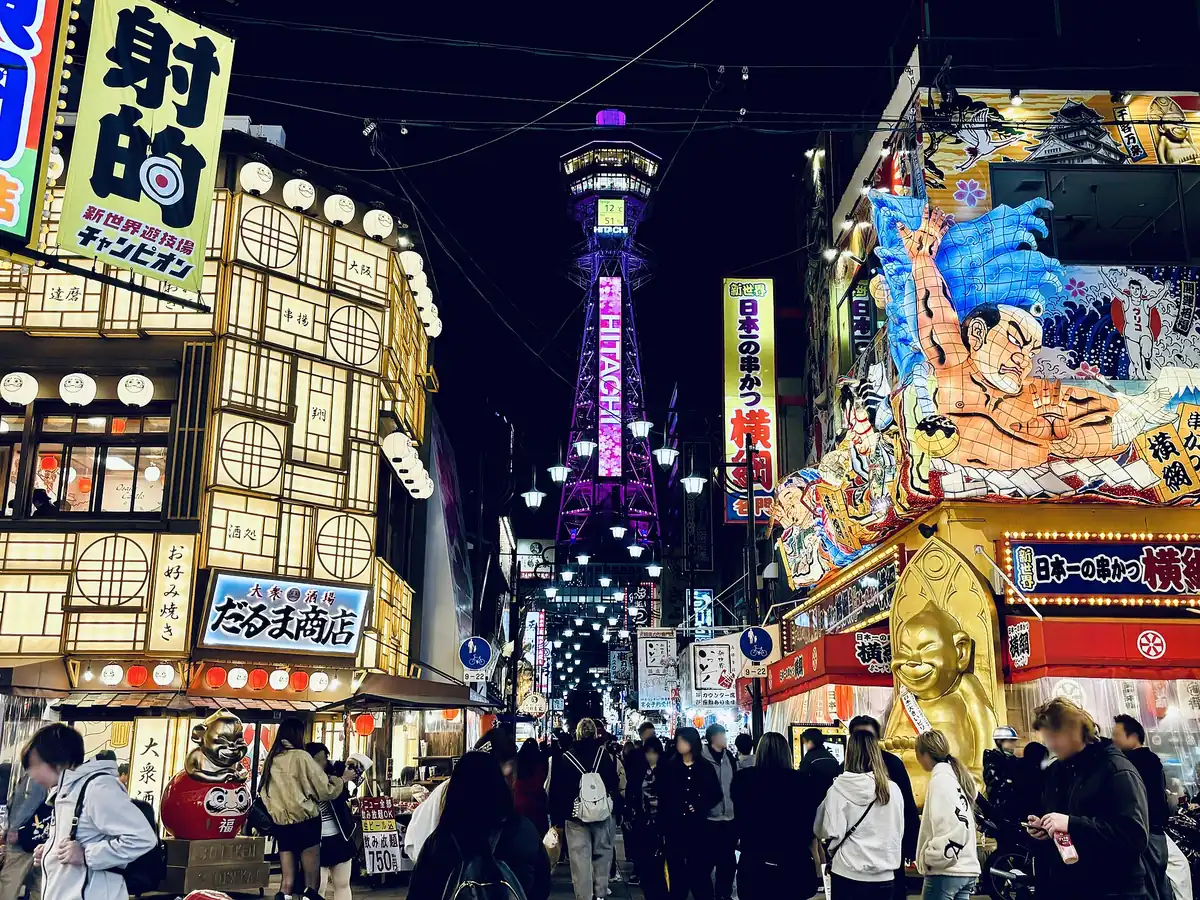
Shinsekai

Writes the autumn colour pages and follows the forecasts as they are issued, which is more than one forecast.
UpdatedShinsekai means “new world”, and it was: an entertainment district laid out in 1912, with a Paris-inspired north half around the first Tsutenkaku tower and a Coney-Island-inspired south half around an amusement park called Luna Park. Luna Park closed in 1923, the district declined for most of a century, and what remains is a 1950s rebuild that has been left almost entirely alone since.
It is the only part of central Osaka that still looks like the post-war city. It is also where you eat kushikatsu – and the one thing you must know before sitting down is that the sauce tray is shared and you do not dip twice.
At a glance
- What it is
- A 1912 pleasure district built around Tsutenkaku, largely rebuilt in the 1950s and barely altered since
- Eat
- Kushikatsu, and nothing else. Skewers from around ¥143 at Daruma
- Stations
- Ebisucho on Osaka Metro Sakaisuji, Dobutsuen-mae on Midosuji, Shin-Imamiya on the JR Loop
- Best hours
- After dark. It is a neon district and daylight does it no favours
In this guide
The sauce rule, which is not a joke
Kushikatsu is deep-fried skewers – beef, quail eggs, lotus root, asparagus, cheese, whatever the counter has – and each shop keeps a communal stainless tray of thin Worcestershire-style sauce on the counter, refilled through the evening and used by everyone sitting at it.
Therefore: dip once, before the first bite. After that the skewer has been in your mouth and the tray is not yours. Every shop provides a bowl of free raw cabbage, and the cabbage is not a garnish or a salad. It is a scoop: you use a leaf to carry more sauce onto the skewer. That is what it is for, and it is refillable.
Breaking this is the one thing that will genuinely annoy people around you, and the signs saying nido-zuke kinshi – no double dipping – are on the wall of every single shop in the district for a reason.
Where to eat, and what it costs
Kushikatsu Daruma began here in 1929 and the Shinsekai original branch is still the one to use. Skewers run from about ¥143 to ¥396, it opens 11:00 to 22:30 and from 10:30 at weekends, and it has twelve counter seats and takes no reservations. You queue. Twelve seats is the number that surprises people who have seen the chain’s branches elsewhere.
There are perhaps forty other kushikatsu shops within three hundred metres and most of them are fine. The tell of a good one is a visible fryer, a short menu on the wall rather than a laminated book, and customers who are not carrying luggage. A full meal of ten to fifteen skewers with a beer comes to ¥2,000 to ¥3,000, which makes this the cheapest good dinner in central Osaka.
If you want the refined counter version instead of the standing version, Gojoya is Michelin-listed, opens 17:00 to 23:00 Monday to Saturday, and is closed Sundays and holidays – but it is in Minami, not here.
The district itself, and the reputation
Shinsekai is routinely described in English-language writing as dangerous. It is not. What it is, is poor: it sits next to Airin, the day-labourers’ quarter around Shin-Imamiya, which has Japan’s largest concentration of cheap lodging houses and of homeless men. That produces a streetscape unlike the rest of central Japan and very little in the way of actual risk. Ordinary care after midnight is enough.
Walk the arcades rather than the main street: the covered Jan-Jan Yokocho to the south is a narrow lane of kushikatsu counters, standing bars and shogi parlours, and it is the most photogenic two hundred metres in Osaka. Tsutenkaku itself is now ¥1,500 and requires an advance reservation, so book it before you come down for dinner rather than deciding at the base.
Shitenno-ji is fifteen minutes’ walk east and free, and Tennoji Park with the zoo and the Abeno Harukas tower is immediately south-east. The Namba to Shinsekai walk links all of it.
Frequently asked questions
Is Shinsekai safe?
Yes, with ordinary care. It borders the Airin day-labourers’ district, which makes the street scene unusual by Japanese standards, but the practical risk to visitors is very low. It is poor rather than dangerous.
What is the no double dipping rule?
Kushikatsu shops keep a shared tray of sauce on the counter. You dip a skewer once, before the first bite, and never again. Use the free cabbage as a scoop if you want more sauce. Every shop has a sign about it.
Where should I eat kushikatsu in Shinsekai?
Kushikatsu Daruma’s original branch, skewers from around ¥143, open 11:00 to 22:30 and 10:30 at weekends. It has twelve counter seats and no reservations, so expect a queue. The Jan-Jan Yokocho arcade has many good alternatives.
How do I get to Shinsekai?
Ebisucho on the Osaka Metro Sakaisuji line is closest, or Dobutsuen-mae on the Midosuji line. Shin-Imamiya on the JR Loop Line also works, but note that JR and Osaka Metro are separate companies with separate fares.
When should I visit Shinsekai?
After dark. The whole district is built around illuminated signage and it looks tired in daylight. Between six and ten in the evening it is at its best and the kushikatsu shops are all working.
Further reading
Official sources
- OSAKA-INFO – Shinsekai – Osaka Convention and Tourism Bureau area guide
- Kushikatsu Daruma (official) – Branch list, opening hours and skewer prices
- Tsutenkaku (official) – Admission, hours and the reservation requirement
- OSAKA-INFO – Tsutenkaku – Tower listing and access