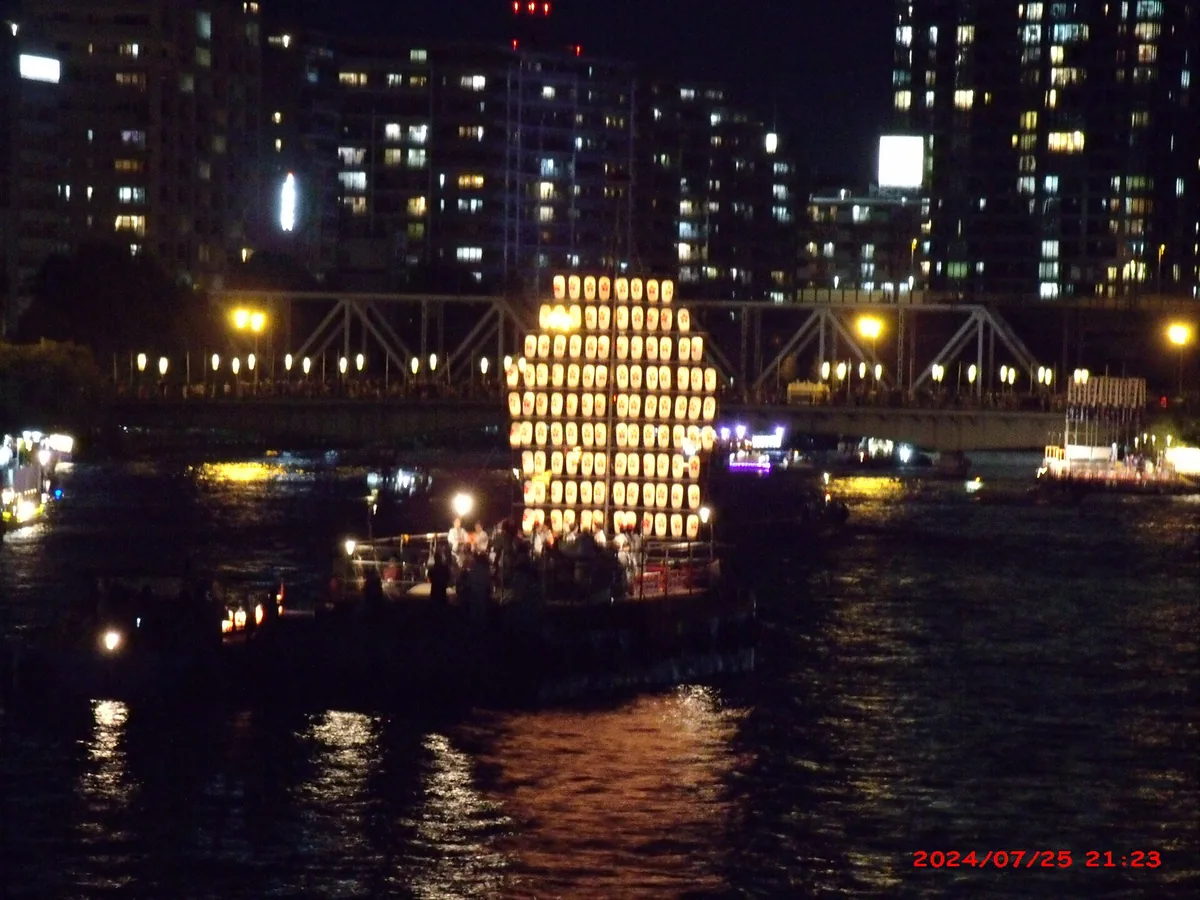
Tenjin Matsuri

Writes the autumn colour pages and follows the forecasts as they are issued, which is more than one forecast.
UpdatedTenjin Matsuri runs on 24 and 25 July, every year, without variation. The dates are fixed to the calendar rather than to a weekend, which makes this one of the very few major Japanese festivals you can plan a trip around a year in advance with complete confidence.
It is counted among Japan’s three great festivals, alongside Kyoto’s Gion Matsuri and Tokyo’s Kanda Matsuri, and it has been held in some form for over a thousand years. It is free.
At a glance
- Dates
- 24 and 25 July, every year, fixed. They do not move for weekends
- Main day
- The 25th. Land procession from 15:30, boat procession in the evening
- Fireworks
- Roughly 90 minutes over the Okawa, after the boats are on the water
- Cost
- Free to watch from the riverbanks. Paid seating exists and is not necessary
In this guide
The 25th, hour by hour
The 24th is the opening day: rituals at Osaka Tenmangu, the shrine to Sugawara no Michizane that the whole festival belongs to, and a smaller set of processions. Worth seeing if you are here, not worth arranging a trip around.
The 25th is the festival. From 15:30 the land procession leaves the shrine: around three thousand people in Heian-period costume, portable shrines, drummers on raised platforms, and the danjiri carts, working north through the streets around Tenjinbashi.
In the evening the procession reaches the river and becomes the funatogyo, the boat procession: around a hundred lit vessels on the Okawa, carrying the deity, the drummers and the shrine parties, moving up and down the water and exchanging greetings between crews as they pass. Then roughly ninety minutes of fireworks over the same stretch, with the lit boats still on the water underneath them. That combination – fire above, lanterns below, both reflected – is what the festival is famous for and it is genuinely unlike anything else in Japan.
Where to stand, and what to expect
The riverbanks along the Okawa between Tenmabashi and Sakuranomiya are the free viewing ground, and they are full. Paid seating is sold and is not necessary; what is necessary is arriving early, which for a good free position on the bank means late afternoon, before the land procession finishes.
It is late July in Osaka, which means around 33 degrees at six in the evening with very high humidity and no meaningful drop after dark. Carry more water than you think you need, take a fan, and do not plan to stand for six hours without a break. The convenience stores within a kilometre of the river will be stripped by early evening.
Getting out afterwards is the hard part. A hundred thousand people leave the riverbank within about thirty minutes of the last firework and the nearby stations queue accordingly. Walking twenty minutes to a station further out is faster than waiting at the nearest one, and walking back to Umeda is entirely possible from the western end of the bank.
Planning around it
Hotels in Osaka for 24 and 25 July book out and price up, and the accommodation tax applies on top of whatever you pay. Book early, and remember that Kyoto’s Gion Matsuri runs through the same month, which puts pressure on the whole of Kansai’s July accommodation.
One practical knock-on: the Tombori River Cruise is suspended on 24 and 25 July because the city’s river traffic is given over to the festival. If those are your only two days in Osaka, that is a trade you should be delighted with.
The shrine itself, Osaka Tenmangu, sits just off Tenjinbashisuji, the covered arcade that runs two and a half kilometres north and is worth walking on any day of the year – it is also where Harukoma is, closed Tuesdays.
Frequently asked questions
When is Tenjin Matsuri?
24 and 25 July, every year, on fixed dates that do not move for weekends. The 25th is the main day and the one to be in Osaka for.
What happens on the main day?
The land procession leaves Osaka Tenmangu from 15:30 with around three thousand costumed participants. In the evening it becomes a boat procession on the Okawa, followed by roughly ninety minutes of fireworks over the lit boats.
Does it cost anything to watch?
No. The riverbanks are free. Paid seating is sold but is not necessary; arriving in the late afternoon for a position on the bank matters far more than paying for a seat.
How crowded is it?
Very. Hundreds of thousands of people, in high humidity and around 33 degrees after dark. Carry water, and expect the stations nearest the river to be heavily queued for half an hour after the fireworks end.
Does anything shut for the festival?
The Tombori River Cruise is suspended on 24 and 25 July, because the city’s river traffic is given over to the festival’s own boat procession.
Further reading
Official sources
- OSAKA-INFO – Tenjin Matsuri – Dates, programme and procession times
- Tenjin Matsuri (official) – Festival organisers’ own site
- Tombori River Cruise – Ipponmatsu Kaiun – Confirms the 24–25 July suspension of the cruise
- OSAKA-INFO – Tenjinbashisuji Shopping Street – The arcade beside Osaka Tenmangu