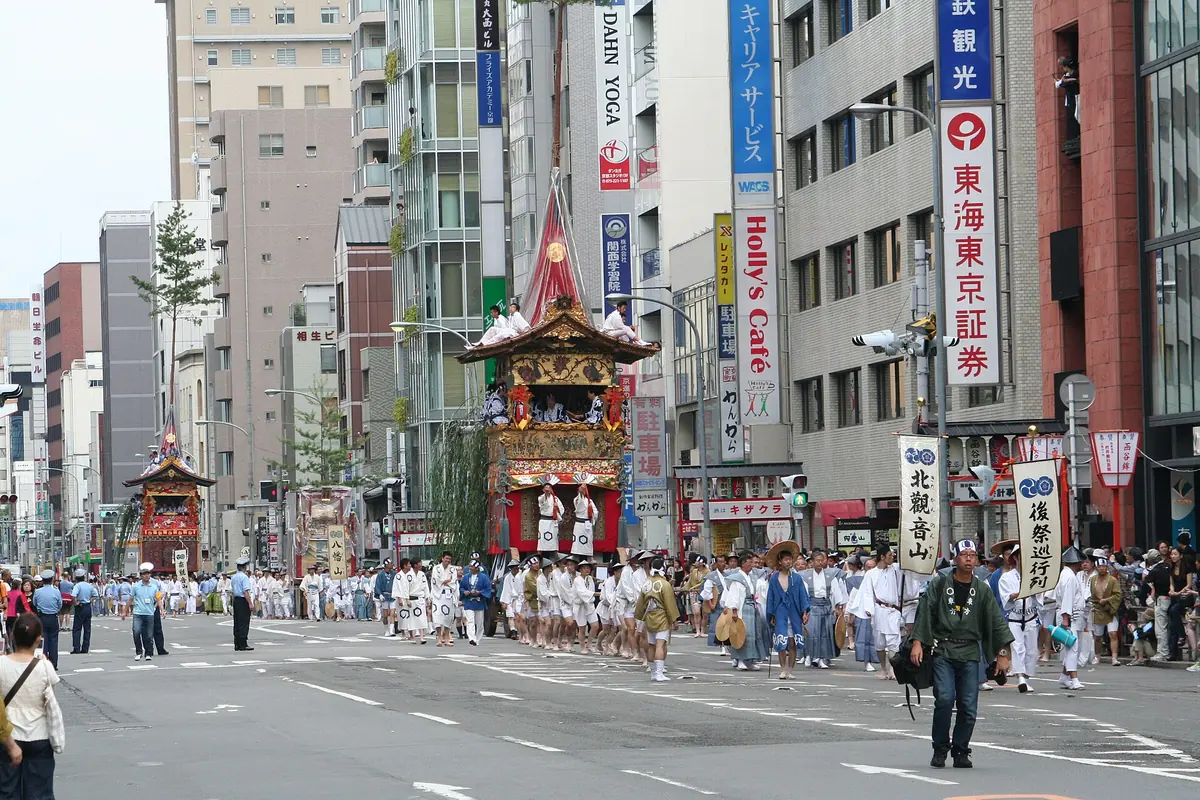
Gion Matsuri

Writes the autumn colour pages and follows the forecasts as they are issued, which is more than one forecast.
UpdatedGion Matsuri runs through the whole of July, but two dates carry it: the Yamaboko Junko float processions on 17 July and 24 July. Those dates are fixed every year. They do not move to a weekend, and in a year when they fall on a Tuesday they happen on that Tuesday.
The other dates worth knowing are the Yoiyama evenings: 14, 15 and 16 July before the first procession, and 21, 22 and 23 July before the second. These are the nights the completed floats stand lit by lanterns in the streets they were built in, with the central roads closed to traffic. For most visitors they are the better experience.
At a glance
- Processions
- Saki Matsuri on 17 July and Ato Matsuri on 24 July, fixed every year regardless of the day of the week
- Yoiyama evenings
- 14, 15 and 16 July before the first procession; 21, 22 and 23 July before the second
- Cost
- Free to watch from the street. Paid grandstand seats along Oike-dori are sold in advance
- Where
- The float districts of Shimogyo and Nakagyo, and the procession route along Shijo, Kawaramachi and Oike
In this guide
Why the Yoiyama evenings beat the procession
On procession day the floats move through the city on a fixed route and you watch them go past from a crowd four or five deep. It is impressive, it is hot – Kyoto in the middle of July is punishing – and it is essentially a parade.
On the Yoiyama evenings you walk among them. The thirty-odd yamaboko stand in the narrow streets of the merchant districts where their neighbourhoods built them, hung with lanterns, with musicians sitting on the upper decks playing the Gion-bayashi. The main downtown streets are closed to cars and given over to food stalls. Several of the machiya houses open their front rooms to show heirloom screens and textiles, a custom called the byobu matsuri.
Some floats can be climbed for a small fee, usually with a token or a charm included, though a number of them do not admit women onto the upper deck – a restriction that is openly discussed and slowly changing. It is the part of the festival that is most obviously still a religious event rather than a spectacle.
Of the two runs, the Ato Matsuri nights of 21 to 23 July are considerably quieter than the 14 to 16 July ones. Fewer floats, far fewer people, same festival.
The two processions
The Saki Matsuri on 17 July is the larger, with twenty-three floats setting off along Shijo in the morning. The Ato Matsuri on 24 July follows with the remaining eleven, running the route in the opposite direction. The two-procession format was restored in 2014 after half a century of a single combined parade.
The floats divide into two kinds. Hoko are the enormous ones – up to twenty-five metres tall and twelve tonnes, on solid wooden wheels, pulled by dozens of men on ropes. Yama are smaller and carried or wheeled. None of them uses a nail. The moment everyone waits for is the tsuji-mawashi, where a hoko has to turn a right-angled corner: wet bamboo slats go under the wheels and the whole thing is dragged sideways across them, several times, to get round.
Watching is free from the street. Paid grandstand seating along Oike-dori is sold in advance through the city and is worth it only if you cannot stand for three hours in July heat – which is a more serious consideration than it sounds.
Planning around it
Book accommodation months ahead. Kyoto fills for July and rates rise sharply, on top of the lodging tax increase that took effect in March 2026. If you are coming specifically for the festival, the Ato Matsuri week is easier to book and less crowded on the ground.
The festival happens in downtown, not in Gion, despite the name – it belongs to Yasaka Shrine, which is in Gion, but the floats are built and paraded in the merchant quarters west of the river. Staying centrally is worth a great deal during the closures, because the buses do not run their normal routes.
Heat is the real constraint. Kyoto in July is around 33 degrees with very high humidity and the basin traps it. Evening events are more bearable than the mid-morning processions, another argument for Yoiyama. Carry water, and do not plan a temple day either side of a procession day.
Frequently asked questions
When is Gion Matsuri?
Through the whole of July, with the two float processions on 17 and 24 July. Those dates are fixed every year and do not move to a weekend.
What are the Yoiyama evenings?
The nights before each procession – 14, 15 and 16 July, and 21, 22 and 23 July – when the finished floats stand lit by lanterns in the streets, the central roads are closed to traffic and food stalls fill them. For most visitors they are better than the processions themselves.
How much does it cost to watch?
Nothing from the street. Paid grandstand seats along Oike-dori are sold in advance and are worth considering only if standing for hours in July heat is not realistic for you.
Which week is less crowded?
The second. The Ato Matsuri on 24 July and its Yoiyama evenings of 21 to 23 July carry fewer floats and far fewer people than the 17 July run.
Is Gion Matsuri actually in Gion?
It belongs to Yasaka Shrine, which is in Gion, but the floats are built and paraded in the merchant districts of Shimogyo and Nakagyo west of the Kamo river. The action is downtown, not in Gion.
Further reading
Official sources
- Kyoto City official travel guide – Yoiyama and procession guide – Official city guidance on the 2026 Yoiyama evenings and the two float processions
- Yasaka Shrine (official) – The shrine whose festival this is, and its own Gion Matsuri observances