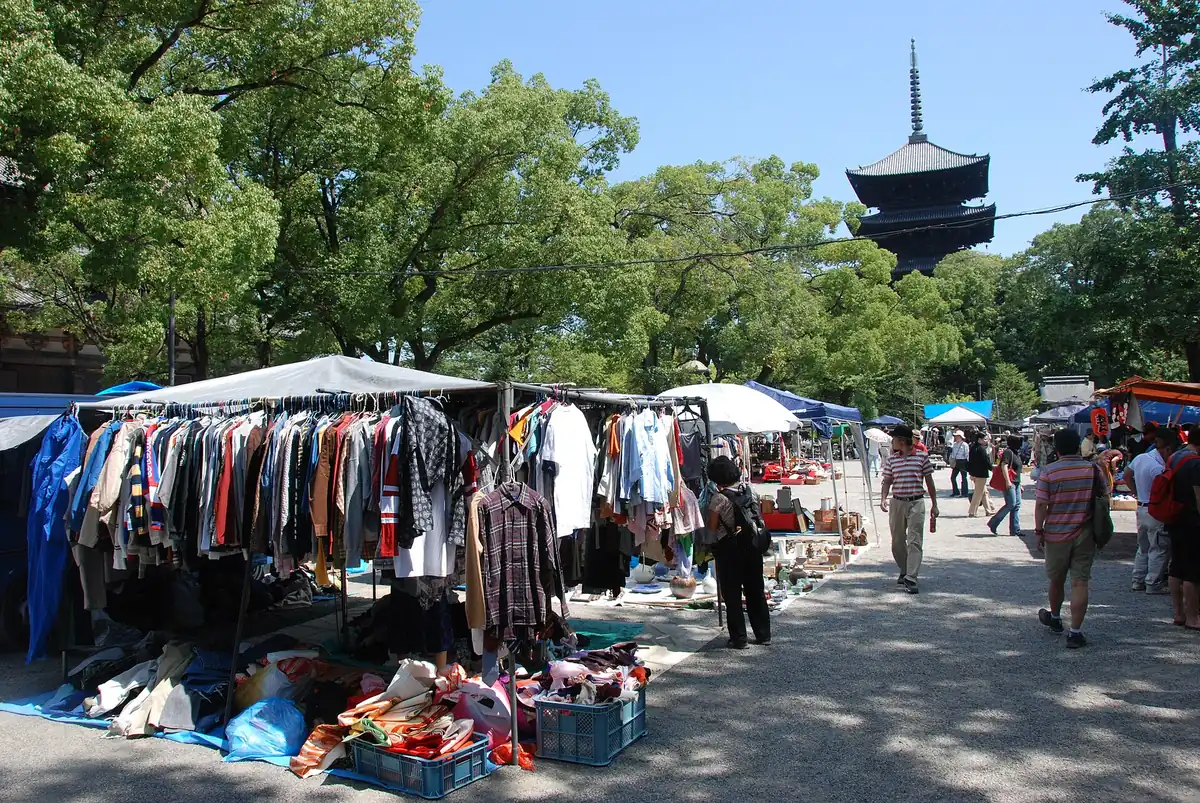
Shitennoji flea market

Writes the autumn colour pages and follows the forecasts as they are issued, which is more than one forecast.
UpdatedOn the 21st of every month, Shitenno-ji holds its memorial service for Prince Shotoku, who founded the temple in 593, and several hundred stalls fill the grounds around it. Hours are extended for the day and the whole thing is free, because the temple grounds are free every day.
The date does not move. It is not a seasonal festival and it is not weather-dependent. If your trip includes a 21st, this is the single best-value fixed event in the Osaka calendar, and it is the opposite of the polished markets tourists are usually pointed at.
At a glance
- When
- The 21st of every month, without exception, for the Prince Shotoku memorial day
- Cost
- Free. The temple grounds carry no admission charge on any day
- Hours
- Extended on the 21st; stalls set up early and the best of it is over by mid-afternoon
- What is sold
- Second-hand kimono, tools, ceramics, plants, food, and a great deal of unclassifiable junk
In this guide
What is actually on the tables
Roughly in descending order of quantity: second-hand kimono and obi, often in the ¥500 to ¥3,000 range for things that would be four times that in a Kyoto antique shop; old tools, plane blades, chisels, garden shears; ceramics, mostly domestic rather than collectable but with real pieces mixed in; plants and bonsai; military and Showa-era ephemera; and a very large quantity of things somebody cleared out of a house.
There is also a substantial food section – takoyaki, yakisoba, grilled things, sweet things – run at market prices rather than Dotonbori prices, which alone is worth the trip.
The clientele is largely local and largely elderly, and the trade is real: people come here to buy things they intend to use. That is the difference between this and a craft market. Haggling is possible and is done quietly and briefly; a polite request for a small reduction on a second item is normal, and pushing hard is not.
Timing the day
Stalls set up early and the serious buyers are there first. Before 10:00 is when the good kimono and the good tools move. By early afternoon the crowd is at its thickest and by mid-afternoon sellers start packing, which is also when prices soften if you are willing to gamble on something still being there.
Combine it with the temple itself, which is the point of the site on the other 364 days: the grounds are free, the Central Garan is ¥500, the Honbo Garden ¥300 and the Treasure House ¥500, three separate tickets. Standard hours are 8:30 to 16:30 from April to September and 8:30 to 16:00 from October to March, extended on the 21st.
A note on crowd type: this is busy in a way that is completely different from Minami. It is dense, slow and good-natured, and the lanes between stalls are narrow. It is not a good place for a pushchair and it is an excellent place to be on foot with a small bag.
Getting there, and what else is nearby
Shitennoji-mae Yuhigaoka on the Osaka Metro Tanimachi line puts you at the north gate in four minutes. From Tennoji station, served by JR, Kintetsu and two metro lines, it is about twelve minutes on foot north.
South and west of the temple is Shinsekai, fifteen minutes on foot, which is where you should eat afterwards: kushikatsu at ¥143 to ¥396 a skewer, and Tsutenkaku above it at ¥1,500 with an advance reservation now required. The Namba to Shinsekai walk covers the route in the other direction.
If you miss the 21st, the equivalent in Kyoto is the Toji market on the same date, and Osaka has smaller markets on other days that are not in the same class. The 21st is the one.
Frequently asked questions
When is the Shitennoji flea market?
The 21st of every month, without exception. It coincides with the temple’s memorial service for Prince Shotoku and the date does not shift for weekends or holidays.
Does it cost anything?
No. The temple grounds are free every day of the year, and the market takes place in them. Only the Central Garan, the Honbo Garden and the Treasure House carry separate charges.
What time should I arrive?
Before 10:00 for the best of the stock, particularly the kimono and the old tools. Mid-afternoon is when sellers begin packing up and prices soften, if you are willing to risk the item being gone.
What is sold there?
Second-hand kimono and obi, old tools, ceramics, plants, Showa-era ephemera and a large quantity of house-clearance goods, plus a substantial food section at ordinary market prices.
Can I haggle?
Quietly and briefly. Asking for a small reduction when buying more than one thing is normal. Sustained bargaining is not, and the trade here is mostly local people buying things they intend to use.
Further reading
Official sources
- OSAKA-INFO – Shitennoji flea market – Monthly date, scale and what is sold
- Shitenno-ji (official) – The memorial day on the 21st and extended hours
- OSAKA-INFO – Shitennoji Temple – Temple listing, access and ticketed areas