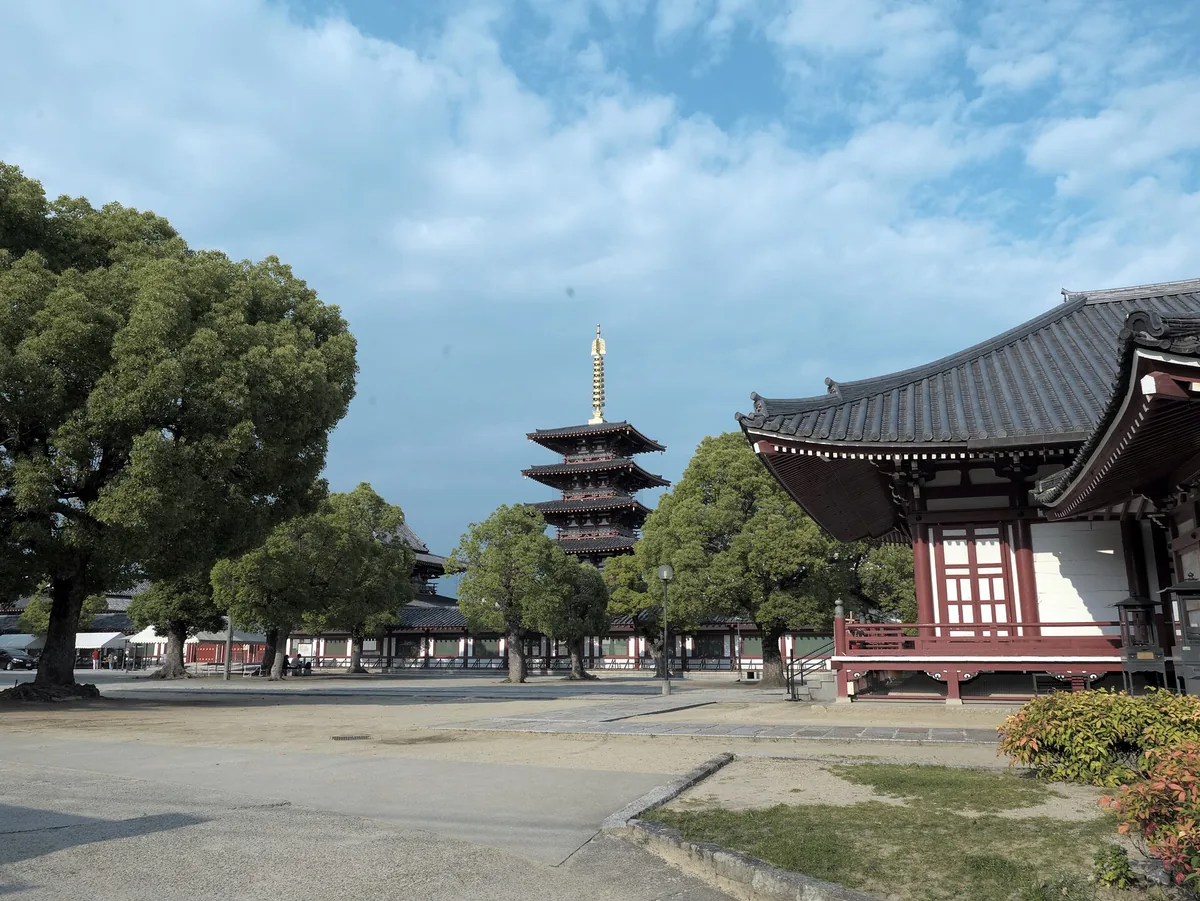
Shitenno-ji

Writes the autumn colour pages and follows the forecasts as they are issued, which is more than one forecast.
UpdatedShitenno-ji was founded in 593 by Prince Shotoku and is generally counted as the oldest officially administered Buddhist temple in Japan. Walking into the grounds costs nothing, and a great many visitors never spend a yen here, which is a perfectly reasonable visit.
What money buys is split three ways and sold separately: the Central Garan at ¥500, the Honbo Garden at ¥300 and the Treasure House at ¥500. There is no single combined ticket at the gate in the way most guides imply, so decide which of the three you actually want before you queue.
At a glance
- Admission
- Grounds free. Central Garan ¥500, Honbo Garden ¥300, Treasure House ¥500 – three separate tickets
- Hours
- 8:30–16:30 April to September, 8:30–16:00 October to March
- The 21st
- A large flea market fills the grounds on the 21st of every month, with extended hours
- Time needed
- 45 minutes free, 90 minutes if you pay for the Garan and the garden
In this guide
What is old here, and what is 1963 concrete
Nothing you can see is from 593. Shitenno-ji has burned or fallen down repeatedly – lightning, fire, and finally the air raids of 1945 – and the pagoda and main hall you walk around today were rebuilt in reinforced concrete in 1963. In that respect it is the same story as Senso-ji in Tokyo.
What is genuinely ancient is the plan. The Shitennoji-style layout – south gate, middle gate, five-storey pagoda, main hall and lecture hall all on a single north-south axis inside a roofed corridor – is the oldest temple arrangement in Japan, imported directly from the Korean peninsula, and every rebuild has kept it. You are looking at a sixth-century diagram rendered in twentieth-century material, and standing in the corridor at the south end is the only place in Japan you can read that plan at full size.
The ¥500 Central Garan ticket is what puts you inside that corridor and lets you climb the pagoda. It is the one of the three charges worth paying if you are paying for anything. The ¥300 Honbo Garden, laid out on Pure Land principles with two ponds and a tea house, is quiet and pleasant and entirely skippable on a tight day.
The 21st of the month
On the 21st of every month the temple holds its memorial day for Prince Shotoku, and the grounds fill with one of the largest and least sanitised flea markets in Kansai – several hundred stalls of second-hand kimono, old tools, ceramics, plants and unclassifiable junk, running through the forecourt and along the corridors. Hours are extended on that day and the atmosphere is completely different: less temple, more medieval market fair, which is closer to what a great temple precinct was for.
If your dates allow any flexibility at all, put Shitenno-ji on the 21st. If you are in Kyoto that month instead, the equivalent is Toji on the 21st, and both are free. There is more on the Osaka market on its own page.
The 22nd, for what it is worth, is the quietest day of the month here.
Hours, access and the seasonal close
Open 8:30, closing 16:30 from April to September and 16:00 from October to March. The outer grounds stay walkable later than the ticketed areas. That winter 16:00 close is early even by Japanese temple standards and is the commonest wasted trip here.
Shitennoji-mae Yuhigaoka on the Tanimachi subway line puts you at the north gate in four minutes. From Tennoji Station it is about a twelve-minute walk north, which makes the temple an easy pairing with Shinsekai and Tsutenkaku on the same afternoon – that route is written up as the Namba to Shinsekai walk.
Frequently asked questions
Is Shitenno-ji free?
The grounds are free. Three areas inside are charged separately: the Central Garan ¥500, the Honbo Garden ¥300 and the Treasure House ¥500. You can have a full visit without paying any of them.
What are the opening hours?
8:30 to 16:30 from April to September, and 8:30 to 16:00 from October to March. The winter closing time is early and catches people who plan a late afternoon around it.
What happens on the 21st of the month?
A very large flea market fills the grounds for the Prince Shotoku memorial day, with several hundred stalls and extended hours. It is the best day of the month to come and it costs nothing.
Is the temple original?
No. The pagoda and main hall were rebuilt in reinforced concrete in 1963 after the 1945 air raids. The sixth-century axial layout, which is the oldest temple plan in Japan, has been preserved through every rebuild.
Which of the three tickets is worth it?
The Central Garan at ¥500, which is what lets you inside the roofed corridor and up the pagoda. The garden is pleasant but optional, and the Treasure House only earns its ¥500 when a good rotation is on.
Further reading
Official sources
- Shitenno-ji (official) – Temple hours, the separate admission areas and the monthly memorial day
- Shitenno-ji – visitor guide (official) – Precinct layout and the ticketed areas
- OSAKA-INFO – Shitennoji Temple – Osaka Convention and Tourism Bureau listing
- OSAKA-INFO – Shitennoji flea market – The market held on the 21st of each month