Kiyomizu-dera to Gion

Writes the autumn colour pages and follows the forecasts as they are issued, which is more than one forecast.
UpdatedThis is the most walked route in Kyoto: down from Kiyomizu-dera through the stepped stone lanes of Sannenzaka and Ninenzaka, past the Yasaka pagoda and Kodai-ji, through Maruyama Park and Yasaka Shrine, and out into Gion. About two kilometres, downhill throughout.
The reason to do it is that Kiyomizu-dera opens at 6:00 and nothing else in Kyoto opens before 8:30. Starting at six means you are walking down empty lanes with the shutters still on the shops. Starting at ten means the same two kilometres as a shuffling queue. It is the same walk and it is not the same experience at all.
At a glance
- Route
- Kiyomizu-dera, Sannenzaka, Ninenzaka, the Yasaka pagoda, Kodai-ji, Maruyama Park, Yasaka Shrine, Gion
- Length
- About two kilometres, downhill almost the whole way
- Time
- Two to three hours with stops, or ninety minutes walked briskly
- Cost
- ¥500 for Kiyomizu-dera. The lanes, Maruyama Park and Yasaka Shrine are free
In this guide
The route, in order
Kiyomizu-dera, 6:00. ¥500, an hour on the stage and round to the Okunoin terrace for the view back at the main hall, and down past the Otowa waterfall with no queue at it.
Sannenzaka and Ninenzaka. Two stepped lanes falling away north from the temple approach, preserved districts with no overhead cables and controlled shopfronts. At seven in the morning they are stone, timber and nobody. At eleven they are the most congested two hundred metres in Kyoto.
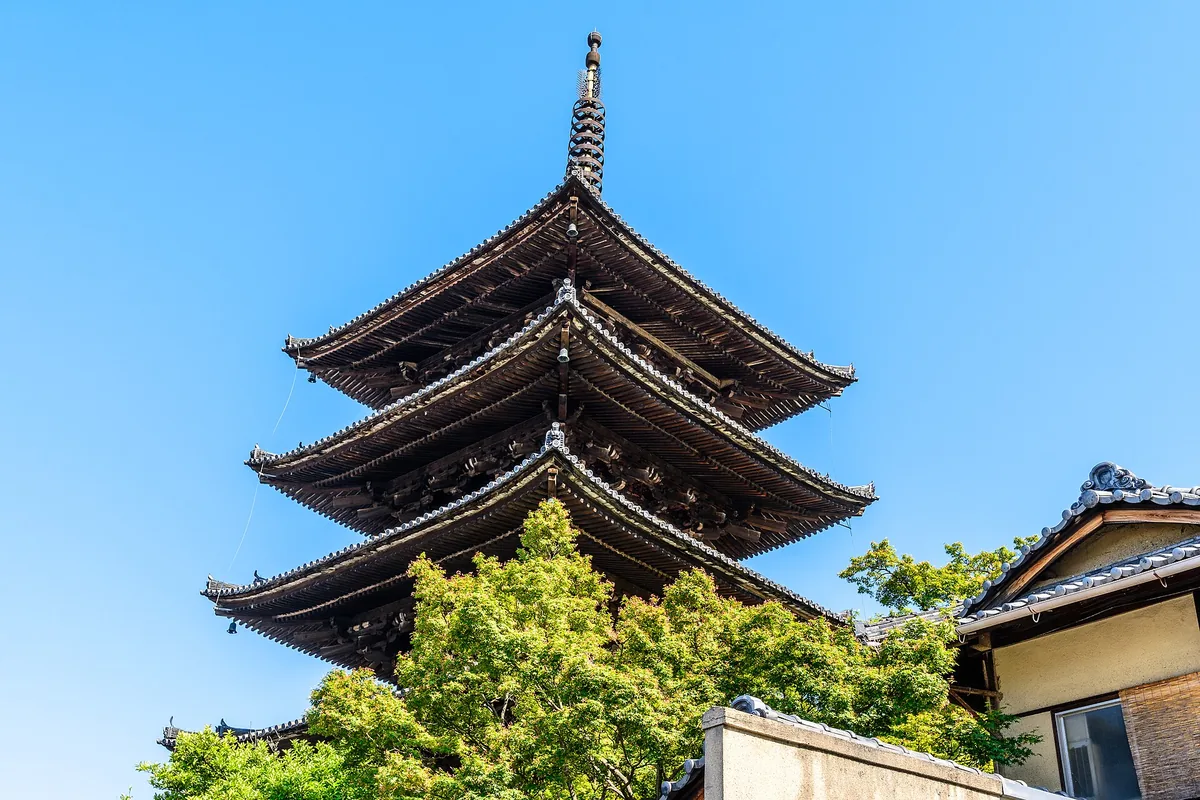
The Yasaka pagoda. Hokan-ji, the five-storey pagoda that appears in every photograph of Kyoto, framed at the bottom of a lane. The classic shot needs an empty street, which is available for about an hour a day.
Kodai-ji and Maruyama Park. Kodai-ji charges and opens later; Maruyama is free and always open, and its weeping cherry is the most famous single tree in the city.
Yasaka Shrine, then Gion. The shrine has no gate and no closing time, and walking out of its western gate puts you at the top of Shijo with Gion below you.
Why six o’clock changes everything
Kyoto’s congestion is a timetable problem. The temples open between 8:30 and 9:00, the coach tours are built around that, and by ten the eastern hills are at capacity. There is exactly one lever available, and it is the 6:00 opening at Kiyomizu-dera.
Two and a half hours is a very long head start. By the time the first coaches reach the temple you are a kilometre downhill and finished with the difficult part. You then arrive in Gion at around nine, as the coffee shops open, having done the whole thing.
The cost is that the shops and tea houses on Sannenzaka are shut while you walk past them. Most people find that a good trade – the lanes are the attraction and the shops sell roughly what every other tourist lane in Japan sells – but if the shopping is the point for you, this is not the plan.
Manners on the route, which are now enforced
These are residential streets. Photography restrictions have been progressively tightened across the district, tripods are unwelcome on the stepped lanes, and the residential alleys off the main run are not part of the route. In Gion at the bottom, the private alleys off Hanamikoji have been closed to visitors since April 2024, with signs warning of fines up to ¥10,000.
Eating while walking is discouraged throughout Higashiyama and is explicitly prohibited in Nishiki Market across the city. Eat standing where you bought it.
Practical notes: the lanes are stone steps, worn and slippery in rain, and not wheelchair-accessible – Kiyomizu-dera itself is, via the Chawan-zaka service road. Afterwards, Okutan serves yudofu below the temple, though it closes Thursdays, and Matsuba at the bottom of Shijo does nishin soba until 20:30.
Frequently asked questions
How long does the Kiyomizu to Gion walk take?
Two to three hours with stops, or about ninety minutes walked briskly. It is roughly two kilometres and downhill almost the whole way.
What time should you start?
6:00, when Kiyomizu-dera opens. That is two and a half hours before anything else in Kyoto opens, and it means the whole walk happens before the coach groups arrive.
How much does it cost?
¥500 for Kiyomizu-dera. The lanes, Maruyama Park and Yasaka Shrine are all free. Kodai-ji along the way charges separately and opens later in the morning.
Is the walk accessible?
Not really. Sannenzaka and Ninenzaka are worn stone steps, slippery in rain. Kiyomizu-dera itself is accessible via the Chawan-zaka service road, and Maruyama Park and Yasaka Shrine are level.
Can you do it in reverse?
You can, but it is uphill and it puts you at Kiyomizu-dera at its busiest. The whole logic of the route is starting at the top at six and descending ahead of the crowd.
Further reading
Official sources
- Kiyomizu-dera – 2026 opening hours (official) – The 6:00 opening every day, the seasonal closing times and the two permitted approach routes
- SoraNews24 – Gion private alley restrictions – The April 2024 closure of Gion’s private lanes and the ¥10,000 notice at the end of the walk