Matsuba

Writes the logistics pages. Works to one rule: a price comes from the company that charges it.
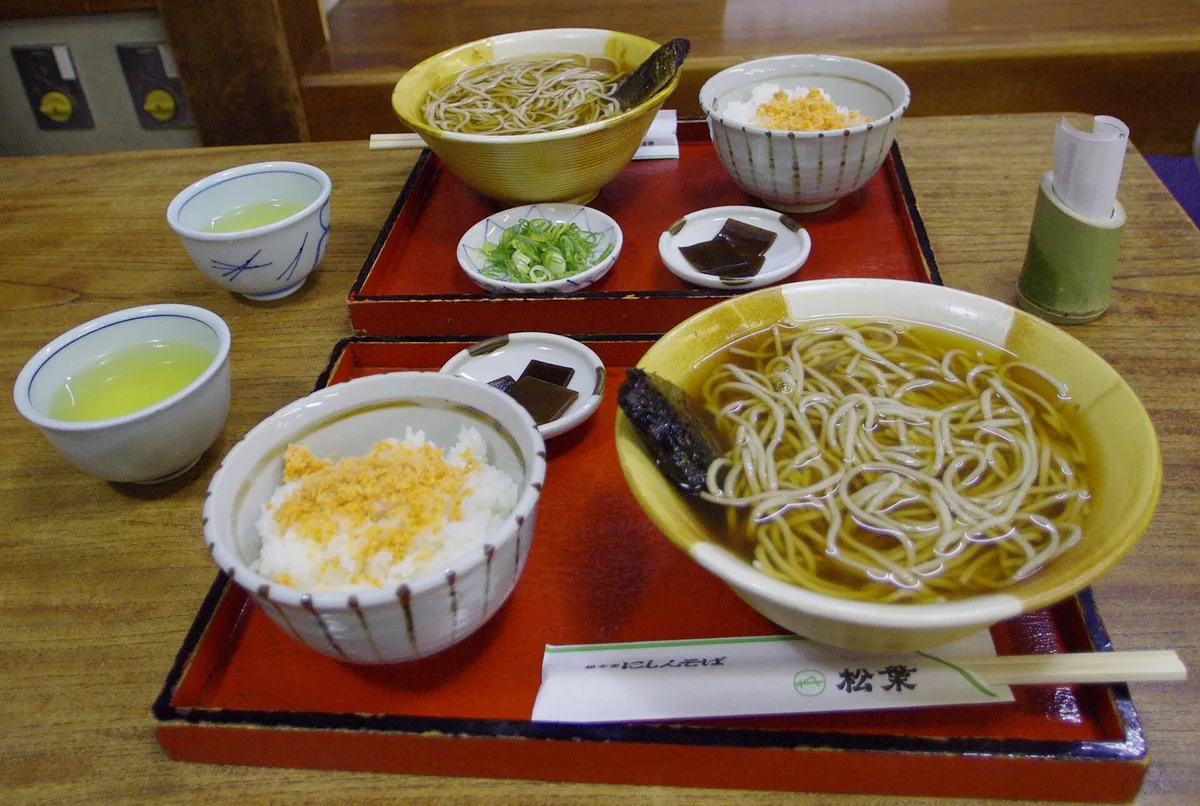
UpdatedMatsuba has stood at the eastern end of Shijo bridge since 1861, and in 1882 its second-generation owner did something that changed Kyoto’s food: he put a piece of slow-simmered dried herring on a bowl of buckwheat noodles and called it nishin soba.
It is still on the menu, it still costs ¥1,650, and the restaurant is still in the same spot beside the Minamiza theatre. It opens 11:00 to 20:30 and closes Wednesdays and Thursdays – two days, which catches people who have checked for one.
At a glance
- Signature dish
- Nishin soba, ¥1,650
- Hours
- 11:00–20:30
- Closed
- Wednesdays and Thursdays
- Where
- At the eastern end of Shijo bridge, beside the Minamiza kabuki theatre
In this guide
Why herring, on noodles, in a landlocked city
The same logic that produced saba-zushi. Kyoto is an inland basin and fresh sea fish was, for most of its history, a problem rather than an ingredient. What arrived reliably was preserved: salted, dried, pressed. Migaki-nishin – herring split and dried hard as wood, shipped down from Hokkaido – was cheap protein that kept, and every Kyoto household knew what to do with it.
The preparation is the skill. The dried fillet is soaked for a day or more, then simmered slowly in soy, sake, sugar and mirin until it turns soft, dark and sweet. Done badly it is leathery and aggressively fishy. Done properly it falls apart under chopsticks, and the sweetened simmering liquid bleeds into the dashi so the broth turns richer as you eat.
That is the argument for eating it here rather than at a station stand. A whole fillet cooked this way takes two days of attention, and the difference between a house that does it properly and one that buys it in is immediately obvious in the broth.
The restaurant, and how to use it
It is not a hushed place. Matsuba sits on one of the busiest corners in Kyoto, at the bridge where Shijo crosses the Kamo river into Gion, and it has fed theatregoers from the Minamiza next door for a hundred and sixty years. There is no reservation system, you queue if it is full, and turnover is quick.
Order the nishin soba. If you want it cold in summer there is a chilled version, and there is a nishin donburi if you would rather have the fish on rice. The tempura and the duck options are fine and beside the point.
One structural note: soba is a light meal and ¥1,650 for one bowl reads expensive against a ¥700 lunch counter. What you are paying for is the fish, which is the expensive part, and the location, which is the most valuable restaurant corner in Kyoto. It is still the cheapest good meal in the district by a distance – Kikunoi is fifteen minutes uphill and fifteen times the price.
Two closed days, and a useful evening
Closed Wednesdays and Thursdays. Two consecutive days off is unusual and it wrecks midweek plans if you have noted only one. Kyoto has no shared closing convention – the Manga Museum closes Wednesdays, the National Museum closes Mondays, Izuu closes Tuesdays – so each place has to be checked individually.
The 20:30 close is more useful than it looks. Kyoto’s temples empty at five and the gap between then and a late dinner is where itineraries fall apart; a bowl of soba at the bridge at seven, after walking down through Higashiyama, fills it properly. It is also directly across the road from the Kamo riverbank, where in summer half of Kyoto sits out on the stones after dark.
There is a second branch further north in Higashiyama with its own hours, and counters at Kyoto Station. The Shijo Ohashi shop is the original and the one to go to.
Frequently asked questions
How much is nishin soba at Matsuba?
¥1,650 for the signature bowl. It is not a cheap noodle lunch by Japanese standards, but the simmered herring fillet is the expensive component and it is prepared over two days.
What days is Matsuba closed?
Wednesdays and Thursdays – two consecutive days, which catches out people who have checked for a single closing day.
What are the opening hours?
11:00 to 20:30, which makes it one of the more useful early-evening options in Gion once the temples have closed.
Did Matsuba invent nishin soba?
Yes. The restaurant was founded in 1861 and its second-generation owner created the dish in 1882, combining slow-simmered dried Hokkaido herring with buckwheat noodles. It has been served there continuously since.
Do you need to book?
No. There is no reservation system. It is a busy, quick-turnover soba house next to the Minamiza theatre and you queue if it is full.
Further reading
Official sources
- Sohonke Nishin-Soba Matsuba – directory listing – ¥1,650 nishin soba, 11:00–20:30, Wednesday and Thursday closure, 1861 founding
- Kyoto City Central Wholesale Market – Matsuba – The restaurant’s history and the 1882 creation of nishin soba