Gion

Writes the autumn colour pages and follows the forecasts as they are issued, which is more than one forecast.
UpdatedSince April 2024 the private alleys of Gion have been closed to visitors. The local residents’ council put up signs in Japanese and English marking the side lanes off Hanamikoji as private property, warning that entering them or photographing on them without permission can attract a fine of up to ¥10,000.
The other thing to know is about the people in the kimono. Most of the costumed figures you will see on Hanamikoji in the afternoon are tourists who have paid for a makeover at one of the rental studios in Higashiyama. Working geiko and maiko move between engagements in the early evening, quickly, and generally not down the street where everyone is standing with a phone.
At a glance
- What is open
- Hanamikoji and Shirakawa, both public streets; Yasaka Shrine; Kenninji temple
- What is closed
- The private alleys off Hanamikoji have been closed to non-residents since April 2024, with signs warning of fines up to ¥10,000 for trespass and unauthorised photography
- Best time
- Dusk, roughly 17:00 to 18:30, when the lanterns come on and the restaurants open
- Getting there
- Keihan line to Gion-Shijo, or City Bus 206 to Gion
In this guide
What the 2024 closure actually means
Gion has been trying to manage visitor behaviour for years. A first attempt in 2019 posted no-photography notices on private lanes and introduced the ¥10,000 figure. It did not work. The 2024 measure went further and closed the lanes themselves to anyone who is not a resident or a customer of a business on them.
What this does not mean is that Gion is closed. Hanamikoji itself is a public street and you may walk it, as is the Shirakawa canal area to the north, Yasaka Shrine at the eastern end and Kenninji temple to the south. The closure applies specifically to the narrow private alleys that run off Hanamikoji between the ochaya teahouses.
The enforcement is social rather than legal in practice – there is no police cordon, and the ¥10,000 is a notice posted by the residents’ association rather than a municipal fine schedule. But the signs are unambiguous, they are in English, and walking past them is a choice you are making about somebody’s front door.
The people in kimono are mostly not geiko
Kyoto has a large and profitable maiko-makeover industry. For a few thousand yen a visitor gets the white face, the wig, the hikizuri kimono and two hours to walk around in it, and Higashiyama in the afternoon is full of the results. They are usually easy to spot once you know: the walk is wrong, the group is wrong, and no working maiko is posing for photographs outside a souvenir shop at two in the afternoon.
Real geiko and maiko do appear, mainly between about 17:30 and 18:30, walking briskly between the teahouse where they are booked and the car that brought them. They are at work. Blocking one to photograph her is the behaviour the alley closures exist to stop.
If you want to actually see geiko perform, that is a ticket, not a street. The Miyako Odori at Gion Kobu Kaburenjo in April and the Gion Odori in November are public dances with seats, and there are afternoon performances aimed at visitors at Gion Corner. Those are the honest routes in.
What is actually worth walking
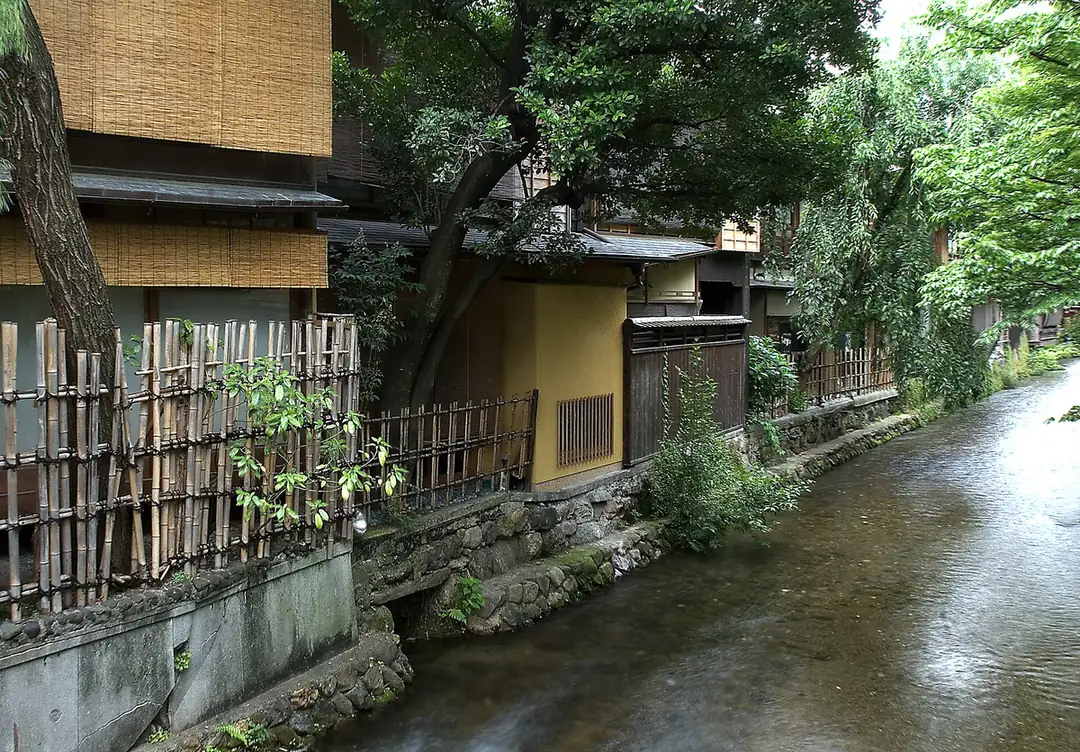
The best part of Gion is not Hanamikoji. It is Shirakawa, north of Shijo – a short canal lined with willows and machiya, stone-flagged, with small bridges and restaurant frontages backing straight onto the water. At dusk it is as good as Kyoto gets, and it carries a fraction of Hanamikoji’s numbers.
Yasaka Shrine at the eastern end is open all hours and free, and its lanterns at night are worth the detour. It is also the shrine at the centre of Gion Matsuri in July. Kenninji, Kyoto’s oldest Zen temple, sits at the southern end of Hanamikoji and takes almost none of the passing traffic despite being fifty metres from it.
Realistically Gion is twenty minutes of walking plus whatever you stop for. The right way to use it is as the end of the walk down from Kiyomizu-dera, arriving at dusk, and then eating – Izuu is in the Gion backstreets and Kikunoi is a short walk up toward Maruyama Park.
Frequently asked questions
Can tourists still visit Gion?
Yes. Hanamikoji, Shirakawa, Yasaka Shrine and Kenninji are all public and open. What closed in April 2024 are the private alleys running off Hanamikoji, which are marked with signs warning of fines up to ¥10,000.
Is there really a 10,000 yen fine?
That is the figure on the signs posted by the Gion residents' council for entering private lanes or photographing there without permission. It is a community measure rather than a municipal penalty schedule, but the restriction is clearly marked in English.
Will I see a geisha in Gion?
Possibly, briefly, between about 17:30 and 18:30, walking to an engagement. Most of the costumed figures on the street in the afternoon are visitors who have paid for a maiko makeover, not working geiko.
What is the best time to visit Gion?
Dusk, roughly 17:00 to 18:30. The lanterns come on, the restaurants open, and the daytime coach traffic has gone. Shirakawa in particular is far better in the last of the light than at midday.
What is worth seeing besides Hanamikoji?
Shirakawa, the willow-lined canal north of Shijo, which is prettier and much quieter. Yasaka Shrine at the eastern end is free and open at all hours, and Kenninji at the southern end is Kyoto's oldest Zen temple and is barely visited.
Further reading
Official sources
- Kyoto City official travel guide – Gion – Official city tourism guidance on Gion and visitor conduct in the district
- Time Out Tokyo – Kyoto limits tourist access in Gion – The March 2024 announcement of the private-alley closure
- SoraNews24 – Gion alley ban and the ¥10,000 notice – Photographs of the signage and the terms of the restriction