Downtown and Nishiki Market

Writes the logistics pages. Works to one rule: a price comes from the company that charges it.
UpdatedThe one thing to know about Nishiki Market before you walk into it: eating while walking is prohibited. This is not a soft cultural preference. The market association publishes it as a formal request to visitors, the shops post it, and it is treated as a serious nuisance rather than a quirk – because the arcade is narrow, the shops are open-fronted, and skewers and sauce in a moving crowd end up on the merchandise.
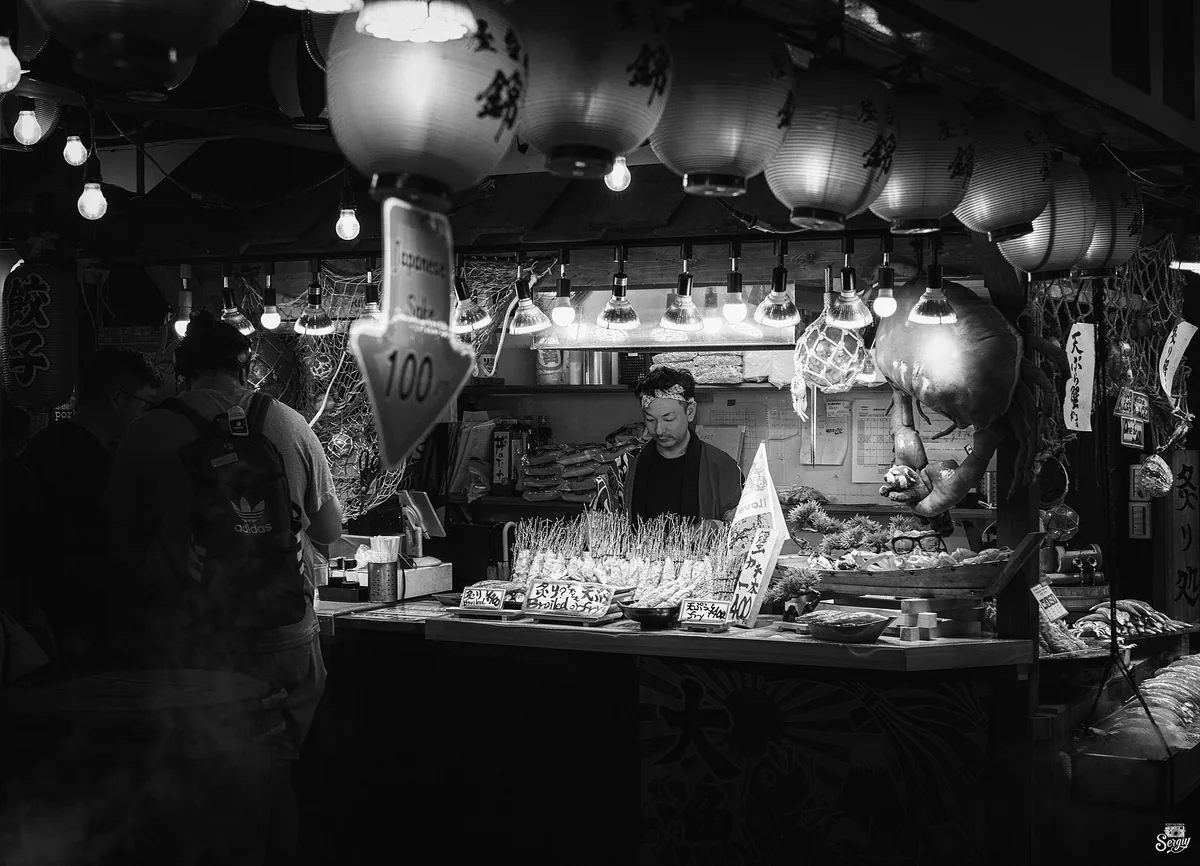
The convention is simple and every stall supports it: you buy, you stand at the counter or in the space the shop provides, you eat there, you hand back the stick or the cup. Most stalls take your rubbish. It is not an inconvenience once you know the shape of it.
At a glance
- Nishiki Market
- About 400 metres of covered arcade running east from Takakura to Teramachi, roughly 120 shops
- The rule
- Eating while walking is prohibited. The market association asks visitors to eat at the shop they bought from and treats walking-and-eating as a serious nuisance
- Hours
- Individual shops set their own; most run roughly 9:00 or 10:00 to 17:00 or 18:00, and many close one day a week
- Getting there
- Karasuma line to Shijo or Hankyu to Karasuma; the arcade starts a two-minute walk east
In this guide
What Nishiki actually is
Four hundred metres of covered arcade, five metres wide, running east from Takakura to Teramachi, with about a hundred and twenty shops under a striped translucent roof. It has been a fish market on this site since the early fourteenth century and it is still, importantly, a trade market: a significant proportion of its customers are Kyoto restaurant kitchens buying for service.
That is what makes the first hour of the day the good one. Before about ten the chefs are there and the stock is at its best; from midday it is visitors, and a proportion of the stalls have reorganised themselves around selling one-bite snacks to them. Both markets are real, but they are not the same market and they do not happen at the same time.
What to look at rather than eat: the tsukemono stalls with forty kinds of pickle in wooden tubs, the tofu and yuba makers, dried fish, sansho pepper, knives at Aritsugu, and the pressed-sushi counters. Kyoto cooking is built out of this street, which is the honest reason to come.
The downtown around it
Nishiki sits inside the only genuinely flat, dense, walkable part of Kyoto, and it is worth understanding as a district rather than a single arcade.
Teramachi and Shinkyogoku run north from the market’s eastern end as covered shopping streets. Pontocho, a lane barely two metres wide, runs parallel to the Kamo river and is the densest concentration of restaurants in the city – in summer the places on its east side put out kawayuka platforms over the riverbank. Kiyamachi, one street east, is the drinking street, and where you will find L’Escamoteur and Bee’s Knees.
This is also where Kyoto stays open late. The temple districts finish at five; downtown runs to midnight and beyond. Building a day that does Higashiyama in the morning and downtown in the evening is the single most useful piece of Kyoto planning there is.
Practicalities and manners
Hours are per shop. There is no market-wide opening time. Most stalls run somewhere between 9:00 and 18:00, many close one day a week, and the day varies by trade – fish sellers often take Wednesday or Sunday. A Sunday afternoon in Nishiki will find a noticeable number of shutters down.
The market association’s published requests go beyond the eating rule: do not touch produce you are not buying, do not photograph inside a shop without asking, do not block the arcade, and take your rubbish to the shop that sold it to you rather than leaving it on a neighbouring stall. All of that is on their own site in English.
For what to eat properly rather than in the street, the sensible move is to buy at the market and sit down elsewhere – obanzai in the evening is the downtown dish, and Kikkoya is a few minutes away.
Frequently asked questions
Can you eat while walking in Nishiki Market?
No. The market association prohibits it and treats it as a serious nuisance. Buy from a stall, eat standing at that stall or in the space it provides, and hand your rubbish back there.
What time does Nishiki Market open?
There is no single opening time – each shop sets its own, typically somewhere between 9:00 and 18:00. Many close one day a week and the day varies by trade, so some shutters are always down.
When is the best time to go?
Before about ten in the morning, when the restaurant buyers are there and the produce is at its best. From midday onward it becomes a visitor market with queues at the snack counters.
How long is Nishiki Market?
Roughly 400 metres, about five metres wide, with around 120 shops. Walking it without stopping takes ten minutes; doing it properly takes an hour.
What else is in downtown Kyoto?
Pontocho and Kiyamachi for eating and drinking, the covered Teramachi and Shinkyogoku arcades for shopping, and the Kamo riverbank. It is the part of Kyoto that stays open after the temples close at five.
Further reading
Official sources
- Nishiki Market – requests to visitors (official) – The prohibition on eating while walking and the market association’s other published requests
- Kyoto Nishiki Market shopping street association (official) – Shop directory, arcade layout and per-shop hours