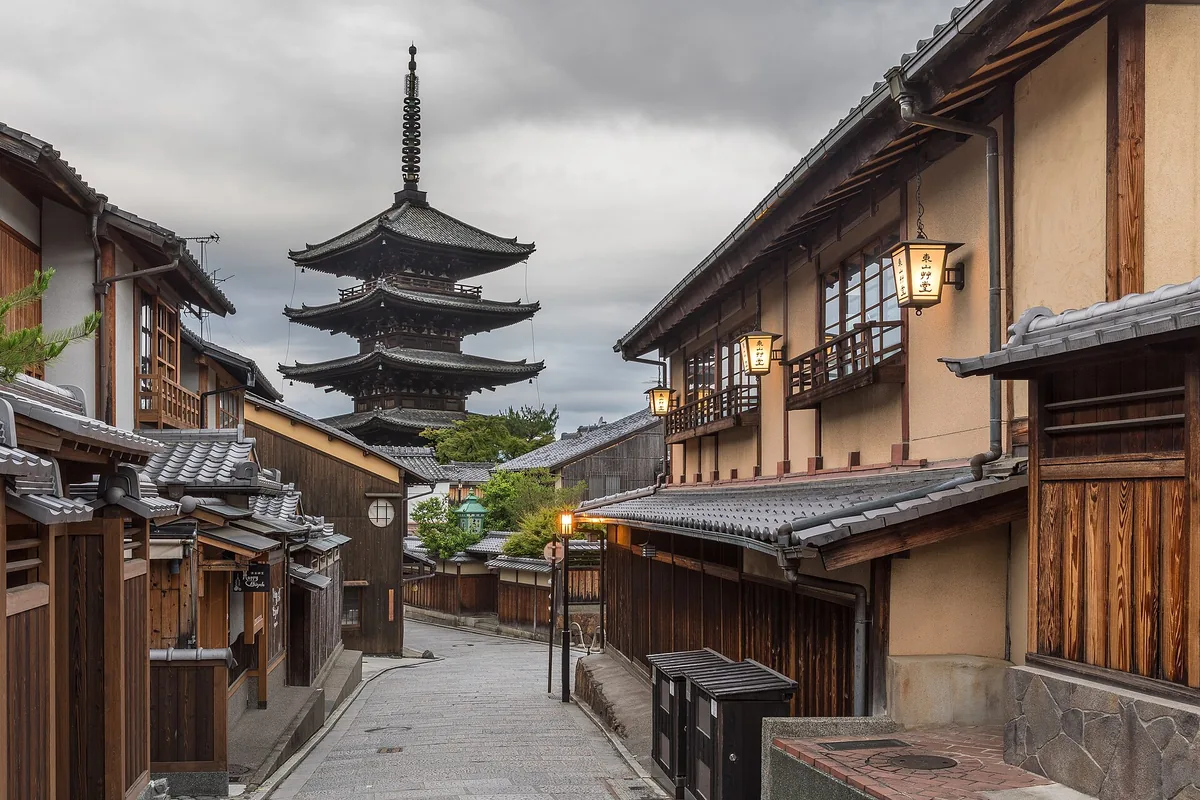
Higashiyama

Writes the autumn colour pages and follows the forecasts as they are issued, which is more than one forecast.
UpdatedHigashiyama is the strip of hillside running north from Kiyomizu-dera to Ginkaku-ji, and it holds a majority of what people actually come to Kyoto for: the stone lanes, the wooden shopfronts, the pagoda on the skyline, most of the great temples and all of the famous photographs.
The thing that shapes a day here is not distance – you can walk the whole thing – it is closing time. Kyoto’s temples shut between 16:30 and 17:00, earlier than visitors expect and earlier than Tokyo or Osaka. The hillside is effectively over by five, and the only way to buy back time is at the other end of the day.
At a glance
- What it covers
- The strip below the eastern hills from Kiyomizu-dera in the south to Ginkaku-ji in the north
- Cost
- The lanes are free. The temples along them charge individually, typically ¥500 to ¥1,000
- Key constraint
- Almost every temple here closes between 16:30 and 17:00. Kiyomizu-dera, which opens at 6:00, is the exception at both ends
- Getting there
- City Bus 100, 206 or 207 along Higashioji, or Keihan to Gion-Shijo or Kiyomizu-Gojo
In this guide
The shape of the district
From south to north: Kiyomizu-dera on its stage above the city; the stepped lanes of Sannenzaka and Ninenzaka dropping away from it; Kodai-ji and the Yasaka pagoda; Maruyama Park and Yasaka Shrine; Gion spilling west toward the river; then Chion-in and Nanzen-ji with its brick aqueduct; and finally the Philosopher’s Path running up to Ginkaku-ji.
End to end that is about five kilometres of walking and six to eight hours with stops. Most people do the southern half – Kiyomizu-dera down to Gion – as a morning, and the northern half as a separate afternoon. Trying to do all of it in one day means paying several admissions and rushing every one.
Nothing here needs a bus between stops. The buses along Higashioji are slow, full, and slower than walking for anything under a kilometre.
The clock is the whole problem
Ginkaku-ji closes at 17:00 from March to November and 16:30 in winter. Nanzen-ji, Kodai-ji and most of the smaller temples are the same. Kiyomizu-dera is the outlier: open at 6:00 every day and to 18:00 most of the year.
So the efficient Higashiyama day starts at six, at the top. You get Kiyomizu-dera almost empty, walk down Sannenzaka while the shops are still shuttered and the lanes are photographable, and reach Gion or Nanzen-ji by mid-morning with the hard part done. The alternative – arriving at ten and working up the hill – means doing every stop at its worst and running out of daylight at the good end.
What fills the evening, then, is not a temple. It is dinner, the lanterns at Yasaka Shrine, which is open at all hours, or the Friday late opening at the Kyoto National Museum. Plan the evening separately from the hillside and the day stops feeling truncated.
The lanes, and the rules on them
Sannenzaka and Ninenzaka are preserved districts, which is why they look the way they do: no overhead cables, no plastic signage, controlled shopfronts. They are also, at eleven on a Saturday, close to impassable.
Photography on the stepped lanes has become a genuine friction point. There are posted restrictions in parts of the district and the local associations have been progressively tightening them, in the same spirit as Gion’s closure of its private alleys in 2024. The practical version: the stone steps are somebody’s street, tripods are not welcome, and the residential lanes off the main run are not a set.
Eating as you walk is frowned on throughout the district and is explicitly prohibited in Nishiki Market across town. The convention in Higashiyama is to eat standing at the shop you bought it from. Most of the shops that sell skewers and sweets provide a spot to do exactly that.
Frequently asked questions
What is Higashiyama?
The district along the foot of Kyoto's eastern hills, running roughly from Kiyomizu-dera in the south to Ginkaku-ji in the north. It contains most of the city's best-known temples, the preserved stone lanes of Sannenzaka and Ninenzaka, and Gion.
How long does it take to walk Higashiyama?
About five kilometres end to end, or six to eight hours with temple stops. Most people split it, doing Kiyomizu-dera down to Gion as one walk and Nanzen-ji up to Ginkaku-ji as another.
What time do the temples close?
Between 16:30 and 17:00 almost without exception. Kiyomizu-dera is the one that breaks the pattern, opening at 6:00 and closing at 18:00 for most of the year.
Can you eat while walking in Higashiyama?
It is discouraged. The convention is to eat standing at the shop you bought from, and most vendors provide space for that. In Nishiki Market across town it is explicitly prohibited.
Is it worth staying in Higashiyama?
It helps considerably, because the 6:00 start at Kiyomizu-dera is much easier from a bed ten minutes away than from a hotel near the station. The area is short on budget options, though, and Kyoto's lodging tax rose sharply in March 2026.
Further reading
Official sources
- Kiyomizu-dera – 2026 opening hours (official) – The 6:00 opening and seasonal closing times that set the shape of a Higashiyama day
- Ginkaku-ji (official) – 17:00 and 16:30 seasonal closing at the northern end of the district
- Kyoto City official travel guide – District information and visitor conduct guidance for the eastern hills