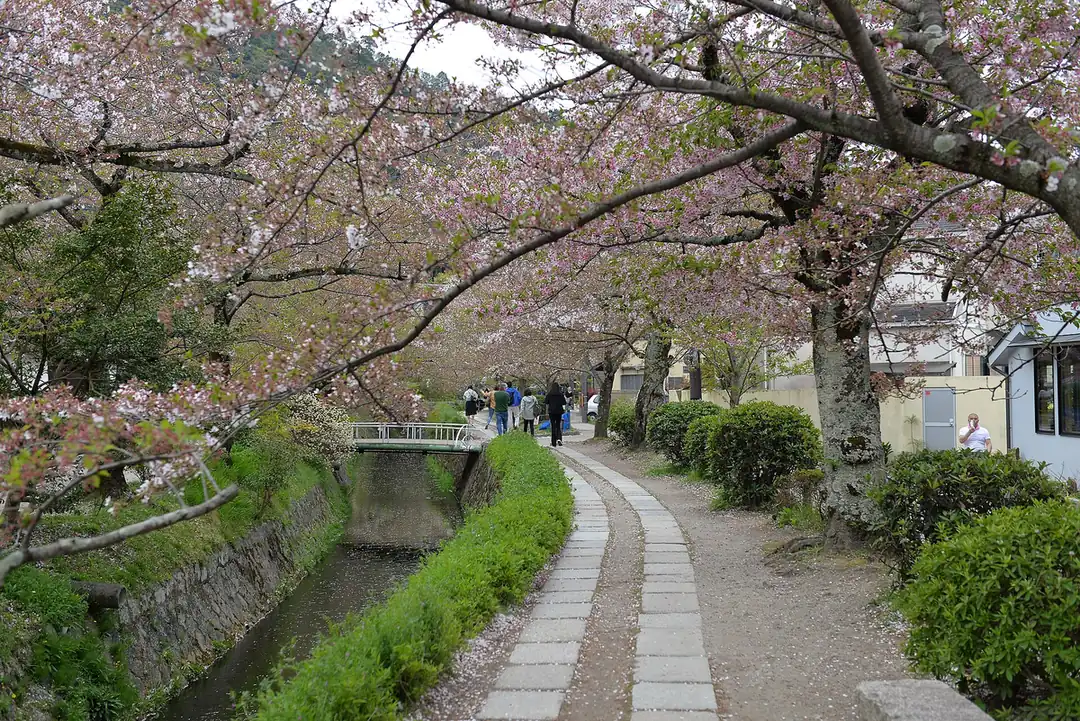
The Philosopher’s Path

Writes the autumn colour pages and follows the forecasts as they are issued, which is more than one forecast.
UpdatedThe Philosopher’s Path runs about two kilometres along a branch of the Lake Biwa canal in eastern Kyoto, from Nanzen-ji in the south to Ginkaku-ji in the north. It is free, it has no gate, and it is lined with several hundred cherry trees.
The advice that actually matters is about direction. Walk it south to north. Ginkaku-ji now charges ¥1,000, doubled in April 2026, and arriving at it at the end of the walk turns that into a decision you make knowing how tired you are. Starting at Ginkaku-ji means paying first and walking afterwards, which is the wrong way round.
At a glance
- Length
- Roughly two kilometres along the Lake Biwa canal, between Nanzen-ji at the south end and Ginkaku-ji at the north
- Cost
- Free, at all hours. The temples along it charge individually
- Time
- Thirty minutes walked straight through; ninety with stops
- Direction
- Walk south to north, so that the ¥1,000 at Ginkaku-ji is a choice you make at the end
In this guide
The walk itself
A narrow stone and earth path on one bank of a canal barely three metres across, with the Higashiyama hills rising immediately to the east. It is flat, it is shaded, and it takes half an hour if you do not stop. The name comes from Nishida Kitaro, the Kyoto School philosopher who walked it daily on his way to the university.
What makes it work is that it is a connector rather than a destination. Almost everything worth stopping for is a few metres off it: Honen-in, up a mossy flight of steps through a thatched gate, free to enter and one of the quietest places in the city; Anraku-ji and Reikan-ji, both opening only for short seasonal windows; Otoyo Shrine with its guardian mice instead of foxes or lions; and Eikan-do near the southern end, which is the best autumn maple temple in Kyoto and priced accordingly in November.
There are cafés and small craft shops along the path, most of them closing around five with the temples. Nothing here operates in the evening, although the path itself is walkable and lit enough to use after dark.
When it is at its best, and when to avoid it
Cherry blossom, in the first week of April, is when it is famous and when it is worst. The canal under several hundred trees in flower is genuinely spectacular, and so is the single-file queue of people photographing it. If you are in Kyoto for the blossom, go at seven in the morning or accept the crowd.
Late November is better. The maples along the canal and at Eikan-do peak in the last week of the month, the light is low and the path takes the autumn crowd far more comfortably than it takes the spring one.
Winter is the underrated version. Bare trees, the canal running fast, almost nobody on it, and Honen-in in snow. The trade is that Ginkaku-ji at the top closes at 16:30 from December to February rather than 17:00, which shortens the afternoon considerably.
How to build a day around it
Start at Nanzen-ji, which you reach from Keage station on the Tozai subway line. Look at the aqueduct – a brick Roman-style arcade carrying the canal straight through a Zen temple compound, which is one of the strangest and best sights in Kyoto and costs nothing. Then pick up the path north.
Allow ninety minutes to two hours to reach Ginkaku-ji with stops. At the top you make the ¥1,000 decision with the walk already banked. If you decide against it, the bus back into town goes from Ginkakuji-michi and you have lost nothing.
This is also the northern half of Higashiyama, and it pairs badly with the southern half in one day – Kiyomizu-dera down to Gion is its own morning. Doing both means five kilometres, four admissions and no time at any of them. Take the Philosopher’s Path as an afternoon and finish at the Kyocera Museum in Okazaki, which stays open until six.
Frequently asked questions
How long is the Philosopher's Path?
About two kilometres, which takes thirty minutes walked straight through or ninety with stops at the temples and shrines along it.
Is it free?
Yes. The path itself has no gate, no ticket and no closing time. The temples along it charge individually, and Ginkaku-ji at the northern end is now ¥1,000.
Which direction should you walk it?
South to north, from Nanzen-ji up to Ginkaku-ji. That way the ¥1,000 admission at the top is a decision you make after the walk rather than a ticket you buy before it.
When is the best time to walk it?
Late November for the maples, which is less congested than the cherry blossom in early April. Winter is the quietest, though Ginkaku-ji closes at 16:30 rather than 17:00 from December to February.
What is worth stopping for along the way?
Honen-in, free and very quiet, up steps through a thatched gate; Otoyo Shrine with its guardian mice; and Eikan-do near the southern end, which is the best autumn maple temple in Kyoto. The Nanzen-ji aqueduct at the start costs nothing and is remarkable.
Further reading
Official sources
- Ginkaku-ji (official) – The ¥1,000 admission since 1 April 2026 and the seasonal 17:00 and 16:30 closing times at the northern end of the path
- Weathernews – Kyoto autumn colour calendar – Typical peak dates for the maples in eastern Kyoto