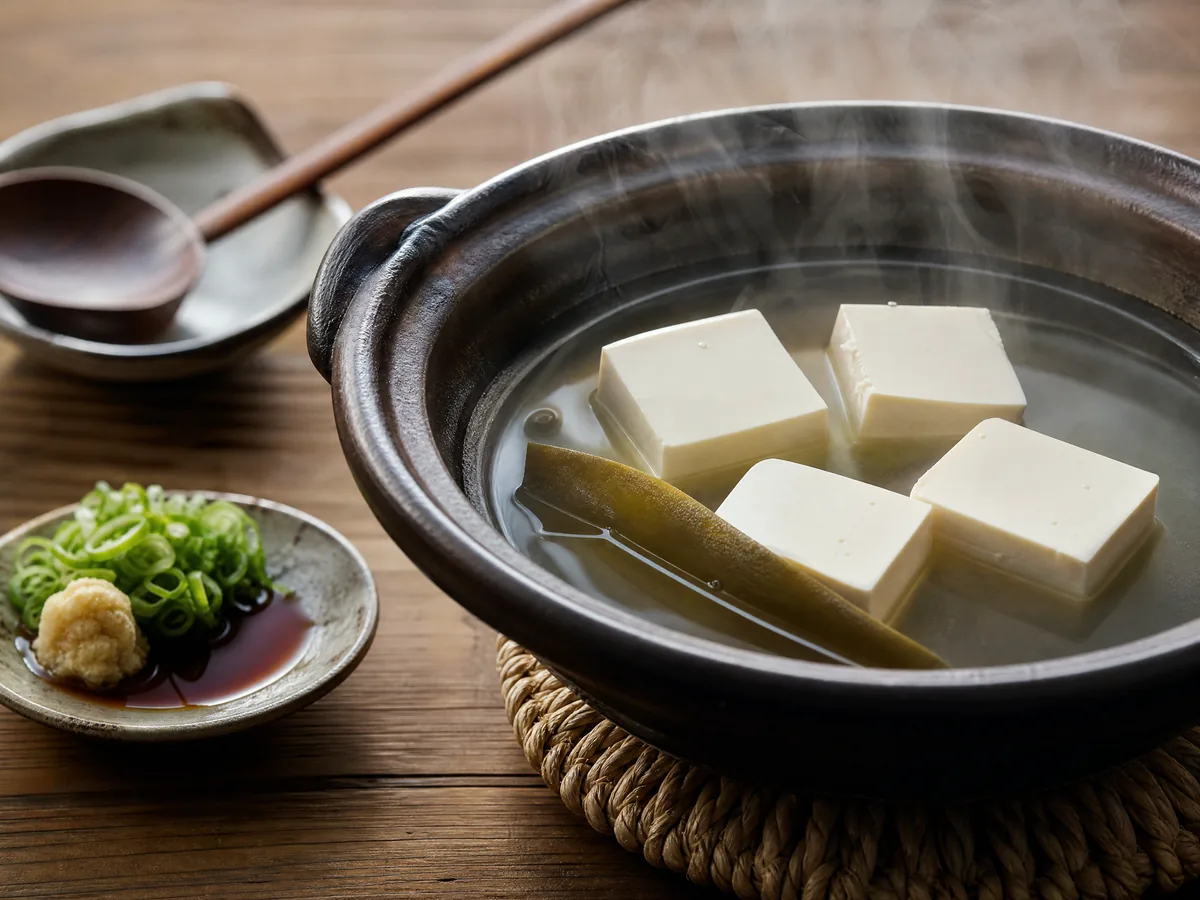
Yudofu

Writes the logistics pages. Works to one rule: a price comes from the company that charges it.
UpdatedYudofu is tofu, warmed in water. That is the whole dish. A shallow earthenware pot goes on a flame at the table with a sheet of kombu in the bottom and blocks of tofu in the water; you lift one out with a slotted spoon, dip it in a soy-based sauce, and eat it with chopped spring onion, grated ginger and a shake of shichimi.
Nothing is fried, browned, seasoned or sauced. There is no way to disguise mediocre tofu in it, which is the entire point and also the reason it disappoints people. If you approach it as dinner you will find it thin. If you approach it as the Japanese equivalent of eating very good bread with nothing on it, it makes sense.
At a glance
- What it is
- Blocks of tofu warmed in a pot of water with kombu, lifted out and dipped in a soy-based sauce with spring onion, ginger and shichimi
- Where to eat it
- The tofu houses clustered around Nanzen-ji, Kiyomizu-dera and the Arashiyama temples
- Season
- A winter dish by tradition, though served year round
- Dietary
- Vegetarian, and vegan if the dipping sauce is made without bonito – worth asking, because many are not
In this guide
Why this is a Kyoto dish and not a Japanese one
Two local conditions produced it. The first is water. Kyoto sits on a large basin aquifer and its groundwater is notably soft – low in calcium and magnesium – which affects how soy protein coagulates and gives a softer, sweeter tofu. The same water is why Fushimi brews the sake it does.
The second is Buddhism. Kyoto was for centuries the administrative centre of Japanese Buddhism, with thousands of monks eating no meat and no fish. Tofu makers set up around the great temple complexes to supply them, and yudofu is the simplest thing those kitchens did with the product. That is why the tofu houses are still where they are: at Nanzen-ji, below Kiyomizu-dera, in Arashiyama, outside the Daitoku-ji walls.
It is also a winter dish in origin. Kyoto’s basin climate produces a cold, damp winter, and a pot of hot water on the table is doing thermal work as well as culinary work. Eaten in August it loses something.
How to eat it properly
Do not let it boil. The tofu is being warmed through, not cooked; at a rolling boil the structure breaks down and it goes grainy. If the flame is too high, turn it down – this is expected of you, not an intervention.
Take one block at a time. Drain it briefly against the side of the pot so it does not dilute the dipping sauce. Use the condiments sparingly at first: the point of the exercise is the tofu, and a heap of ginger and shichimi in the sauce turns it into a dish about condiments.
It never arrives alone. A yudofu meal at a specialist house is a set – sesame tofu, dengaku with sweet miso, tempura of seasonal vegetables, rice, pickles, sometimes a small grilled item. The pot is the centre of the meal rather than the whole of it, which is worth knowing before you write it off as insufficient.
Where to eat it, and the vegan question
Okutan Kiyomizu, in a garden a few minutes below the temple, is the obvious pairing with a dawn start at Kiyomizu-dera – though it closes Thursdays and does not publish its hours, so check before you build a day on it. The older Okutan house at Nanzen-ji dates to the seventeenth century. Arashiyama has several, and the Nanzen-ji approach has a row of them.
For a fuller version of the same tradition, Izusen at Daitoku-ji serves complete shojin ryori courses from ¥4,500 and is open every day of the year but four.
On dietary requirements: the tofu and the broth are vegan, but the dipping sauce usually is not. Standard ponzu and tsuke-daré are made with katsuobushi, dried bonito. Temple restaurants working in the strict shojin tradition will use kombu only; commercial tofu houses frequently do not. Ask specifically about the sauce rather than about the dish.
Frequently asked questions
What is yudofu?
Blocks of tofu warmed in a pot of water with kombu at the table, lifted out and dipped in a soy-based sauce with spring onion, ginger and shichimi. Nothing is fried or sauced – the dish is about the quality of the tofu itself.
Why is yudofu associated with Kyoto?
Kyoto's groundwater is unusually soft, which makes softer and sweeter tofu, and the city's large Buddhist establishment created centuries of demand for meat-free protein. Tofu makers clustered around the temples and the restaurants are still there.
Is yudofu vegan?
The tofu and the kombu broth are, but the dipping sauce usually contains dried bonito. Temple restaurants in the strict shojin tradition use kombu only. Ask about the sauce specifically, not about the dish.
When should you eat it?
Traditionally in winter, when a pot of hot water on the table does real work in Kyoto's cold, damp basin climate. It is served all year but it is a colder-weather dish by design.
Is yudofu a full meal?
The pot alone is not. At a specialist tofu house it comes as a set with sesame tofu, dengaku, tempura, rice and pickles, which adds up to a proper lunch. Ordering only the pot and expecting dinner is the usual mistake.
Further reading
Official sources
- Kyoto Tourist Information Center – yudofu (PDF) – Kyoto City tourist office sheet on the dish and the city’s tofu restaurants
- Izusen – Daiji-in branch (official) – Shojin ryori courses at Daitoku-ji, ¥4,500 upward, 11:00–16:00