Kaiseki

Writes the logistics pages. Works to one rule: a price comes from the company that charges it.
UpdatedKaiseki is the formal multi-course meal that Kyoto is famous for, and the first useful thing to know about it is how wide the price range is. Temple-style shojin ryori at Izusen starts at ¥4,500. A good kaiseki lunch in a serious house runs roughly ¥8,000 to ¥15,000. Dinner at Kikunoi starts at ¥65,000.
The second useful thing is that the structure is the same at every price. The sequence of courses, the logic of the seasons, the pacing and the conventions do not change. What changes is the quality of the ingredients, the ceramics, the room and the number of people looking after you.
At a glance
- What it is
- A fixed sequence of small courses built around the season, served in a set order rather than chosen from a menu
- Price range
- From ¥4,500 for shojin ryori at Izusen, through roughly ¥8,000 to ¥15,000 for a good lunch, to ¥65,000 and upward at Kikunoi at dinner
- Duration
- Two hours at lunch, two and a half to three at dinner
- Booking
- Effectively compulsory at the upper end, and at the top often only through a platform or a concierge
In this guide
The sequence, and what each course is doing
Broadly: sakizuke, a small opener; hassun, a tray of several bites presented to state the season; mukozuke, sashimi; suimono, a clear soup that is the technical centrepiece; yakimono, something grilled; takiawase, vegetables and protein simmered separately and served together; a palate course; then rice, pickles and miso soup together; and a restrained sweet.
The clear soup is where you judge the kitchen. It is close to transparent, it contains two or three things, and it is made from a dashi struck once from kombu and shaved katsuobushi with nothing to hide behind. If the soup is good the meal will be good.
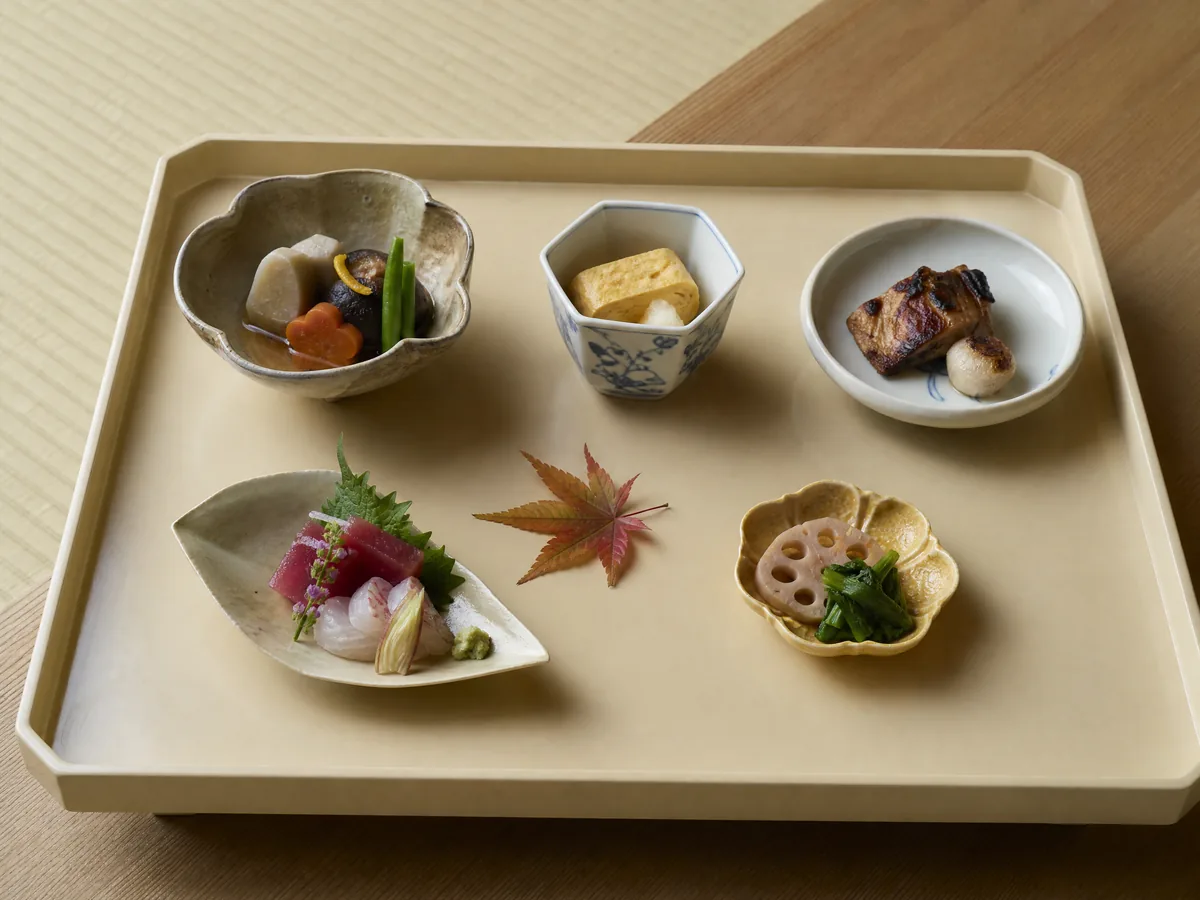
The hassun is where you see the season stated outright – a maple leaf in November, bamboo in spring, something on the plate that is not food at all. The best houses work to the traditional calendar of seventy-two micro-seasons of about five days each, which is why two visits a fortnight apart give you different meals.
What the price difference actually buys
Not more food. A ¥65,000 dinner is not five times the volume of a ¥13,000 lunch. It is: first-cut ingredients, including things with genuinely restricted supply; antique or commissioned ceramics chosen per course; a private tatami room and a garden; a service ratio close to one person per table; and one or two more courses.
The marginal value of all that falls off steeply. For someone eating kaiseki for the first time, the difference between ¥4,500 and ¥13,000 is enormous and the difference between ¥13,000 and ¥65,000 is largely legible only to people who have eaten a lot of it. That is the honest advice: spend at the bottom of the serious range rather than the top of the affordable one.
Lunch is the arbitrage. Most houses serve the same kitchen’s cooking at lunch for between a third and a half of the dinner price, with fewer courses. You also see the garden, which at dinner is dark.
Booking, conventions and what can go wrong
Book ahead. At the top end the reservation is the hard part: Kyoto’s ryotei tradition runs on introduction, and the practical routes for a visitor are a platform such as Tableall or a hotel concierge. Cancellation terms are real and charged.
Declare dietary requirements when you book, not when you sit down. A kaiseki menu is planned and purchased in advance; a vegetarian request made on arrival cannot be accommodated, and fish dashi is in almost everything. If you need a meal without fish stock, the reliable answer in Kyoto is shojin ryori, which excludes it by definition.
On conventions: eat things in the order they are given to you, drink tea when it comes, do not photograph the room without asking, and do not wear strong perfume – the soup is built on aroma and the room is small. None of this is enforced at a visitor, but all of it is noticed.
Frequently asked questions
How much does kaiseki cost in Kyoto?
From about ¥4,500 for shojin ryori at Izusen, through roughly ¥8,000 to ¥15,000 for a good kaiseki lunch, up to ¥65,000 and beyond for dinner at Kikunoi. The structure of the meal is the same across that whole range.
How long does a kaiseki meal take?
About two hours at lunch and two and a half to three at dinner. It is paced by the kitchen and cannot be hurried.
Is lunch cheaper than dinner?
Substantially – usually a third to a half of the dinner price for the same kitchen with fewer courses. It is also in daylight, which means you can see the garden. For a first kaiseki, lunch is the better decision.
Can kaiseki be vegetarian?
Only if arranged in advance, and even then fish dashi is difficult to remove from a classical menu. The dependable vegetarian equivalent is shojin ryori, Buddhist temple cuisine, which excludes fish and meat by definition.
Which course tells you if the restaurant is good?
The clear soup. It is nearly transparent, contains two or three ingredients and is built on a single-strike dashi, so there is nothing for a weak kitchen to hide behind.
Further reading
Official sources
- Kikunoi (official English site) – The upper end of the Kyoto kaiseki range and its reservation policy
- Izusen – Daiji-in branch (official) – Shojin ryori courses at ¥4,500, ¥5,500 and ¥6,500
- Tableall – Kikunoi – The reservation route used by high-end Kyoto restaurants for overseas guests