Imperial Palace to Asakusa
Writes the route pages and owns the fare data behind them. Re-checks every segment on a quarterly sweep.
UpdatedThis page carries dated prices or seasonal forecasts checked on the date above, and that window has now passed. Re-check the sources at the foot of the page before you book anything.
Tokyo makes no sense from the subway map. It makes a great deal of sense on foot, because the city is still laid out around a castle: the palace at the centre, the merchant districts to the east and north-east, the temple at the far end of the road out.
This walk follows that logic. It starts at the Imperial Palace East Gardens – which are closed on Mondays and Fridays, the most common wasted trip in central Tokyo – and finishes at Senso-ji in Asakusa. Seven kilometres, almost entirely flat.
At a glance
- Start
- Ote-mon gate, Imperial Palace East Gardens. Closed Mondays and Fridays – check the day before you build a morning around it
- Finish
- Senso-ji, Asakusa
- Distance
- About seven kilometres, two to three hours walking, longer with stops
- Cost
- Nothing. Both ends are free
- Bail-out
- The route runs close to the Ginza and Toei Asakusa lines for most of its length, so you can stop at any point
In this guide
The castle and Nihonbashi, about 45 minutes
Enter the East Gardens at Ote-mon, the ceremonial gate, and take the numbered tag they hand you. Walk up through the Ninomaru garden to the Tenshudai, the bare stone base of the castle keep that burned in 1657 and was never rebuilt. Climb it. This is the centre of the map you are about to walk across, and the empty platform makes the point better than a reconstruction would.
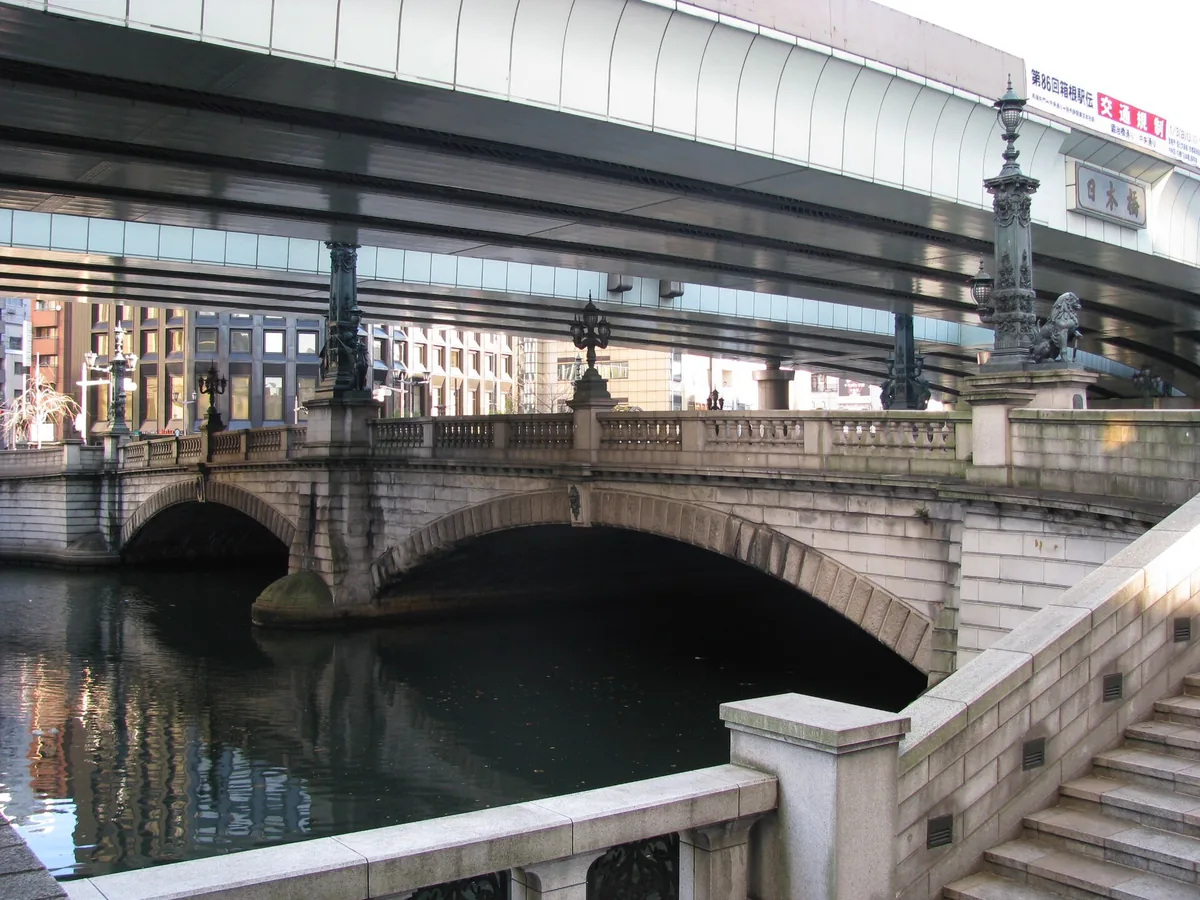
Leave by Hirakawa-mon on the north-east side and head east. Within ten minutes you are in Nihonbashi, and at the bridge of that name – the point from which every distance in Japan was measured in the Edo period, and still the zero marker for the national road network. There is an expressway directly over it, which is either a scandal or the most honest thing in Tokyo depending on your temperament.
The streets around it are the old merchant quarter: department stores descended from seventeenth-century kimono dealers, knife shops, paper shops, and the Bank of Japan in a Meiji-era building modelled on European classicism.
Kanda and Akihabara, about 45 minutes
North from Nihonbashi the city changes character every few blocks. Kanda was the artisans’ district and retains the street grid and some of the trade: Jimbocho, slightly west, is a whole neighbourhood of second-hand bookshops and is worth a detour of an hour if books are your weakness.
Continue north-east and you hit Akihabara, which was a radio-parts market after the war, became the electronics district, and is now the anime and gaming district. Walking into it from Kanda rather than arriving by train makes the continuity obvious: it is still a district of small specialist stalls, and only the specialism has changed.
From Akihabara, cross the Kanda river and continue north-east. The blocks here are ordinary and that is useful: this is what most of Tokyo actually looks like between the places guides send you, and twenty minutes of it does more for your understanding of the city than another temple would.
Kuramae to Asakusa, about 45 minutes
Kuramae is the surprise of the walk. It was the shogunate’s rice warehouse district and is now full of small makers – leather, notebooks, coffee roasters, ceramics – in converted warehouse buildings. It has been called Tokyo’s Brooklyn, which is lazy but not wrong, and it is an excellent place to stop for coffee about two-thirds of the way through.
From there follow the Sumida river north. The riverside path gives you Tokyo Skytree on the opposite bank growing steadily larger, which is a good piece of accidental staging.
Arrive at Asakusa at Azuma-bashi bridge and walk into the temple precinct from the east, which avoids Nakamise entirely and delivers you beside the pagoda. Time it for late afternoon and you get the temple as the light goes; the main hall shuts at 17:00 but the grounds never close, and the floodlighting after dark is the best free spectacle in eastern Tokyo. The free eighth-floor terrace at the tourist information centre opposite Kaminarimon lets you look back over the route you have just walked.
Frequently asked questions
How long does the walk from the Imperial Palace to Asakusa take?
About seven kilometres and two to three hours of walking, or most of a day with stops in Nihonbashi, Jimbocho and Kuramae.
Do I need to check anything before starting?
Yes, that the Imperial Palace East Gardens are open. They close on Mondays and Fridays, and as early as 16:00 from November to February.
Is the walk difficult?
No. It is almost entirely flat and on pavements, and the route stays close to the Ginza and Toei Asakusa subway lines so you can stop at any point.
What is the best time of day to do it?
Start mid-morning so the gardens are open and you reach Asakusa in the late afternoon. Senso-ji's grounds never close, so arriving at dusk is a feature rather than a problem.
What is worth detouring for?
Jimbocho, a whole district of second-hand bookshops just west of Kanda, and Kuramae, the old rice-warehouse quarter now full of small makers and coffee roasters.
Further reading
Official sources
- Imperial Household Agency – East Gardens (official) – Monday and Friday closures and seasonal hours at the start of the walk
- GO TOKYO – Asakusa – Official area guide for the finish
- Senso-ji (official) – Temple history and buildings
- Asakusa Culture Tourist Information Center – Taito City – The free terrace at the end of the route