Senso-ji

Writes the autumn colour pages and follows the forecasts as they are issued, which is more than one forecast.
UpdatedThis page carries dated prices or seasonal forecasts checked on the date above, and that window has now passed. Re-check the sources at the foot of the page before you book anything.
Senso-ji costs nothing, and the main hall opens at 06:00 – 06:30 in the October-to-March half of the year. The grounds are a public right of way and are never shut at all. That is the single most useful fact about the most visited religious site in Japan.
It matters because the Nakamise shopping street does not open until about 09:30. For three hours every morning the temple is functioning and the retail in front of it is not, and the difference between those two Senso-jis is not a matter of degree. One is a place of worship with a few dozen people in it. The other is a corridor of two hundred souvenir stalls with a temple at the end.
At a glance
- Admission
- Free, and there is no ticket office to queue at
- Hours
- Main hall 06:00–17:00, opening at 06:30 from October to March. The grounds themselves never close
- Nakamise
- Shops open at roughly 09:30 and close in the early evening; individual stalls set their own hours
- Time needed
- 40 minutes for the temple, 90 with Nakamise and Dempo-in Street
In this guide
The dawn window, and what closes it
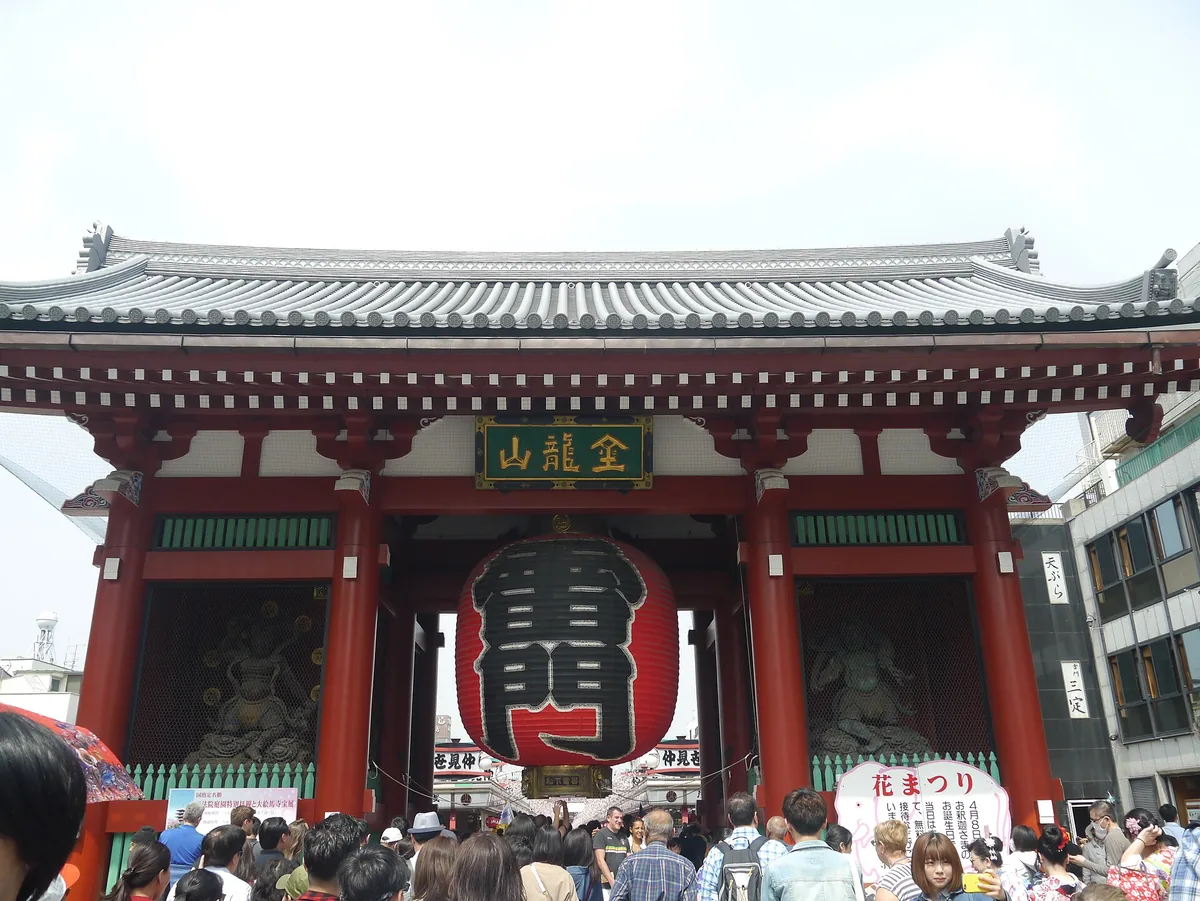
Come at six and you walk through Kaminarimon – the Thunder Gate, with the four-metre lantern – with nobody standing under it taking a photograph. Nakamise is a long empty lane of shuttered fronts, which is when you can actually see that the shutters are painted, and that the street is straight and narrow in the way an Edo approach road was meant to be. At the top, the incense cauldron is lit and the hall is open and there are people at it who are not tourists.
By half past nine the shutters go up and the lane fills. By eleven the queue to photograph Kaminarimon reaches back to the road. Nothing has gone wrong; this is simply what a free site with no admission gate and no capacity control looks like in the middle of the day. If your schedule only allows the middle of the day, use the side approaches: Dempo-in Street runs east-west across Nakamise and is a quarter as busy, and the western gate off Kaminarimon-dori brings you into the precinct without the corridor at all.
The other honest option is the evening. The buildings are floodlit after dark, the main hall is closed but the grounds are not, and the five-storey pagoda against a black sky is the picture most people are trying and failing to take at noon.
The free terrace nobody mentions
Directly opposite Kaminarimon, across the road, is the Asakusa Culture Tourist Information Center – the stacked timber-fronted building by Kengo Kuma. It is a tourist office, so people walk past it. On the eighth floor there is a free observation terrace, open late into the evening, with the one view of Asakusa that makes the place legible: Nakamise running north as a straight line of roofs, Senso-ji at the end of it, and Tokyo Skytree behind on the far bank of the Sumida.
There is no ticket and no lift queue worth speaking of. It is the best free view in eastern Tokyo and it is forty seconds from the gate. If you are weighing Skytree at ¥2,100 and upwards, look from here first – not as a substitute, but so you know what you are paying for.
The ground floor of the same building is a genuine information desk with English-speaking staff, free wi-fi, and toilets that are not the ones behind the temple.
What to actually look at
Almost nothing you see is old. Senso-ji was founded in 628 and burned in the firebombing of March 1945; the main hall, the pagoda and Kaminarimon are post-war reconstructions in reinforced concrete. Knowing that changes what is worth your attention, because it moves the interest from the fabric to the practice.
Watch the omikuji drawers to the right of the hall. You shake a metal cylinder, read the numbered stick, take the paper from the matching drawer, and if it is kyo – bad fortune – you tie it to the rack and leave it behind. Senso-ji is well known among Japanese visitors for handing out a high proportion of bad fortunes, and it does not soften them. It is a hundred yen and it is the most-used thing on the site.
Then walk east, past the pagoda, to Asakusa-jinja – the shrine in the same precinct, which survived the war intact. It is a 1649 building, it is quiet, and it is the one genuinely seventeenth-century thing you can stand in front of here. It is also the shrine that runs Sanja Matsuri in May.
Full context on the neighbourhood, including where to eat before the crowds, is on the Asakusa district page.
Frequently asked questions
How much does Senso-ji cost?
Nothing. There is no admission charge and no ticket office. The only money you need is a hundred-yen coin if you want to draw an omikuji fortune.
What time does Senso-ji open?
The main hall opens at 06:00 from April to September and 06:30 from October to March, closing at 17:00. The grounds, the gates and the pagoda are outdoors and accessible at any hour.
When do the Nakamise shops open?
Roughly 09:30, with each stall setting its own hours and most closing in the early evening. That gap between the temple opening and the shops opening is the quietest time to visit.
Is there a free view of Senso-ji from above?
Yes. The Asakusa Culture Tourist Information Center opposite Kaminarimon has a free eighth-floor terrace open until 22:00, looking straight up Nakamise to the temple with Skytree behind.
Is Senso-ji worth visiting?
Yes, with a time attached. Before 09:00 or after dark it is one of the best things in Tokyo and it is free. Between 11:00 and 16:00 it is a crowded shopping street, and people who only see that version reasonably conclude it is overrated.
Further reading
Official sources
- Senso-ji (official) – Temple history, buildings and annual events
- Asakusa Culture Tourist Information Center – Taito City – The free eighth-floor observation terrace
- GO TOKYO – Asakusa – Tokyo Convention and Visitors Bureau area guide
- Asakusa Tourism Federation – Local federation listings for Asakusa events