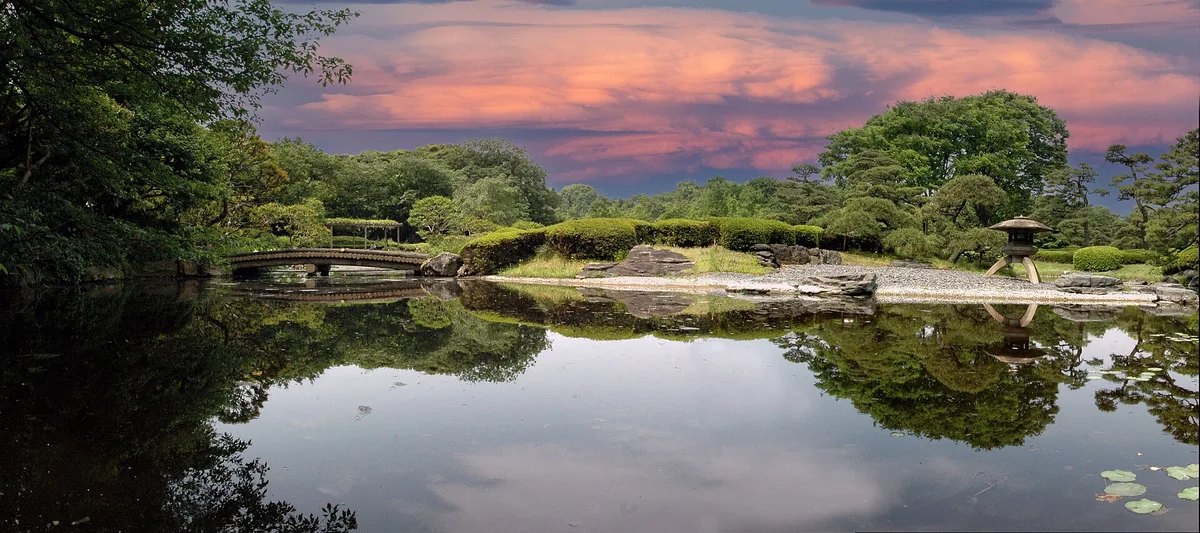
Imperial Palace East Gardens

Writes the route pages and owns the fare data behind them. Re-checks every segment on a quarterly sweep.
UpdatedThis page carries dated prices or seasonal forecasts checked on the date above, and that window has now passed. Re-check the sources at the foot of the page before you book anything.
The East Gardens of the Imperial Palace are free, and they are closed on Mondays and on Fridays. Almost every other major site in Tokyo closes once a week or not at all, so people apply the usual arithmetic, avoid Monday, and walk up to a shut gate on Friday morning with nothing behind it for half a kilometre.
The second trap is the seasonal closing time. From November to February the gardens shut at 16:00, with last entry at 15:30. In midsummer they stay open until 18:00. A plan built around a late-afternoon walk here works in July and fails in December.
At a glance
- Admission
- Free. A numbered entry tag is handed out at the gate and returned when you leave
- Closed
- Mondays and Fridays (open when those fall on a national holiday), 28 December to 3 January, and for imperial functions
- Hours
- 09:00–17:00 from 1 March to 14 April; 09:00–18:00 from 15 April to 31 August; 09:00–17:00 in September; 09:00–16:30 in October; 09:00–16:00 from November to February. Last entry 30 minutes before
- Gates
- Ote-mon, Hirakawa-mon and Kitahanebashi-mon
- Time needed
- 60–90 minutes
In this guide
You are standing on Edo Castle
This is not a park that happens to be near the palace. It is the Honmaru, Ninomaru and Sannomaru – the inner enclosures of Edo Castle, seat of the Tokugawa shoguns for 265 years, and for most of that period the administrative centre of Japan. It has been open to the public since 1968.
The single most striking thing in it is a thing that is not there. The Tenshudai is the stone base of the castle keep: a massive fitted-granite platform you can climb, with nothing on top of it. The keep burned in the Meireki fire of 1657, and the shogunate decided the money was better spent rebuilding the burned city than rebuilding a tower. It was never replaced. Standing on an empty eleven-metre plinth in the middle of Tokyo, with the Marunouchi towers behind you, is a better history lesson than most reconstructions manage.
The Ninomaru garden below it was redesigned in the 1960s from a Kobori Enshu plan and has an iris bed that is at its best in June, a small grove holding one tree from each prefecture, and a pond with a teahouse. The Fujimi-yagura, a three-storey corner turret, is one of the very few genuinely original castle structures left standing.
Which gate, and when
Three gates are in use. Ote-mon is the main one and the right choice if you are coming from Tokyo Station or Otemachi; it is the ceremonial entrance and the walk in through the double gatehouse sets up everything else. Hirakawa-mon is nearest Takebashi and quieter. Kitahanebashi-mon is nearest Kitanomaru and the Budokan.
You are given a numbered plastic tag at the gate and hand it back at whichever gate you leave from. It is not a ticket and there is no charge; it is a headcount.
Go in the morning. The gardens open at 09:00 all year, the light on the stonework is better early, and it removes any risk from the winter 16:00 close. Cherry blossom here runs a few days behind the famous spots and the crowds are a fraction of those at Chidorigafuchi, which is a ten-minute walk north-west and is where everyone else is.
What to put either side of it
The gardens are one corner of a much larger walk. The full circuit of the palace moat is about five kilometres and is Tokyo’s standard running route; the stretch past Nijubashi, the double-arched bridge on the south side, is where the postcard photograph is taken and it is free and always accessible, since it is outside the gates.
Ten minutes east is Tokyo Station’s restored 1914 red-brick facade, and under it Tokyo Ramen Street. North is Kitanomaru Park and the Nippon Budokan. This is the one part of central Tokyo where an unplanned two-hour walk is actually rewarding, and where almost nothing costs anything.
For a longer version that ends in the east of the city, see the Imperial Palace to Asakusa walk.
Frequently asked questions
Are the Imperial Palace East Gardens free?
Yes, completely. You are handed a numbered tag at the gate and return it when you leave, which is a headcount rather than a ticket.
What days are the East Gardens closed?
Mondays and Fridays, plus 28 December to 3 January and any day with an imperial function. When a Monday or Friday is a national holiday the gardens open and close the following day instead.
What time do the East Gardens close?
It varies by season: 16:00 from November to February, 16:30 in October, 17:00 in March, early April and September, and 18:00 from mid-April to the end of August. Last entry is 30 minutes before closing.
Can you go inside the Imperial Palace itself?
Not through the East Gardens. The palace proper is open only on 2 January and on the Emperor's birthday, or on separate guided tours run by the Imperial Household Agency, which are booked separately.
Is there a castle to see?
Only its base. The keep burned in 1657 and was never rebuilt, so what you climb is the bare stone platform. The Fujimi-yagura turret is one of the few original structures still standing.
Further reading
Official sources
- Imperial Household Agency – East Gardens (official) – Free admission, Monday and Friday closures, and the full seasonal hours table
- Imperial Household Agency (official) – Palace tour applications and closure notices
- GO TOKYO – spot directory – Tokyo Convention and Visitors Bureau listings