Sanja Matsuri

Writes the autumn colour pages and follows the forecasts as they are issued, which is more than one forecast.
UpdatedThis page carries dated prices or seasonal forecasts checked on the date above, and that window has now passed. Re-check the sources at the foot of the page before you book anything.
Sanja Matsuri is the annual festival of Asakusa Shrine, the seventeenth-century shrine that stands in the same precinct as Senso-ji and survived the 1945 firebombing when almost nothing else did. In 2026 it runs from Friday 15 to Sunday 17 May.
It is free, it is one of the three great Shinto festivals of Tokyo, and it draws crowds counted in the millions across the three days. The 2027 dates have not been published. It is conventionally the third weekend of May, but conventions are not schedules and we would rather leave a gap than print a date the shrine has not confirmed.
At a glance
- 2026 dates
- Friday 15, Saturday 16 and Sunday 17 May 2026
- 2027 dates
- Not yet published. The festival is conventionally held on the third weekend of May, but we will not print a 2027 date until the shrine does
- Cost
- Free. It is a street festival, not a ticketed event
- Scale
- Around one hundred portable shrines from the surrounding neighbourhoods, plus the three main shrine mikoshi
- Where
- Asakusa Shrine and the streets around Senso-ji
In this guide
What happens, day by day
Friday opens with the daigyoretsu, a costumed procession through Asakusa with musicians, dancers and geisha, which arrives at the shrine for the ritual that formally begins the festival. It is the most orderly day and the easiest one to photograph.
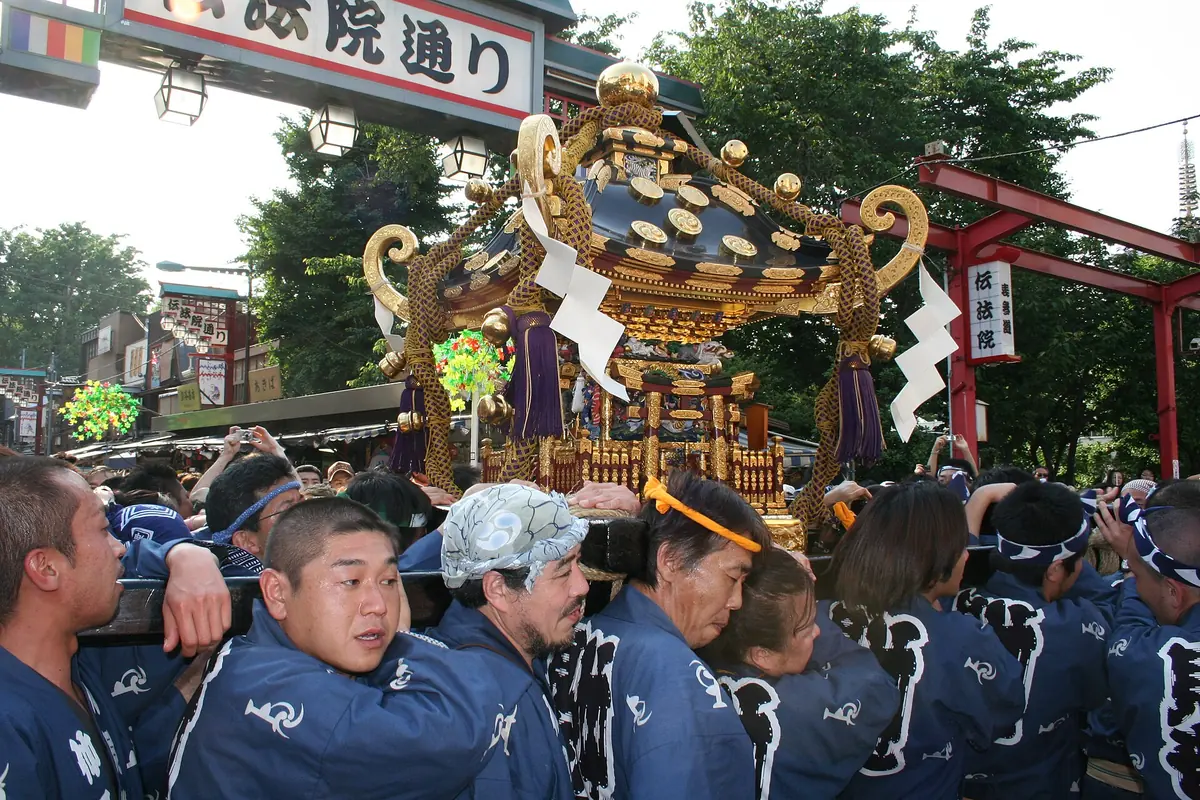
Saturday is the day of the neighbourhood mikoshi. Around a hundred portable shrines, one from each local district association, are carried through the streets and converge on Senso-ji. Each is a lacquered and gilded structure weighing a great deal, carried on the shoulders of forty or more people who are shouting, bouncing it deliberately, and being rotated out as they tire. This is the day with the most to look at.
Sunday is the big one. The three main shrine mikoshi – the ones belonging to Asakusa Shrine itself – leave the shrine at dawn and are carried through the district all day by different neighbourhoods in turn, returning after dark. The crowds are at their densest and the atmosphere at its most intense.
The shaking is not exuberance. A mikoshi carries the kami during the festival, and the violent motion is understood to energise the deity and, through it, the neighbourhood. That is why the carrying is rough and why it looks, to an outsider, faintly out of control.
How to actually see it
Go early. Saturday and Sunday mornings are busy but navigable; by the afternoon the main streets around the temple are packed solid and moving against the flow is not possible.
Watch from a side street. The mikoshi route covers the whole district, not just the approach to the temple, and a narrow residential lane two blocks off the main drag gives you the shrine passing within arm’s reach with a fraction of the crowd. Follow the sound rather than the map.
Do not bring luggage or a pushchair into the core on Sunday afternoon. Coin lockers at Asakusa station fill early on festival days.
Etiquette. Do not touch a mikoshi unless invited by the team carrying it. Photography of the procession is normal and welcome; photographing into private houses and association tents is not. Some carriers will be heavily tattooed, which in this specific context is traditional and not something to stare at or photograph as a curiosity.
Food stalls line the streets for all three days, and this is one of the better opportunities in Tokyo to eat festival food – yakisoba, takoyaki, grilled squid, shaved ice – in the setting it belongs to.
Planning around it
If the festival is the reason you are going, book accommodation early: Asakusa hotels fill for that weekend and rates rise. Staying one or two stops away on the Ginza Line is a sensible compromise.
If the festival is not the reason you are going, and you have Asakusa on your itinerary for those dates, understand what you are walking into. The temple is still there, and you will not get near it in the way you intended. Either lean into it or move that day.
The Asakusa district page covers the neighbourhood the rest of the year, and the Sumida fireworks in July are the other date that transforms this part of Tokyo. Both are free and both reward planning rather than luck.
Frequently asked questions
When is Sanja Matsuri 2026?
Friday 15, Saturday 16 and Sunday 17 May 2026, in Asakusa.
When is Sanja Matsuri 2027?
Not yet published. It is conventionally held on the third weekend of May, but we will not print a specific 2027 date until Asakusa Shrine confirms one.
Does Sanja Matsuri cost anything?
No. It is a street festival and there is nothing to book. Accommodation in Asakusa for that weekend is the only thing that costs more than usual.
Which day should I go?
Saturday for the hundred neighbourhood shrines converging on the temple, Sunday for the three main shrine mikoshi and the biggest crowds, Friday for the costumed procession and the calmest experience.
How do I avoid the worst of the crowds?
Go in the morning and watch from a residential side street a couple of blocks off the main approach. The route covers the whole district, so you do not need to be at the temple gate.
Further reading
Official sources
- Asakusa Tourism Federation – Sanja Matsuri, 15–17 May 2026 – The 2026 dates
- Asakusa Tourism Federation – Local federation listings and event announcements
- GO TOKYO – Asakusa – Official area guide