Monjayaki
Writes the route pages and owns the fare data behind them. Re-checks every segment on a quarterly sweep.
UpdatedThis page carries dated prices or seasonal forecasts checked on the date above, and that window has now passed. Re-check the sources at the foot of the page before you book anything.
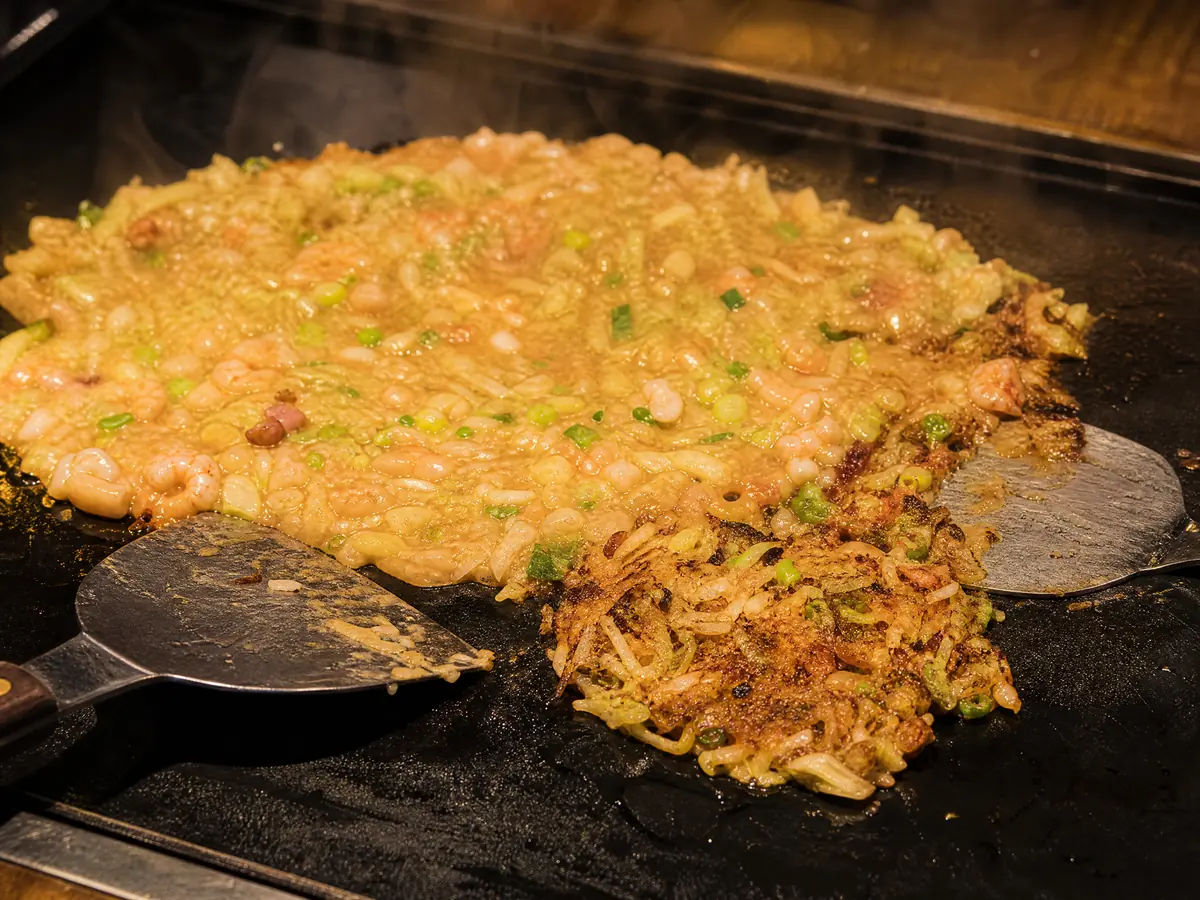
Monjayaki is the dish visitors most often decide has gone wrong. It arrives as a bowl of shredded cabbage sitting in thin brown liquid, you cook it on the hotplate yourself, and the result is a spreading, gluey, brown puddle that never becomes a pancake.
That is what it is. Monja is not okonomiyaki with a problem; it is a different dish with a different technique and a different point. Eaten correctly – in small scrapes, from a crisped base, with a tiny spatula, straight off the hotplate – it is one of the best cheap evenings in Tokyo.
At a glance
- What it is
- Cabbage and fillings in a thin dashi batter, cooked on a table hotplate and eaten straight off it in small scrapes
- Not
- Okonomiyaki. That is the Osaka and Hiroshima pancake, which sets and is cut into pieces. Monja does not set, ever
- Where
- Tsukishima Monja Street, roughly seventy monja restaurants along 400 metres
- Order first
- Mentaiko mochi cheese – cod roe, rice cake and cheese – the default Tsukishima combination
- Tools
- Two small metal spatulas called hagashi. No chopsticks, no plates
In this guide
The method, in four steps
You are given a metal bowl of cabbage and fillings sitting in dashi batter, and two small spatulas called hagashi. Staff will usually cook the first one for you if you ask, and you should ask.
1. Solids first. Tip out only the solid ingredients onto the oiled hotplate, keeping the liquid back. Chop them with the spatulas until the cabbage is finely broken up and wilted. This takes longer than you expect – two or three minutes of real chopping.
2. Build the ring. Push the solids into a circular wall, a doughnut with a hole in the middle. It needs to be tight enough to hold liquid, which is the part people get wrong.
3. Pour and thicken. Pour the reserved batter into the middle of the ring. It will bubble and thicken over a minute or two. Do not stir it yet.
4. Mix, spread, crisp. Break the wall, mix it all together, spread it thin across the plate and leave it. The base catches and goes crisp, and that crisp base is the whole reason to eat monja. Turning the heat down and waiting is the difference between a good monja and a bowl of warm paste.
Then eat: press the small spatula down onto the plate to take a scrape with some crust on it, and eat it straight off the spatula. Keep going until the plate is bare.
Where it came from
Monja is a child’s food that grew up. The ancestor is mojiyaki – batter drawn onto a hotplate in the shape of written characters – sold at sweet shops in the low city, where children were taught to write with it before eating it. The name is a corruption of that.
Through the post-war years, when wheat flour was cheap and plentiful and much else was not, it became a filling snack, then a full dish as fillings were added. It stayed local to the east of Tokyo, and specifically to Tsukishima, a reclaimed island in the Sumida estuary laid out in the 1890s.
Tsukishima Monja Street now carries something like seventy monja restaurants in four hundred metres, which is the highest concentration of a single dish anywhere in Japan. The density is partly self-reinforcing tourism and partly genuine: this is where the local version is from and the standard along the street is high because nothing mediocre survives that much competition.
What to order, and where
Mentaiko mochi cheese is the one to start with: spiced cod roe, rice cake and cheese. The mochi goes stringy, the roe brings salt and heat, and the cheese browns on the plate. It is the default Tsukishima order for a reason.
After that, mixed seafood with squid and prawn, or curry, which sounds wrong and is excellent. Two monja between two people plus a side of yakisoba on the same plate is a normal order and enough food.
Drink beer or a highball. Monja is salty, fatty and shared, and the meal is built around conversation over a hot plate for a couple of hours, which is why it does not travel well as a solo lunch.
For where to eat it, see Monja Mugi – with the sourcing caveat noted on that page – and treat Monja Street itself as the destination. Tsukishima station is on the Yurakucho and Toei Oedo lines, ten minutes from Ginza, and the district pairs naturally with an early start at the Toyosu tuna auction the next morning.
Frequently asked questions
What is the difference between monjayaki and okonomiyaki?
Okonomiyaki is a thick savoury pancake that sets and is cut into pieces. Monjayaki is a loose, wet batter that never sets and is eaten in small scrapes off the hotplate with a tiny spatula. They are different dishes, not variations.
How do you cook monjayaki?
Chop the solids on the hotplate, push them into a ring, pour the reserved batter into the middle, let it thicken, then mix and spread it thin and let the base go crisp before eating it scrape by scrape.
What should I order first?
Mentaiko mochi cheese – cod roe, rice cake and cheese. It is the standard Tsukishima combination and the best introduction to the dish.
Where do you eat monjayaki in Tokyo?
Tsukishima Monja Street, which has around seventy monja restaurants along four hundred metres, a few minutes from Tsukishima station on the Yurakucho and Toei Oedo lines.
Why is it called monjayaki?
From mojiyaki, batter drawn on a hotplate in the shape of written characters at old sweet shops, where children were taught to write with it before eating it.
Further reading
Official sources
- GO TOKYO – Tsukishima Monja Street – Official listing for the street and the dish
- SHUN GATE – tracing the roots of Tsukishima monja – Origins of monjayaki and its move from sweet shop to restaurant
- THE GATE – monjayaki origins in Tsukishima – Background on the dish and the street