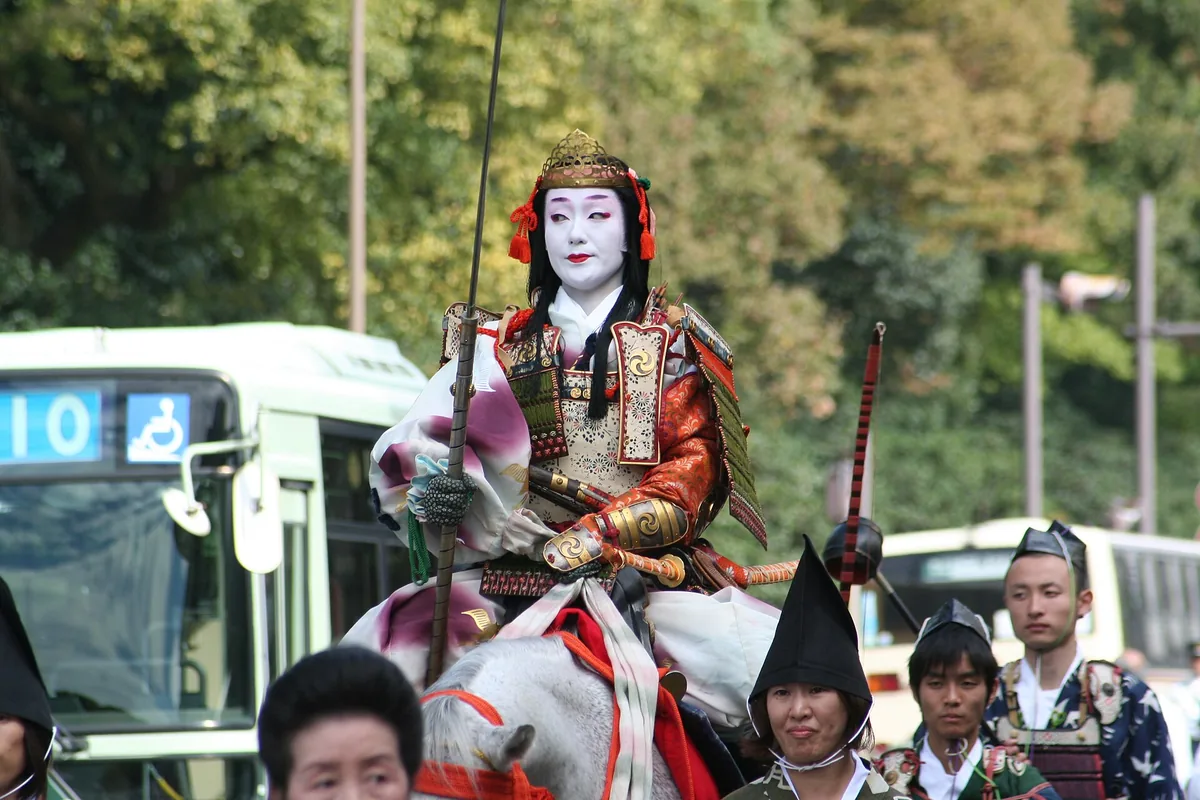
Jidai Matsuri

Writes the autumn colour pages and follows the forecasts as they are issued, which is more than one forecast.
UpdatedJidai Matsuri, the Festival of the Ages, takes place on 22 October every year, postponed to the 23rd if it rains. Around two thousand participants in costume representing twelve centuries of Kyoto history walk from the Imperial Palace to Heian-jingu, departing at noon.
The thing most itineraries miss is that the Kurama Fire Festival happens the same night, an hour north of the city. Two very different events on one date, and if you are in Kyoto on 22 October you can reasonably do both – procession in the afternoon, train north in the evening.
At a glance
- Date
- 22 October every year, postponed to the 23rd if it rains
- Departure
- The procession leaves the Kyoto Imperial Palace at noon and reaches Heian-jingu in the mid-afternoon
- Cost
- Free from the street. Paid seating is sold along parts of the route
- Same night
- The Kurama Fire Festival takes place the same evening, an hour north of the city
In this guide
What the procession is, and is not
It runs backwards through time. The column opens with the Meiji Restoration of 1868 and works steadily back through Edo, Azuchi-Momoyama, Muromachi, Kamakura and Heian, ending with the eighth century. Around two thousand people, two kilometres of column, two hours to pass a given point.
The costumes are the point and they are serious work. Every garment is reconstructed from documentary sources using period techniques and materials, and the sets are maintained and remade continuously by Kyoto workshops. Watching a Heian court lady’s twelve-layer junihitoe go past is watching a piece of research.
It is also, and this is worth being honest about, a modern festival. It was created in 1895 to mark the eleven-hundredth anniversary of the founding of the capital and to console a city that had just lost the emperor and the court to Tokyo. Set against Gion Matsuri, which has been running for over a thousand years and is still organised by the neighbourhoods that own the floats, this is a civic pageant. A very good one, but a pageant.
Where to watch
The route runs from the Imperial Palace south along Karasuma, east along Oike, down Kawaramachi and Sanjo, and across to Heian-jingu in Okazaki, arriving mid-afternoon.
The palace grounds at the start are the best free position: the column forms up on gravel with space around it, and you can see the costumes properly instead of over shoulders. The downtown stretch along Oike and Kawaramachi is the most crowded. Paid seating is sold along parts of the route, including in the palace grounds and on Oike.
Okazaki at the far end is worth considering for a different reason: the Kyocera Museum is beside Heian-jingu, its roof terrace is free, and it stays open to 18:00 – which makes it somewhere to be when the procession arrives and somewhere to go afterwards.
The Kurama Fire Festival, the same night
Kurama is a small mountain village about an hour north of Kyoto on the Eizan line. On the evening of 22 October it lines its single street with burning braziers, and men in traditional dress carry enormous flaming pine torches – some weighing over a hundred kilograms – up the hill to Yuki Shrine. It is loud, extremely hot, and genuinely startling.
It is also seriously difficult logistically. The village is tiny, the Eizan line is the only realistic way in and out, and the crowd substantially exceeds what the railway can move. Expect queues of an hour or more to get out afterwards, entry restrictions at the station, and to be standing in a controlled one-way flow rather than wandering.
If you are choosing between the two, Kurama is the more remarkable event and Jidai Matsuri is the more comfortable one. Doing both means the procession until about two, back into the city, then north on the Eizan line in the late afternoon – and a very late night. Check the Eizan Railway’s own arrangements before committing, because they change the timetable and impose entry controls for this one evening.
Frequently asked questions
When is Jidai Matsuri?
22 October every year, postponed to 23 October if it rains. The procession leaves the Kyoto Imperial Palace at noon and reaches Heian-jingu in the mid-afternoon.
How much does it cost to watch?
Nothing from the street. Paid seating is sold along parts of the route, including in the Imperial Palace grounds and along Oike-dori.
Where is the best place to watch?
The Imperial Palace grounds at the start, where the column forms up on open gravel and you can see the costumes properly. The downtown stretch along Oike and Kawaramachi is the most crowded.
How old is the festival?
It began in 1895, to mark eleven hundred years since the founding of the capital. It is a modern civic pageant rather than an ancient rite – Gion Matsuri in July is the genuinely old festival.
What is the Kurama Fire Festival?
A torch festival held the same night, 22 October, in a mountain village an hour north of Kyoto on the Eizan line. Enormous burning pine torches are carried up to Yuki Shrine. It is spectacular and logistically difficult – the railway is the only way in and out and it is overwhelmed.
Further reading
Official sources
- Heian-jingu (official) – The shrine that holds Jidai Matsuri and the procession’s destination
- Kyoto City official travel guide – City tourism guidance on the October festival calendar and route arrangements