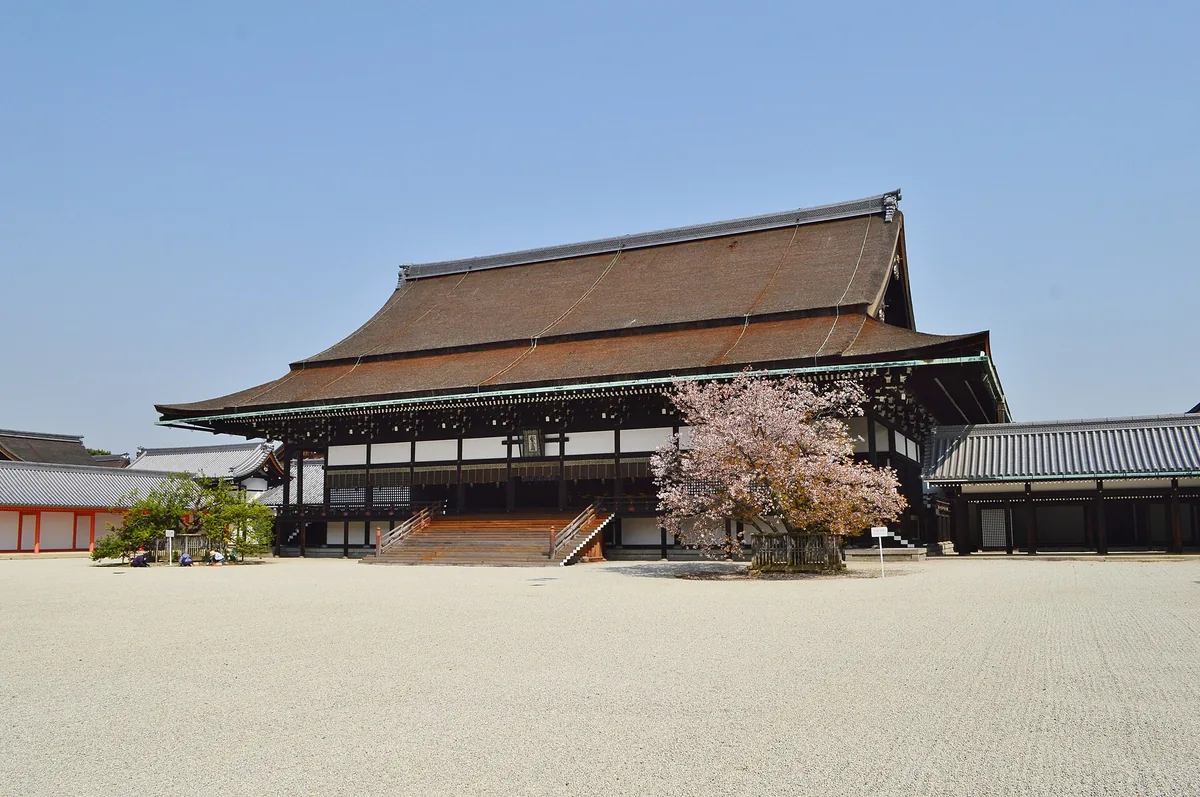
Kyoto Imperial Palace
Writes the route pages and owns the fare data behind them. Re-checks every segment on a quarterly sweep.
UpdatedThe Kyoto Imperial Palace is free and needs no reservation. You turn up, go through a bag check, and walk in.
That is worth saying plainly because for most of the last century it was not true. Visits used to require an application to the Imperial Household Agency, in advance, with a passport, and an enormous amount of published guidance still describes that system. Free walk-in access has been the arrangement for years now. If a guide tells you to apply online, it is out of date.
At a glance
- Admission
- Free, with no reservation required. You join the entry queue, pass a security check and walk the route
- Closed
- Mondays, or the following Tuesday when the Monday is a public holiday, and 28 December to 4 January. Occasional unannounced closures for court functions and weather
- Guided tours
- Free, in Japanese four times a day and in English and Chinese twice. A free multilingual audio-guide app covers self-guided visits
- Important
- None of the palace buildings can be entered. The route is entirely outdoors
In this guide
What the visit consists of
A marked route of about a kilometre through the palace enclosure, past the major ceremonial buildings. The centrepiece is the Shishinden, the hall of state where emperors were enthroned, standing alone on a white gravel court with a cherry tree on one side and a citrus on the other. Then the Seiryoden, the Kogosho, the Oikeniwa garden with its pond and bridges, and the Otsunegoten residential hall.
You do not go inside anything. The Imperial Household Agency is explicit about this: none of the palace buildings can be entered. You look through open doors and from verandas. For some people that is a disappointment; for others the architecture read from outside, in its own courtyards and at its own scale, is the more legible experience.
A word on age: the buildings are nineteenth-century reconstructions, rebuilt in 1855 after the last of many fires, in the Heian style rather than as Heian originals. The site is not even the original site – the palace shifted east from the true Heian-kyo location centuries ago. What it is, accurately, is the best available reconstruction of a courtly architecture that nothing else preserves.
The park around it, which is the underrated part
The palace sits inside Kyoto Gyoen, a walled park of around ninety hectares in the middle of the city, open at all hours and entirely free. Before the Restoration this was a dense quarter of two hundred aristocratic residences; when the court moved to Tokyo they were cleared, and what remains is gravel avenues, enormous pines, orchards and a great deal of space.
It is the only large flat green space in central Kyoto and it is startlingly empty given where it is. The weeping cherries at the north end flower a week or so before the rest of the city, which makes the park a useful hedge if your dates are early, and the plum grove in the south-west runs from late February.
Two other enclosures inside the park – the Sento Imperial Palace and the Omiya Palace – do still require advance application, with age restrictions. It is the confusion between these and the main palace that keeps the ‘you must book’ advice alive.
Practicalities
Nearest station is Imadegawa on the Karasuma subway line, right by the north-west corner. Marutamachi at the south-west corner works for the park. Entry to the palace itself is through the Seishomon gate on the west side.
Allow an hour for the palace route, or two if you take the free guided tour – four daily in Japanese, twice daily in English and Chinese, and an audio-guide app for everyone else. The information desk is open 8:40 to 17:00 and is closed on Mondays with the palace.
The whole visit is outdoors on gravel, so comfortable shoes matter and rain is a genuine problem – on a wet day swap it for Sanjusangendo or the National Museum. It pairs naturally with Nijo Castle, fifteen minutes south-west, which is instructive: the shogun’s palace, which you walk through, against the emperor’s, which you do not.
Frequently asked questions
Do you need to book the Kyoto Imperial Palace?
No. Admission is free and no reservation is required – you join the entry queue at the Seishomon gate and pass a security check. Advice telling you to apply in advance to the Imperial Household Agency is out of date for the main palace.
How much does it cost?
Nothing. It is free, as is the surrounding Kyoto Gyoen park.
What days is it closed?
Mondays, or the following Tuesday if the Monday is a public holiday, and 28 December to 4 January. It can also close at short notice for court functions, visits by dignitaries or bad weather.
Can you go inside the buildings?
No. The Imperial Household Agency states plainly that none of the palace buildings can be entered. The whole route is outdoors, looking at the halls from their courtyards and verandas.
Are there guided tours?
Yes, free of charge – four times a day in Japanese and twice a day in English and Chinese. There is also a free multilingual audio-guide app for self-guided visits.
Further reading
Official sources
- Kyoto Imperial Palace – visit information (Imperial Household Agency) – Free admission with no reservation, Monday closures, guided tour schedule, and confirmation that no palace buildings can be entered
- Imperial Household Agency – visiting the palaces and villas – The separate advance-application system that still applies to Sento Imperial Palace and the imperial villas