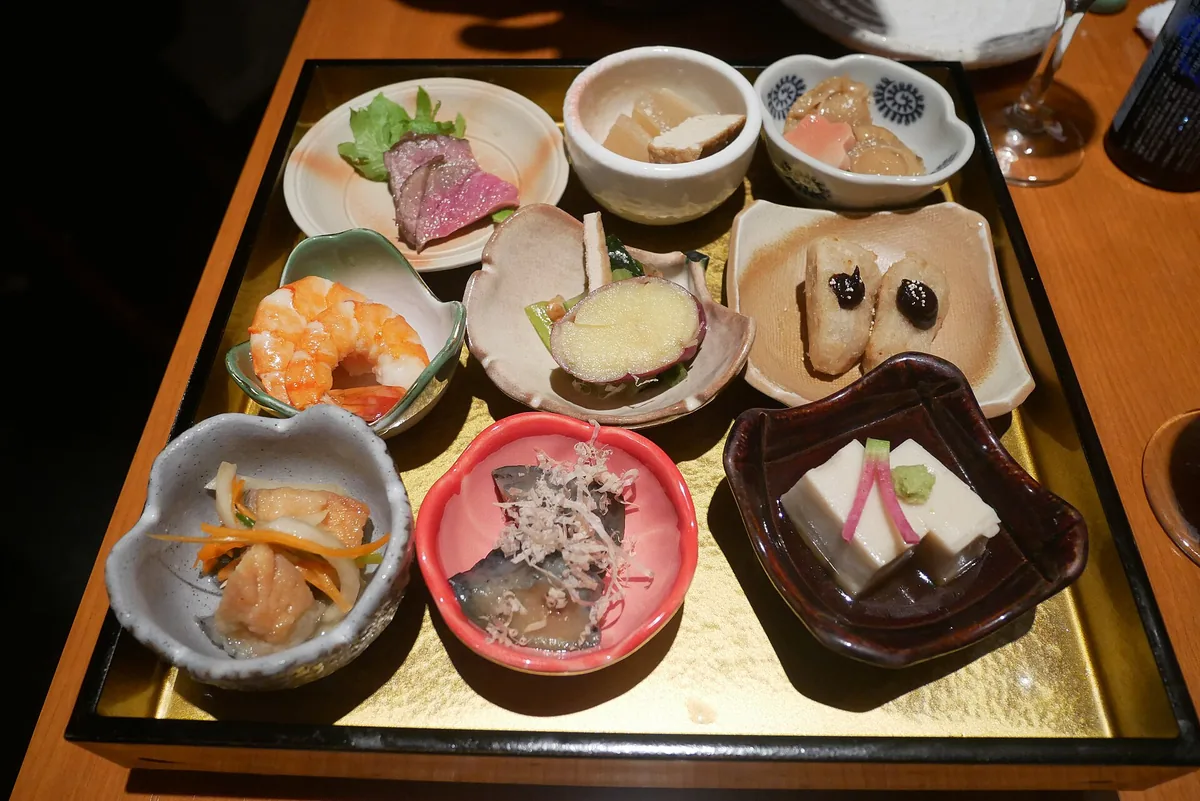
Obanzai

Writes the logistics pages. Works to one rule: a price comes from the company that charges it.
UpdatedObanzai is Kyoto’s home cooking: vegetables, tofu, fu and dried fish, simmered or dressed in the morning and eaten at room temperature through the day. It is the everyday counterpart to kaiseki and, in terms of what the city has actually eaten for four hundred years, much the more representative of the two.
The distinction that matters when you are choosing where to eat it: real obanzai is laid out and ordered dish by dish. The tourist version compresses it into a fixed tray of nine little bowls, which is convenient, photographs well, and removes the only thing that makes the format interesting – choosing six things from a counter of twenty.
At a glance
- What it is
- Kyoto household cooking – seasonal vegetables, tofu, fu, yuba and preserved fish, cooked in quantity and served at room temperature
- How it is served
- Laid out on a counter and ordered dish by dish, rather than on a set tray
- Where
- Small counters in the downtown grid, Nakagyo and around Pontocho
- Cost
- Izakaya rather than restaurant prices, though few places publish a list because you order individually
In this guide
What is actually on the counter
The vocabulary is narrow and specific, because it is built from what a landlocked basin city could reliably get. Kyoto vegetables – kyo-yasai – are the base: kamo aubergine, shogoin turnip, mizuna, kujo negi, ebi-imo. Then tofu, yuba, and fu, the wheat gluten that provides texture where meat would. Then preserved fish: dried herring, salted mackerel, small dried sardines simmered in soy.
Techniques are simple and repetitive. Things are simmered gently in a light dashi (takiawase), dressed with sesame or miso (aemono), or lightly pickled. Almost nothing is fried and nothing is grilled hard. Seasoning is restrained even by Japanese standards – Kyoto uses light soy sauce, usukuchi, which is saltier but paler, so the dish keeps the colour of the vegetable.
Two traditional habits that you will still see: dishes tied to particular days of the month, and a strong preference for cooking once and eating over two or three days. Obanzai is frugal food from a city that had to be, and the thrift is visible in the dishes rather than hidden.
How to order it
Go to a counter where the dishes are visible in bowls in front of you and point. Six to eight small dishes is a dinner. Order in two rounds rather than all at once – take four, decide what you liked, take four more.
If you are eating alone, look for a place that will do half portions, which is rarer than it should be and transforms the experience. Kikkoya in Nakagyo does, which makes it one of the better solo dinners in the city – with the significant caveat that it has no non-smoking area at all.
Drink sake or beer. Obanzai is bar food in the structural sense: it is designed to be eaten slowly alongside drinking, at room temperature, over two hours. It is not designed to arrive hot, and food that has been sitting out is the format working correctly rather than a sign of a lazy kitchen.
Where to find it, and where not to
The downtown grid is where the real counters are: Nakagyo, the streets around Pontocho and Kiyamachi, and the lanes off Karasuma. Look for small places with a counter, a handwritten board and no English photographs outside. They are frequently the ones with no published prices, because you order dish by dish and the bill depends on what you took.
Be sceptical of anywhere in the Gion or Higashiyama tourist corridor advertising an obanzai set at a fixed price with a picture menu. That is a bento of obanzai-ish items, and while it is not a swindle, it is not the thing.
The related pleasure is shopping for the ingredients. Nishiki Market is where this cooking comes from – the pickle stalls, the tofu makers, the dried fish counters are all supplying exactly these dishes. Walk it in the morning, eat obanzai in the evening, and the second makes considerably more sense for having done the first. Just do not eat as you walk through the market itself; that is prohibited.
Frequently asked questions
What is obanzai?
Kyoto home cooking: seasonal vegetables, tofu, fu, yuba and preserved fish, simmered or dressed in the morning and served at room temperature. It is the everyday counterpart to formal kaiseki.
How is it different from kaiseki?
Kaiseki is a fixed sequence of courses served in order by a kitchen. Obanzai is a counter of finished dishes from which you choose. One is a performance, the other is dinner.
Why is the food not hot?
Because it is not meant to be. Obanzai is cooked in quantity and eaten at room temperature over the course of a day, which is the point of the form rather than a failure of service.
How much does obanzai cost?
Izakaya prices rather than restaurant prices, but few places publish a list because you order dish by dish and the bill depends on how many you take. Six to eight small dishes makes a dinner.
Where should you eat it?
At a counter in the downtown grid – Nakagyo, or the lanes around Pontocho and Kiyamachi – where the dishes are visible in bowls and you order them individually. Fixed-price obanzai trays with picture menus in the tourist corridor are a different and lesser thing.
Further reading
Official sources
- Nishiki Market shopping street association (official) – The market that supplies obanzai ingredients: pickles, tofu, yuba and dried fish
- Inside Kyoto – Kikkoya – A downtown obanzai counter with half portions for solo diners and no non-smoking area