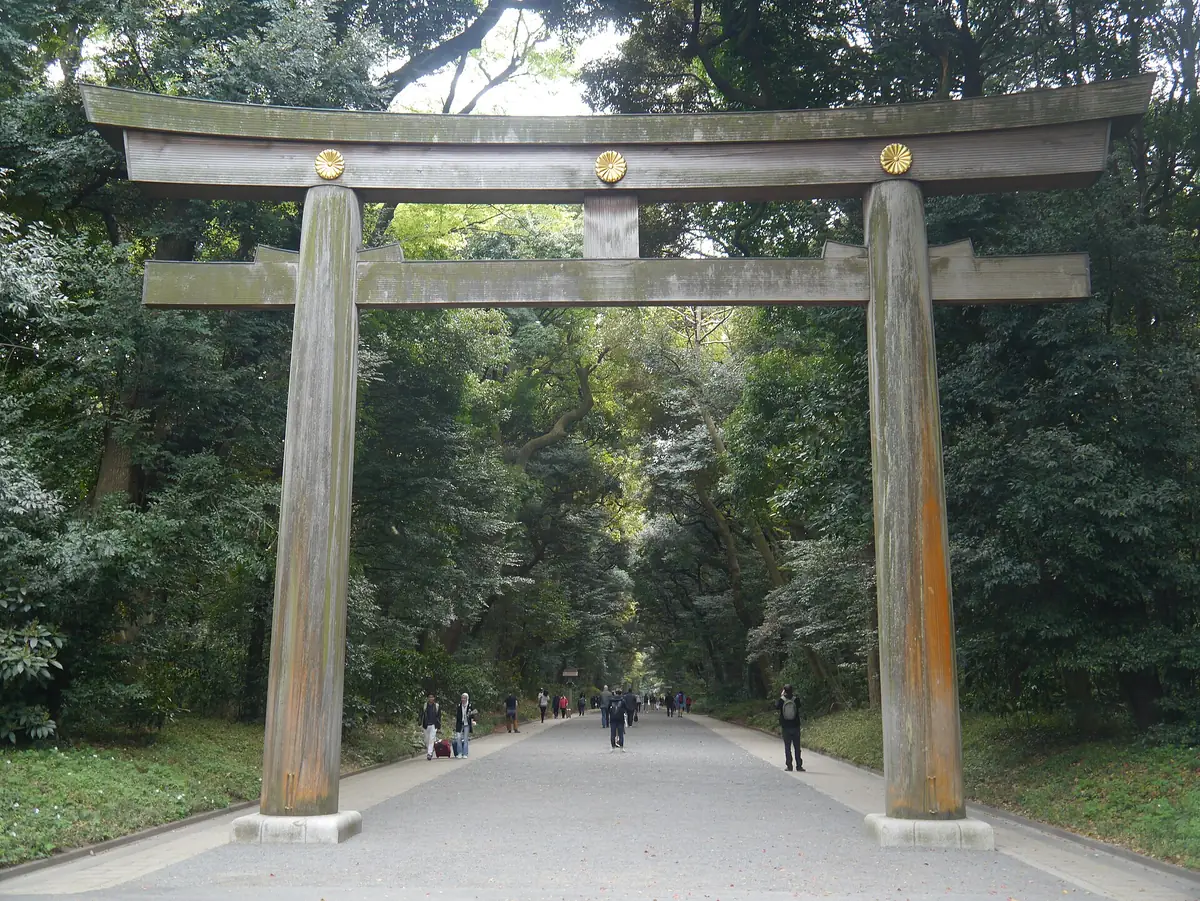
Meiji Jingu

Writes the autumn colour pages and follows the forecasts as they are issued, which is more than one forecast.
UpdatedThis page carries dated prices or seasonal forecasts checked on the date above, and that window has now passed. Re-check the sources at the foot of the page before you book anything.
Meiji Jingu is free, and the thing that catches people out is not the price but the clock. The shrine opens with sunrise and closes with sunset. It does not keep a fixed schedule, and in December the gates shut at about 16:00. A 15:30 arrival in winter gives you half a kilometre of gravel approach and a closed gate at the end of it.
The other half of the problem is that the facilities inside the grounds run on office hours – roughly 09:00 to 16:00 – so in June you can be walking the forest at 18:00 with the museum, the garden and the amulet office all long shut. The grounds and the things in the grounds are two different timetables and only one of them tracks the sun.
At a glance
- Admission
- Shrine grounds free; Inner Garden ¥500; Meiji Jingu Museum ¥500
- Hours
- Opens with sunrise and closes with sunset, so the gate times change every month – roughly 06:40–16:20 in January and 05:00–18:30 in June
- Inside facilities
- Museum, garden and offices keep shorter hours, generally 09:00–16:00
- Getting there
- Harajuku (JR Yamanote) or Meiji-jingumae (Chiyoda, Fukutoshin) at the south gate; Yoyogi or Sangubashi for the north
In this guide
The forest is the point, not the building
The shrine building is a 1958 reconstruction; the 1920 original burned in 1945. What is actually remarkable here is the wood you walk through to reach it. Around 100,000 trees of roughly 365 species were donated from across Japan and the empire and planted by volunteers in the 1910s and 1920s, on what had been bare and largely marshy ground.
It was designed as a chinju no mori, a shrine forest, and specifically designed to become self-sustaining and to look, within a century or so, as though nobody had planted it. That century is up. The canopy you walk under now is the intended final state of a hundred-year landscape plan, which is a rarer thing to be standing in than any of the buildings.
Practically, it means that the seven hundred metres from the Harajuku torii to the main hall is the visit. Walk it slowly. It is one of the few places in central Tokyo where the traffic noise actually stops, and it is about eleven degrees of subjective difference from Takeshita-dori, which is three minutes away.
The two things that cost ¥500
The Inner Garden (Gyoen) is ¥500 and is worth it in exactly one window: early to mid June, when the iris garden is out. It has around 150 varieties, it was laid out for the Empress Shoken, and for those two or three weeks it is one of the best things in the city. Outside that window it is a pleasant pond and a well of clear water, and ¥500 is a fair price for somewhere to sit rather than a reason to come.
The Meiji Jingu Museum is also ¥500, a low timber Kengo Kuma building near the south entrance holding possessions of the Emperor Meiji and Empress Shoken – including the carriage used for the 1889 promulgation of the constitution. It is small, it takes forty minutes, and it closes well before the grounds do.
Both are optional. The free walk is the reason to come, and a visit that spends nothing here is not a lesser visit.
How to time it, and what to put next to it
Go early. The shrine opens at first light, the approach is empty, and if you arrive before 09:00 on a Saturday or Sunday there is a real chance of seeing a Shinto wedding procession cross the main courtyard under a red parasol. That is not staged for visitors; it is simply when weddings happen here.
The 1 to 3 January period is the single busiest religious event in Japan – several million people come for hatsumode, the first shrine visit of the year, and the approach becomes a managed one-way queue. It is an extraordinary thing to witness and a terrible thing to schedule casually.
Pair it with Shibuya to the south rather than with another temple. The point of Meiji Jingu is contrast, and the walk from the north gate down through Harajuku to the Scramble Crossing compresses a century of Tokyo into twenty-five minutes. The Nezu Museum garden, twenty minutes east, is the other good half of a green day.
Frequently asked questions
How much does Meiji Jingu cost?
The shrine grounds are free. The Inner Garden is ¥500 and the Meiji Jingu Museum is ¥500, each paid separately.
What time does Meiji Jingu close?
At sunset, which means the closing time changes every month. It is around 16:00 in December and as late as 18:30 in June. The official monthly table is on the shrine's own visiting page.
Can I visit Meiji Jingu in the evening?
No. Unlike Senso-ji, the grounds are gated and close with the sun. There is no night access and no illumination visit.
Is the Inner Garden worth 500 yen?
In early to mid June, when roughly 150 varieties of iris are flowering, yes. The rest of the year it is a quiet pond garden and an optional extra rather than a highlight.
How long does Meiji Jingu take?
About an hour for the forest approach and the main courtyard at an unhurried pace. Add forty minutes for the museum and twenty to thirty for the Inner Garden.
Further reading
Official sources
- Meiji Jingu – how to visit (official) – Monthly sunrise and sunset gate times, and the 09:00-16:00 facility hours
- Meiji Jingu – questions and answers (official) – Admission, the Inner Garden and the museum
- GO TOKYO – Shibuya – Tokyo Convention and Visitors Bureau area guide, including Harajuku