Shibuya
Writes the route pages and owns the fare data behind them. Re-checks every segment on a quarterly sweep.
UpdatedThis page carries dated prices or seasonal forecasts checked on the date above, and that window has now passed. Re-check the sources at the foot of the page before you book anything.
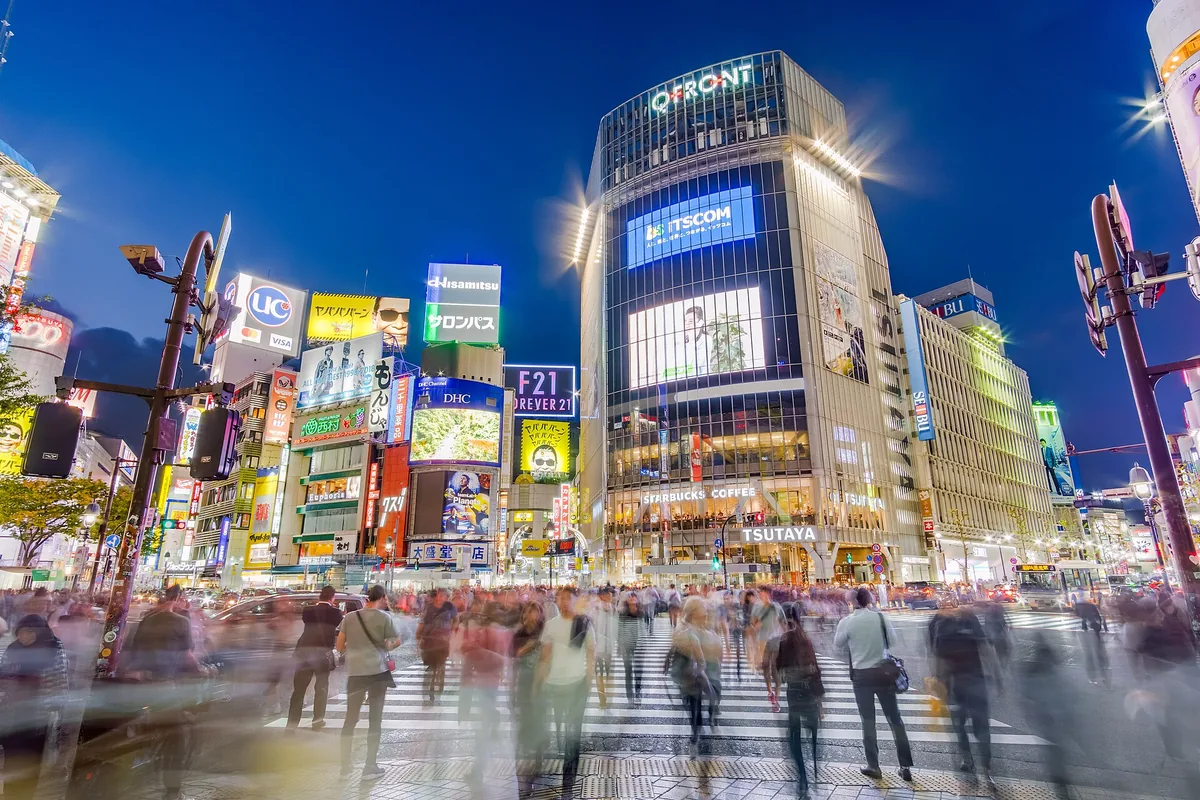
Shibuya is a railway junction that turned into a spectacle. The Scramble Crossing outside the Hachiko exit stops traffic in all directions at once and releases a reported one to three thousand people across it in a cycle, and it is free, permanent and requires no planning at all.
Everything else in Shibuya is, in one way or another, selling you a better angle on that. Shibuya Sky is ¥2,700 online before 15:00 and ¥3,400 from 15:00. The Starbucks in the Tsutaya building is the price of a coffee and has no seats free. The Mark City walkway is free and slightly off-axis. Knowing which of those you actually want is most of a good evening here.
At a glance
- Getting there
- Shibuya station on the JR Yamanote and Saikyo lines, Ginza, Hanzomon and Fukutoshin subways, Tokyu and Keio lines
- The crossing
- Free, and best from about 18:00 when the lights come on and the office exodus starts
- Paid view
- Shibuya Sky, ¥2,700 online before 15:00 and ¥3,400 from 15:00
- Free view
- The Starbucks window in Tsutaya, and the second-floor walkway at Shibuya Mark City – both free, both crowded
- Note
- The station has been under redevelopment for years; signage changes and the exit you used last time may not exist
In this guide
The crossing, and where to watch it from
Go at night. The crossing in daylight is a busy road junction; the crossing at 19:00 on a Friday, with the screens lit and rain on the tarmac, is the image that put it in every film about Tokyo. Weekend evenings are denser than weekday ones and the density is the show.
From street level, stand at the Hachiko corner and cross it yourself, twice, in different directions. This is underrated. Being inside the flow is a different thing from photographing it.
From the Tsutaya Starbucks on the second floor, you get the classic head-on view through glass. It is free with a drink, there is usually a queue for the window counter, and a lot of people spend forty minutes acquiring a photograph that they could have taken from the pedestrian bridge in four.
From Shibuya Sky at 229 metres, you get the crossing from almost overhead and the city to the horizon, on an open roof – which is superb, and which closes in rain or high wind with no refund. That one caveat is the reason the sight has its own page.
Hachiko, the bronze dog, is on the corner. It is small, it is always surrounded, and the story – a dog that met his owner at this station every evening and kept coming for nine years after the man died – is why Japanese visitors stop at it and foreign visitors photograph it without knowing why.
The parts of Shibuya that are not the junction
Walk five minutes and the character changes completely. Miyashita Park, north of the station, is a rooftop park over a shopping street with a food alley underneath it that is open late and unusually good. Udagawacho and Maruyamacho, up the hill west of the crossing, hold the live houses, clubs and record shops that are the actual cultural substance of the district.
North-east, Harajuku and Takeshita-dori are one station or a twelve-minute walk; Omotesando, the boulevard between them, is the architecture strip and is free to walk. From Harajuku it is two minutes into Meiji Jingu, which is the best contrast available in Tokyo: the busiest crossing on earth and a hundred-thousand-tree forest, fifteen minutes apart.
Shibuya Yokocho in Miyashita Park and the lanes behind Center-gai are where to eat and drink cheaply. The Millennials is the obvious place to stay if you want to be inside this rather than looking at it.
The station is the hard part
Shibuya station has been under continuous redevelopment for well over a decade and it is genuinely confusing. Lines sit at different levels, the Ginza Line platform moved, the Saikyo Line platforms moved, and signage that was correct on your last visit may not be now. Allow ten minutes more than you think for any connection here, and follow the line-colour signs rather than memory.
The Hachiko exit is the one that puts you at the crossing, and it is the single most useful thing to know. If you surface anywhere else, follow the crowd.
One money note. JR East raised its fares on 14 March 2026, by around 7.8 per cent – the first revision in thirty-nine years – so every Yamanote Line fare figure published before spring 2026 understates what you will actually pay. Tap an IC card and stop thinking about it; sales restrictions on Suica and PASMO ended on 1 March 2025 and the cards are freely available again.
Frequently asked questions
When is the best time to see Shibuya Crossing?
After dark, from about 18:00, and best on a Friday or Saturday evening. Daylight makes it an ordinary junction; the screens and the volume of people are what make it worth standing there.
Is there a free view of Shibuya Crossing?
Yes. The second-floor Starbucks in the Tsutaya building is free with a drink but usually full, and the Mark City pedestrian walkway is free and gives a slightly off-axis view. Shibuya Sky is the paid option at ¥2,700 or ¥3,400.
How do I find the Shibuya Crossing from the station?
Follow signs to the Hachiko exit. The station is in the middle of a long redevelopment and other exits can put you several streets away.
What else is there to do in Shibuya?
Miyashita Park and its food alley, the record shops and live houses up the hill in Udagawacho, the Omotesando architecture walk, and Meiji Jingu fifteen minutes north.
Have Tokyo train fares gone up?
Yes. JR East raised fares by about 7.8 per cent on 14 March 2026, its first revision in thirty-nine years, so any fare figure published before spring 2026 is understated.
Further reading
Official sources
- GO TOKYO – Shibuya – Official Tokyo Convention and Visitors Bureau area guide
- SHIBUYA SKY (official) – Observation deck prices and timed entry
- JR East – fare revision application (press release, PDF) – The revision implemented on 14 March 2026
- JR East – Suica – Card availability and use