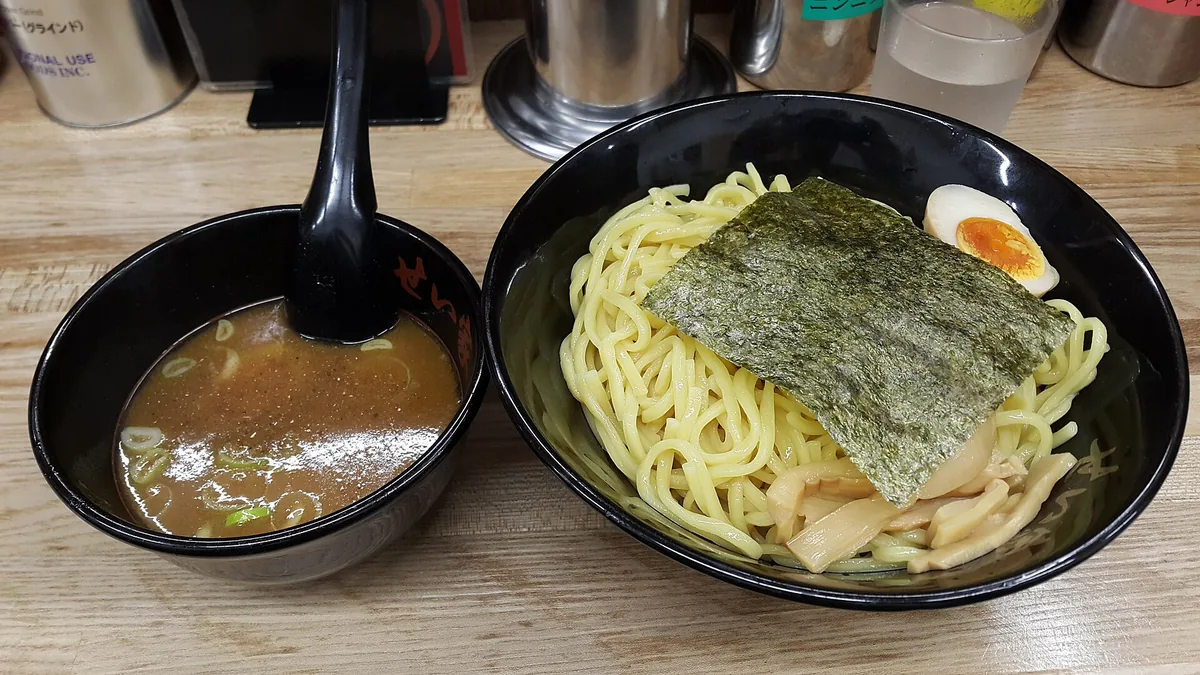
Tsukemen
Writes the route pages and owns the fare data behind them. Re-checks every segment on a quarterly sweep.
UpdatedThis page carries dated prices or seasonal forecasts checked on the date above, and that window has now passed. Re-check the sources at the foot of the page before you book anything.
Tsukemen is Tokyo’s contribution to ramen: the noodles come cooked and rinsed cold in one bowl, the soup comes hot and concentrated in another, and you dip. It was invented by Kazuo Yamagishi at Higashi-Ikebukuro Taishoken, and he is known in Japan as the god of ramen largely because of it.
The date is where guides start disagreeing with each other. Some accounts put the first version in 1955, when Yamagishi was dipping offcut noodles into leftover broth for his own lunch; others date it to 1961, when it went on the menu as a sold dish. Rather than pick one and print it as fact, the honest formulation is that it emerged in the mid-1950s and was on the menu by the early 1960s.
At a glance
- What it is
- Noodles served cold and separate from a small bowl of very concentrated hot broth, dipped a few strands at a time
- Invented by
- Kazuo Yamagishi, at Higashi-Ikebukuro Taishoken in Tokyo
- When
- Sources disagree. Accounts point to the mid-1950s, and it was on the menu by the early 1960s. We do not pick a year
- The broth
- Usually gyokai-tonkotsu – pork bone plus dried fish – reduced until it clings to the noodle
- Finish with
- Soup-wari: ask for hot stock to thin what is left and drink it
In this guide
Why separating the soup works
The problem tsukemen solves is that ramen noodles start dying the moment they hit the soup. Eight minutes into a bowl the texture has gone soft and the last third is worse than the first. Take the noodle out of the soup and it stays firm to the end.
That allows two other changes. The noodles can be much thicker, because they are not relying on the soup to carry flavour and they can be chewy in a way a soup noodle cannot. And the broth can be far more concentrated, because you are only taking a coating of it with each mouthful rather than drinking a bowl of it.
The result is a dish with more texture and more intensity than soup ramen, and one that works much better in summer, since only the broth is hot. In a Tokyo August that matters.
The standard modern broth is gyokai-tonkotsu: pork bone stock combined with dried fish, typically bonito and sardine, cooked down until it is close to a sauce. The fish gives it the marine depth that distinguishes Tokyo tsukemen from a straightforwardly porky bowl.
How to eat it properly
Dip a few strands at a time. Not the whole nest. The broth is intended to coat, and drowning a large quantity of noodle in it makes the dish salty and heavy and empties the bowl before you have finished.
Ask for the noodles warm if you want. Many shops offer atsumori, noodles rinsed and then re-warmed, which is the better order on a cold day – the standard cold noodle chills the broth quickly in winter.
Extra noodles cost nothing at many shops, but must be requested when you order, not when you run out. Look for omori on the ticket machine.
Finish with soup-wari. When the noodles are gone, pass the dipping bowl back and ask for soup-wari. The counter adds hot stock to thin the remaining broth so you can drink it as soup. It is included, it is the intended end of the meal, and the great majority of foreign visitors never do it.
Where to eat it
Taishoken, in its various successor shops around Higashi-Ikebukuro and beyond, is the historical answer – Yamagishi trained a very large number of cooks who went on to open their own places, which is why the Taishoken name appears all over Tokyo in shops with no corporate relationship to one another.
Rokurinsha is the modern standard-setter and the most convenient, with a branch in Tokyo Station’s Ramen Street – noting that the Osaki main shop and the station branch are different outlets with different hours, which is a distinction a lot of guides miss.
For soup ramen rather than dipping noodles, Nakiryu is the Bib Gourmand counter to know about. And the general rules apply at any of them: buy from the ticket machine, carry cash, eat and go.
Frequently asked questions
Who invented tsukemen?
Kazuo Yamagishi, at Higashi-Ikebukuro Taishoken in Tokyo. He is widely known in Japan as the god of ramen.
When was tsukemen invented?
Sources disagree, giving dates from 1955 to 1961. The defensible statement is that it emerged in the mid-1950s and was on the menu by the early 1960s. Anyone printing a single year is choosing between conflicting accounts.
What is the difference between tsukemen and ramen?
In tsukemen the noodles are served cold and separate from a small bowl of concentrated hot broth and are dipped a few strands at a time, so they stay firm and the broth can be far more intense.
What is soup-wari?
Hot stock added to your leftover dipping broth at the end so you can drink it. Hand the bowl back and ask for it; it is included and it is the intended finish to the meal.
Should I order the noodles cold or warm?
Cold is standard. In winter, ask for atsumori – warmed noodles – because cold noodles chill the dipping broth quickly.
Further reading
Official sources
- The Japan Times – how Tokyo’s deconstructed ramen became a national favourite – Taishoken, Yamagishi and the spread of tsukemen
- Wikipedia – Kazuo Yamagishi – Biography, with the conflicting invention dates visible in the sourcing
- Wikipedia – Tsukemen – Dish overview and disputed chronology