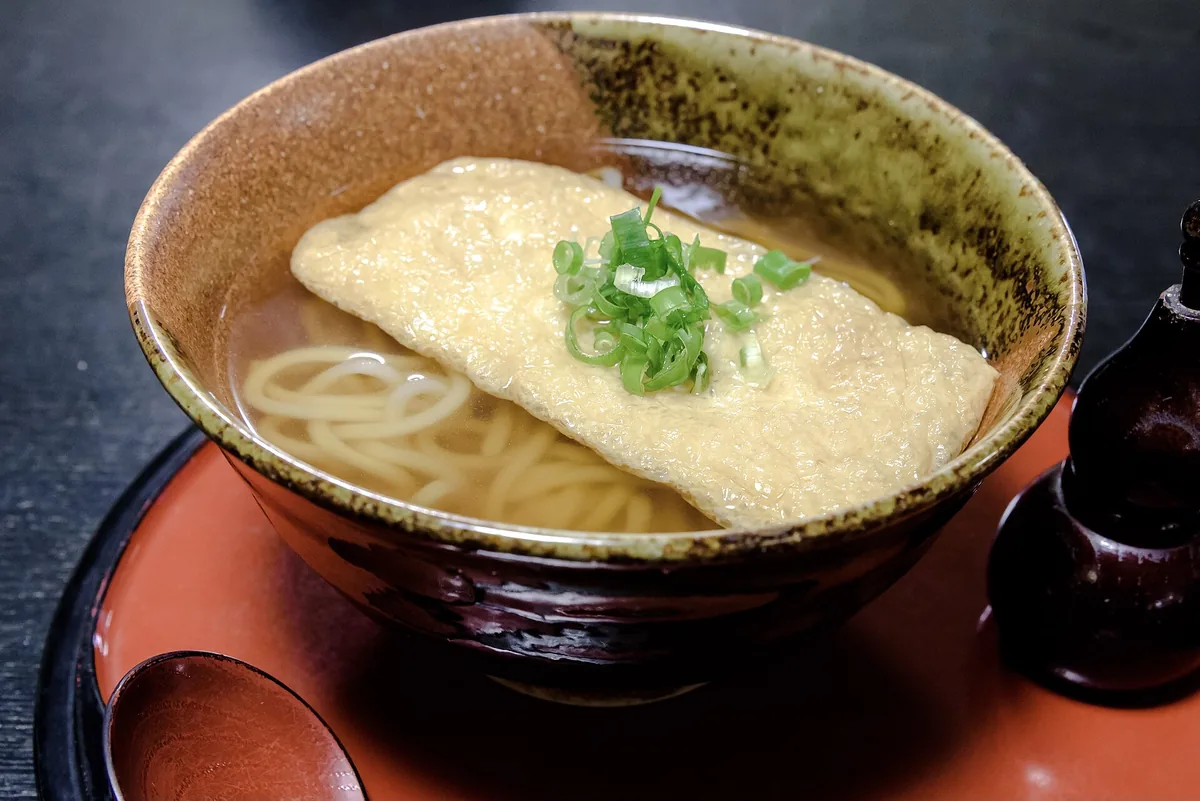
Kitsune udon

Writes the logistics pages. Works to one rule: a price comes from the company that charges it.
UpdatedKitsune udon is soft udon in a pale broth with a single sheet of aburaage – thin deep-fried tofu, simmered in sugar, mirin and soy until it is sweet and saturated – laid over the top. It costs ¥500 to ¥900 in any ordinary shop and it is the dish that explains Kansai cooking faster than anything else on a menu.
The invention is credited to Usami-tei Matsubaya in Osaka in 1893. That is worth stating carefully: it is the restaurant’s own claim, widely repeated but not independently established, and we were not able to verify that shop’s current address, opening hours or prices. So this page does not print them. Sending you to a specific counter on unverified details is worse than telling you the dish is everywhere, which it is.
At a glance
- What it is
- Udon in a pale kombu-and-light-soy broth, topped with a sheet of aburaage simmered in sugar and soy
- Origin
- Credited to Usami-tei Matsubaya in Osaka, 1893. This is the restaurant’s own claim
- Unverified
- We could not confirm that restaurant’s current address, hours or prices, so this page does not print them
- Cost
- ¥500–¥900 in an ordinary udon shop
In this guide
The broth is the whole argument
Kansai and Kanto part company over dashi, and udon is where you can taste it. A Tokyo udon broth is dark: katsuobushi-led, with dark soy, and it looks like weak coffee. An Osaka broth is pale gold and nearly clear – kombu-forward, with light usukuchi soy that is saltier but far less coloured, and often a mixture of dried fish rather than bonito alone.
The result is a broth you are expected to drink rather than leave. It is subtler, more saline, and considerably harder to make well, because there is nothing to hide behind: no caramel colour, no heavy soy. Order kitsune udon in Osaka and in Tokyo in the same week and the two bowls barely look related.
The noodles are part of it. Osaka udon is softer than the famously chewy Sanuki udon of Kagawa – deliberately, not sloppily. The bowl is supposed to be gentle, and people who arrive expecting Sanuki’s springiness read the softness as a fault when it is the local style.
The fox, and the naming
Kitsune means fox. Aburaage is the offering left at Inari shrines, where the fox is the messenger of the rice deity, and the association is old and completely straightforward: the fox’s food on top of the noodles.
Which produces the naming trap. In Osaka, kitsune means udon with fried tofu, and tanuki – raccoon dog – means soba with the same fried tofu. In Tokyo, tanuki means noodles with tenkasu, the crunchy tempura scraps, and has nothing to do with tofu at all. Ordering tanuki in the wrong city gets you a different bowl entirely, and both shops think they are being obvious.
The other Osaka variant on the same menu is kasu udon, made with abura-kasu, crisp rendered beef intestine from southern Osaka. It is much richer, it is genuinely local in a way kitsune no longer is, and it is worth ordering once.
Where to eat it, given what we can confirm
Everywhere. Kitsune udon is in every standing noodle bar, every station counter, every shopping-arcade shop in the city, and at ¥500 to ¥900 it is the cheapest sit-down meal in Osaka. A station counter in Umeda at eight in the morning is a perfectly good introduction.
The long arcade at Tenjinbashisuji has a run of old udon shops and is worth walking for that alone; it is also where Harukoma is, which is closed on Tuesdays.
On the 1893 claim: if you want to try the shop credited with the invention, look it up yourself and check its hours the same day. We are not printing an address and a set of opening times we could not confirm, because a shop that has been trading since the nineteenth century is exactly the kind of business whose hours change without anybody updating the internet.
Frequently asked questions
Who invented kitsune udon?
It is credited to Usami-tei Matsubaya in Osaka in 1893. That is the restaurant’s own claim, widely repeated but not independently established, and we were unable to verify the shop’s current details, so this page does not print them.
Why is it called kitsune?
Kitsune means fox. The sweet fried tofu on top, aburaage, is the traditional offering at Inari shrines, where the fox is the messenger of the rice deity.
How is Osaka udon broth different?
It is pale and nearly clear: kombu-led, made with light usukuchi soy that is saltier but much less coloured than the dark soy used in Tokyo. The Tokyo version is bonito-led and dark. The Osaka broth is meant to be drunk.
What does tanuki mean in Osaka?
Soba with the same sweet fried tofu. In Tokyo, tanuki means noodles topped with crunchy tempura scraps and has nothing to do with tofu, which is a reliable way to be served the wrong bowl.
How much does kitsune udon cost?
¥500 to ¥900 at an ordinary udon shop or station counter, which makes it the cheapest sit-down meal in Osaka. It is on essentially every noodle menu in the city.
Further reading
Official sources
- OSAKA-INFO (Osaka Convention and Tourism Bureau) – Official city food information. Note: we could not verify current details for the restaurant credited with the 1893 invention
- OSAKA-INFO – Tenjinbashisuji Shopping Street – The arcade with the city’s best run of old udon shops