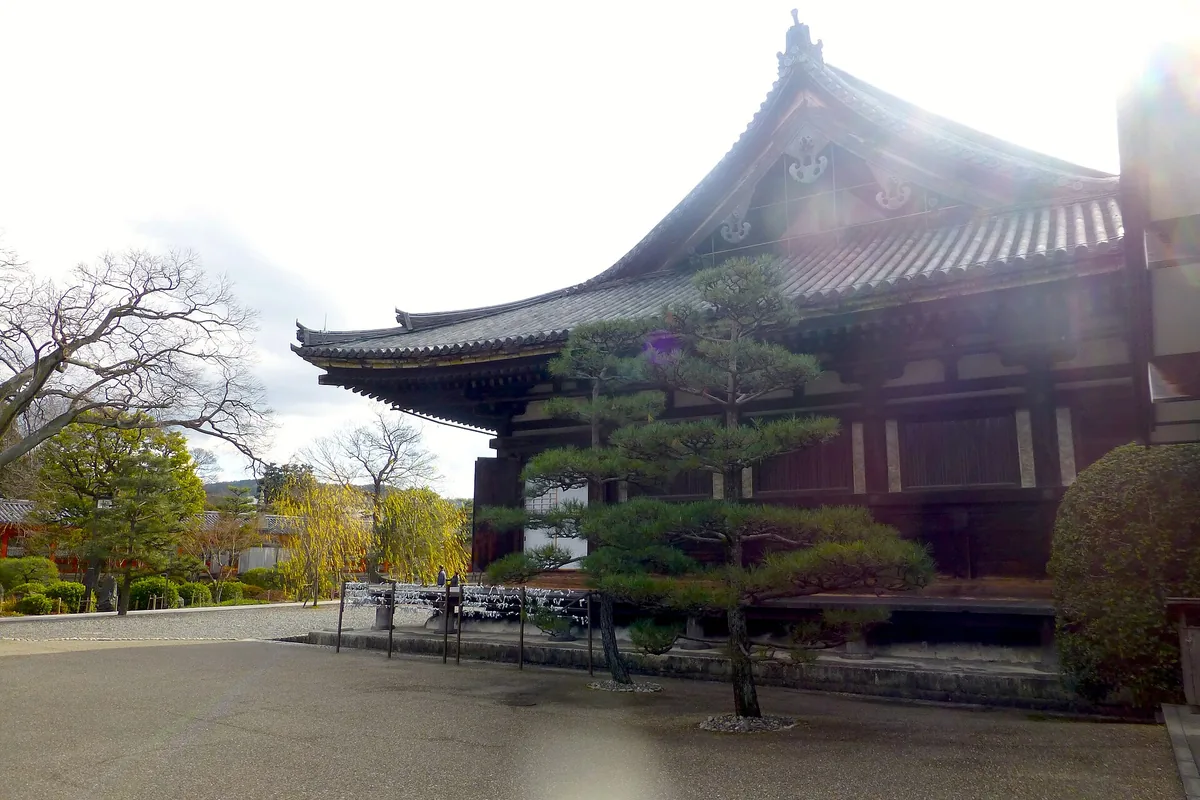
Sanjusangendo

Writes the autumn colour pages and follows the forecasts as they are issued, which is more than one forecast.
UpdatedSanjusangendo is a single timber hall, about a hundred and twenty metres long, containing 1,001 gilded statues of Kannon standing in ten tiered ranks with a seated figure at the centre. It costs ¥600. It takes an hour. Most visitors to Kyoto skip it.
They skip it because photography inside is banned, so it does not circulate. That is also precisely why it is worth your time: no phones up, no queue at a viewpoint, no shuffling for an angle. Just a very long room that people walk down quietly because there is nothing else to do in it.
At a glance
- Admission
- ¥600 adults, ¥400 middle and high school, ¥300 primary school
- Hours
- 8:30–17:00 from 1 April to 15 November; 9:00–16:00 from 16 November to 31 March. Last admission thirty minutes before closing
- Photography
- Prohibited inside the hall, without exception
- Getting there
- City Bus 206 or 208 to Hakubutsukan-Sanjusangendo-mae, or fifteen minutes on foot from Kyoto Station
In this guide
What is in the hall
The 1,001 figures are life-sized, carved in cypress, lacquered and covered in gold leaf, and each has forty arms and eleven faces. Around a hundred and twenty-four survive from the original hall of 1164; the rest were carved after a fire in 1249 by the Kei school workshop over about sixteen years. They are individually carved rather than copied, and if you walk slowly the faces stop blurring into a pattern and start being people.
In front of them stand the twenty-eight guardian deities, which are the real reason to come. These are thirteenth-century sculpture at the top of its form – wiry, veined, furious, with inlaid crystal eyes that catch the light from the corridor. Basu Sennin as an emaciated old ascetic and the wind god Fujin at the end of the row are as good as anything in a Japanese museum, and here they are standing in the building they were made for.
The name means ‘thirty-three intervals’, after the bays between the pillars, and thirty-three is the number of forms Kannon takes. Everything in the building is that number multiplied out.
The photography ban is the feature
No photographs are permitted inside the hall. There is no exception for phones, no permitted section, and staff enforce it.
The effect on the visit is dramatic. Kyoto’s congestion is largely congestion at camera positions – the pond rail at Kinkaku-ji, the gate tunnel at Fushimi Inari, the stage at Kiyomizu-dera. Remove the photograph and the bottleneck disappears. People move through at walking pace and the hall never feels full even when the car park is.
It also means you have to actually look. An hour in there is closer to an hour in a cathedral than an hour at a sight.
Kyoto’s best wet-weather hour
Most of what people come to Kyoto for is outdoors: gardens, hillsides, lanes, mountain paths. A full day of rain wrecks an itinerary built on those. Sanjusangendo is entirely under cover from the ticket gate, it is ten minutes on a bus from Kyoto Station, and it sits opposite the Kyoto National Museum, which is also indoors. That pairing is the best rainy morning in the city.
Watch the hours, which switch twice a year: 8:30 to 17:00 from 1 April to 15 November, and 9:00 to 16:00 from 16 November to 31 March, with the desk closing thirty minutes before the hall does. The winter 16:00 close is early even by Kyoto standards, and 16 November is an awkward date to have as a cut-off because it lands in the middle of the autumn-colour rush.
One day a year, in mid-January, the hall hosts the Toshiya archery competition, when young archers in kimono shoot the length of the west veranda. Admission to the grounds is free that day and the place is packed.
Frequently asked questions
How much does Sanjusangendo cost?
¥600 for adults, ¥400 for middle and high school students and ¥300 for primary school children. Group rates are slightly lower, and holders of a disability certificate plus one carer pay half.
What are the opening hours?
8:30 to 17:00 from 1 April to 15 November, and 9:00 to 16:00 from 16 November to 31 March. The ticket desk closes thirty minutes before the hall.
Can you take photographs inside?
No. Photography is prohibited throughout the hall and the rule is enforced. It is the main reason the building stays calm.
How many statues are there?
1,001 figures of Kannon – 1,000 standing in ranks plus the large seated central figure – along with twenty-eight guardian deities and the wind and thunder gods at the ends of the row.
Is Sanjusangendo good in the rain?
It is the best wet-weather sight in Kyoto. The whole visit is indoors, it is a short bus ride from Kyoto Station, and the Kyoto National Museum is directly opposite for a second indoor hour.
Further reading
Official sources
- Sanjusangendo – visiting information (official) – ¥600 / ¥400 / ¥300 and the seasonal 8:30–17:00 and 9:00–16:00 hours
- Sanjusangendo – the precinct (official) – The hall, the 1,001 Kannon and the twenty-eight guardian deities