Monja Mugi
Writes the route pages and owns the fare data behind them. Re-checks every segment on a quarterly sweep.
UpdatedThis page carries dated prices or seasonal forecasts checked on the date above, and that window has now passed. Re-check the sources at the foot of the page before you book anything.
An honest note before anything else. Our record of Monja Mugi comes from a 2020 article. Six years is a long time for a small independent restaurant in central Tokyo, and the pandemic years were hard on exactly this kind of business. We have kept the entry because the recommendation was a good one and because the street it sits on is worth a page of its own – but check it is trading before you travel for it, and treat everything below as guidance rather than a guarantee.
We do not print its hours or prices, because we cannot verify either from a current source. What we can tell you properly is how to eat monjayaki, which almost every first-timer gets wrong, and what to do on Monja Street if this particular door is shut.
At a glance
- Caveat
- Our information on this shop comes from a 2020 article. Small Tsukishima restaurants close, move and change hands. Confirm it is trading before you make a journey for it
- Dish
- Monjayaki – the loose, savoury Tokyo relation of okonomiyaki, cooked by you on the table hotplate
- Where
- Tsukishima Monja Street, a few minutes from Tsukishima station on the Yurakucho and Toei Oedo lines
- Hours and prices
- Not verifiable from a current source, so we do not print them
- If it is shut
- Monja Street has around seventy other monja restaurants within 400 metres
In this guide
Monja Street, which is the real destination
Tsukishima is a reclaimed island in the Sumida estuary, laid out in the 1890s, and its main shopping street – Tsukishima Monja Street – carries something like seventy monjayaki restaurants along roughly four hundred metres. Nowhere else in Japan has this density of a single dish.
That density is your insurance policy. If Mugi is closed, gone or full, you walk twenty metres and sit down somewhere else, and the standard along the street is high because nothing that is not good survives seventy doors of competition. The shops that are busiest at eight on a weeknight with people who are clearly local are the ones to join.
The street itself is worth the trip. Tsukishima is low-rise, slightly shabby, threaded with back alleys full of potted plants, and completely unlike the Chuo ward towers a kilometre away. Walk the side lanes before you eat.
How to actually cook monjayaki
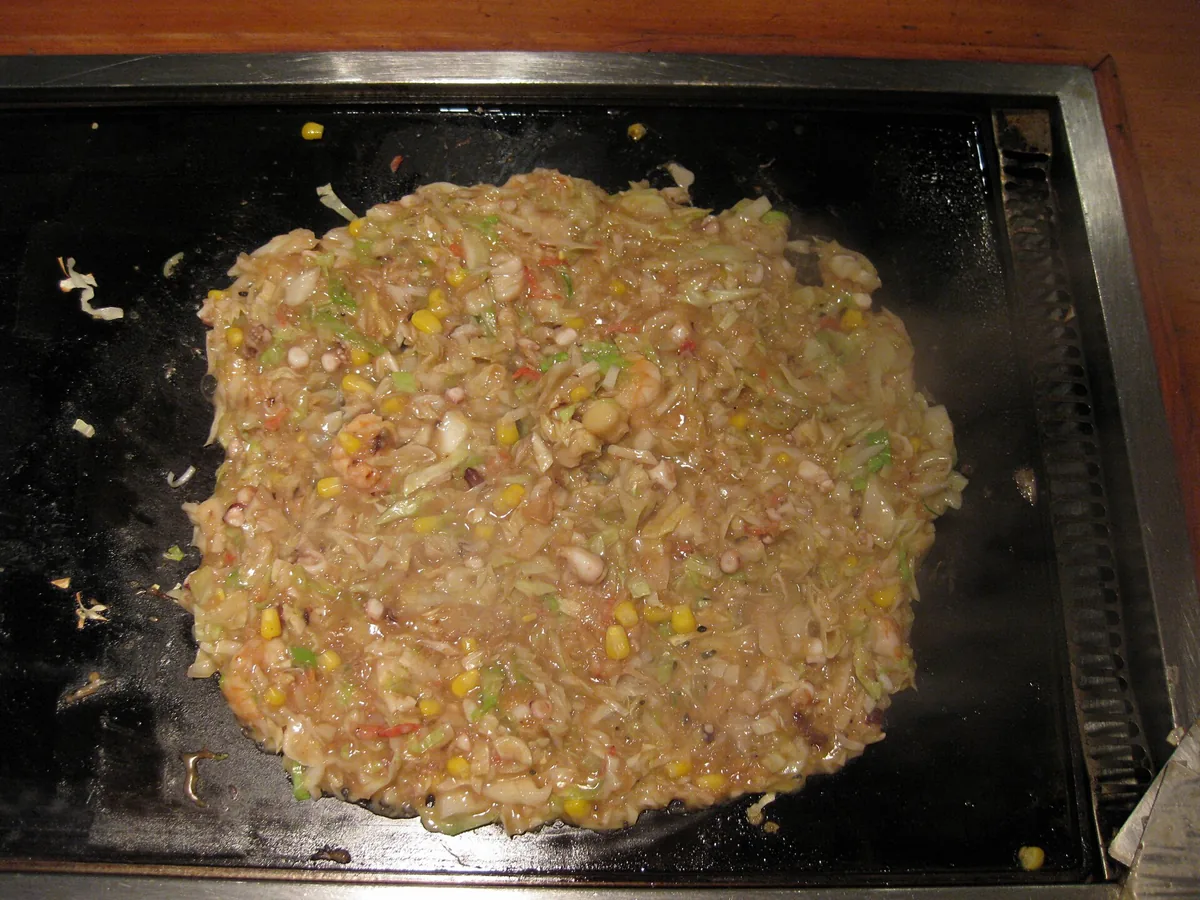
Monjayaki is not okonomiyaki. Okonomiyaki is a thick savoury pancake that holds together; monja is a loose, wet batter that never sets and is eaten straight off the hotplate in small scrapes. Visitors who expect a pancake decide it has gone wrong. It has not.
You get a metal bowl with cabbage and your chosen ingredients sitting in thin dashi batter, and two small spatulas called hagashi. The method:
One. Tip out the solids only, keeping the liquid back in the bowl. Chop them on the hotplate with the spatulas until the cabbage is wilted and finely broken up.
Two. Push the solids into a ring – a doughnut with a wall – then pour the reserved liquid into the middle of it. Let it bubble and thicken for a minute or two.
Three. Break the wall, mix everything together and spread it flat across the plate. Let the bottom catch slightly. The crisp base is the best part of monja and rushing this step is the main way to produce a disappointing one.
Four. Eat with the small spatula, pressing a little down onto the plate to crisp each scrape, straight from hotplate to mouth. No plates and no chopsticks.
Order mentaiko mochi cheese if it is available. Cod roe, rice cake and cheese is the default Tsukishima combination and it is the one to start with.
Practicalities
Monja is an evening meal and the street is busiest from about seven. Weekends fill up; a weeknight is easier and the staff have more time to show you the technique, which they will if you let them.
It is cheap. Two people can eat two or three monja and drink beer for well under the price of one course at most central Tokyo restaurants, which makes it one of the better-value evenings in the city.
Tsukishima station is on the Yurakucho and Toei Oedo lines and is ten minutes from Ginza. It combines well with a walk over to Toyosu the following morning, and the dish itself is explained in full on the monjayaki page.
Frequently asked questions
Is Monja Mugi still open?
We cannot confirm it. Our information dates from a 2020 article and we have not been able to re-verify it from a current source, so check before you travel. Monja Street has around seventy alternatives if it has closed.
What are Monja Mugi's hours and prices?
We do not publish them, because we cannot verify them. Printing a six-year-old price as though it were current would be worse than saying nothing.
What is the difference between monjayaki and okonomiyaki?
Okonomiyaki is a thick pancake that sets and is cut into pieces. Monjayaki is a loose, wet batter that never sets and is eaten in small scrapes straight off the hotplate with a tiny spatula.
How do you cook monjayaki?
Chop the solids on the hotplate, build them into a ring, pour the reserved liquid into the middle, let it thicken, then mix and spread it flat and let the base crisp before eating it scrape by scrape.
Where is Tsukishima Monja Street?
A few minutes from Tsukishima station on the Yurakucho and Toei Oedo lines, about ten minutes from Ginza, with roughly seventy monja restaurants along four hundred metres.
Further reading
Official sources
- GO TOKYO – Tsukishima Monja Street – Official listing for the street and the dish
- SHUN GATE – the roots of Tsukishima monja – History of monjayaki in Tsukishima
- GO TOKYO – spot directory – Tokyo Convention and Visitors Bureau listings