Yanaka

Writes the autumn colour pages and follows the forecasts as they are issued, which is more than one forecast.
UpdatedThis page carries dated prices or seasonal forecasts checked on the date above, and that window has now passed. Re-check the sources at the foot of the page before you book anything.
Yanaka is the reason to stop thinking of Tokyo as a modern city. The 1923 Great Kanto earthquake and the 1945 firebombing between them destroyed most of the low city; Yanaka came through both largely intact, and what stands there now is timber houses, tiled roofs, lanes too narrow for two cars, and around seventy temples in about a square kilometre.
There is no ticket to buy and nothing to book. It is the cheapest good day in the city, and its one practical trap is a mild one: the shops on Yanaka Ginza close early, many small businesses take Mondays off with no shared convention about it, and an afternoon arrival can find a photogenic neighbourhood with the shutters down.
At a glance
- Getting there
- Nippori on the JR Yamanote Line for the cemetery and Yanaka Ginza, or Sendagi on the Chiyoda subway for the north end
- Cost
- Nothing, other than what you eat. The temples are free and there is no ticketed attraction
- Best hours
- Morning, and note that the Yanaka Ginza shops mostly shut by early evening
- Closed days
- Many small shops and cafes close on Mondays; there is no single convention
- Time needed
- Half a day on foot
In this guide
Start at the cemetery, which is not morbid
Come out of Nippori station’s west exit and you are at the edge of Yanaka Cemetery, ten hectares of graves under a canopy of cherry trees. It is a public park in everything but name, with a central avenue known as Sakura-dori that is one of the best and least crowded blossom walks in Tokyo in early April.
Tokugawa Yoshinobu, the last shogun, is buried here, and so is much of Meiji Tokyo’s professional class. The point is not the graves but the atmosphere: cats, cicadas in summer, people walking to work through it, and complete quiet ten minutes from the Yamanote Line.
West from the cemetery the lanes begin. This is the part to do without a map. Walk slowly, take turnings that look too small, and you will pass wooden houses with pot plants stacked three deep against the wall, a wood-fired bathhouse converted into a gallery, tiny temples with no signage in any language, and about four cats per block. The Yanaka old-town walk sets out a route for anyone who would rather not improvise.
Yanaka Ginza, and the stairs above it
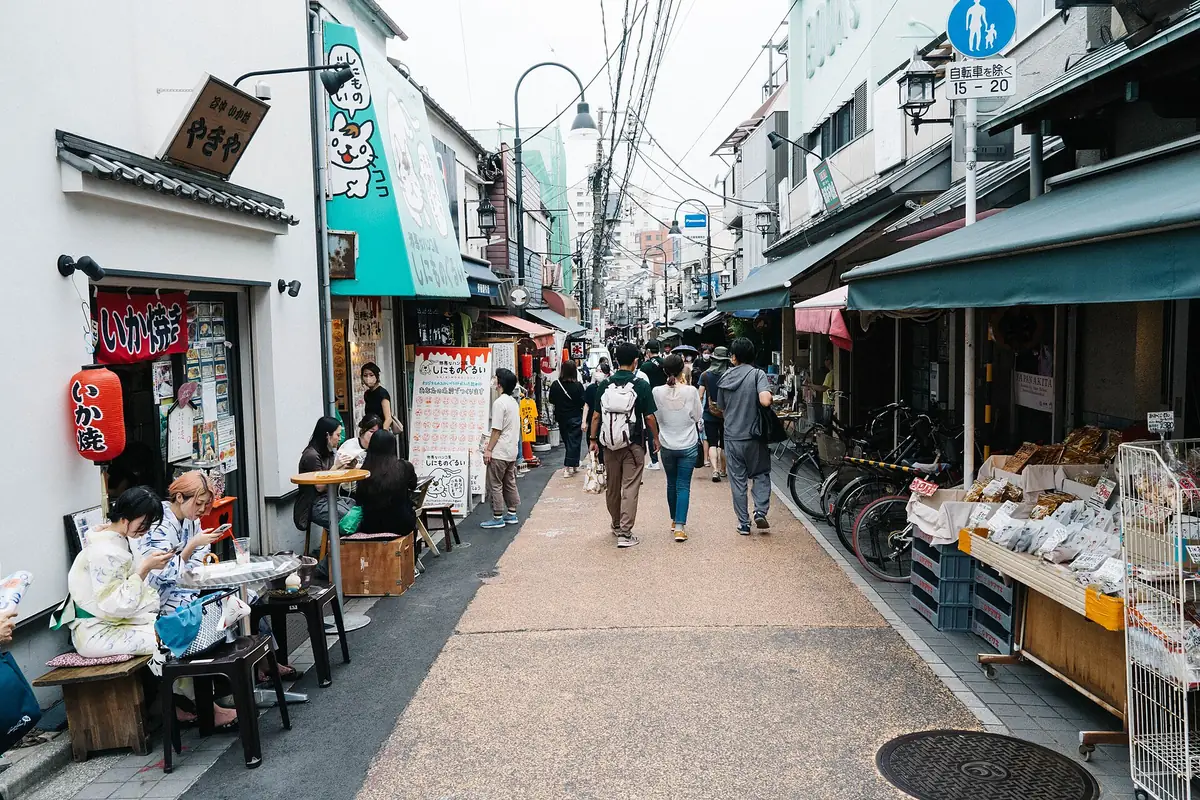
Yanaka Ginza is a 170-metre shopping street of about seventy small shops, almost none of them chains: a butcher, a fishmonger, senbei grilled to order, croquettes fried in front of you, a shop selling only cat-shaped things because of the neighbourhood’s cat population. It is a functioning local high street that happens to be photogenic, rather than a restored one.
At its eastern end are the stairs known as Yuyake Dandan, sunset steps, which look down the length of the street. That is the view on every article about Yanaka and it is best about an hour before sunset. Note that the shops will be closing at roughly the same time, so the photograph and the shopping are not quite compatible.
Eat as you walk here, standing near the shop you bought from. Menchi-katsu, croquettes, grilled senbei, ice cream. Two thousand yen is a full lunch for two.
Nezu, Sendagi and what to do next
Yanaka is the Y of Yanesen, the local name for Yanaka, Nezu and Sendagi together. Nezu-jinja, fifteen minutes south-west, is a genuine 1706 shrine complex that survived the war, with a tunnel of small red torii up the slope behind it and an azalea garden that is spectacular and ticketed for a few weeks in April. Sendagi to the north has the coffee shops and the second-hand bookshops.
South from there it is a twenty-minute walk into Ueno Park and the Tokyo National Museum, which is the natural pairing: two hours of the best collection of Japanese art in the world, then an afternoon in the streets the city it came from actually looked like.
Yanaka is also a serious option for where to stay. It is quiet, it is on the Yamanote Line at Nippori, and Nippori is the Skyliner terminus, which puts Narita airport thirty-six minutes away – a better arrival and departure than almost anywhere in central Tokyo.
Frequently asked questions
Why did Yanaka survive when the rest of Tokyo did not?
It came through both the 1923 earthquake and the 1945 firebombing with much of its fabric intact, and it was never comprehensively redeveloped afterwards. The result is a district of pre-war timber houses and around seventy temples.
How much does Yanaka cost to visit?
Nothing beyond food. The temples, the cemetery and the streets are free, and there is no ticketed attraction in the district.
When should I go to Yanaka?
A weekday morning. The Yanaka Ginza shops shut in the early evening, many small businesses close on Mondays with no shared convention, and the lanes are at their best before the afternoon.
Which station is best for Yanaka?
Nippori on the JR Yamanote Line puts you at the cemetery and a few minutes from Yanaka Ginza. Sendagi on the Chiyoda subway is better for the northern end and for Nezu-jinja.
Is Yanaka a good place to stay in Tokyo?
It is a strong choice if you want quiet. It sits on the Yamanote Line at Nippori, which is also the Keisei Skyliner terminus, putting Narita airport about thirty-six minutes away.
Further reading
Official sources
- GO TOKYO – Yanaka and Nezu – Official Tokyo Convention and Visitors Bureau area guide
- GO TOKYO – Yanaka Ginza – The shopping street and its shops
- GO TOKYO – Yanaka Cemetery – The cemetery and its cherry avenue
- GO TOKYO – walks around Yanaka and Nezu – Official suggested walking route