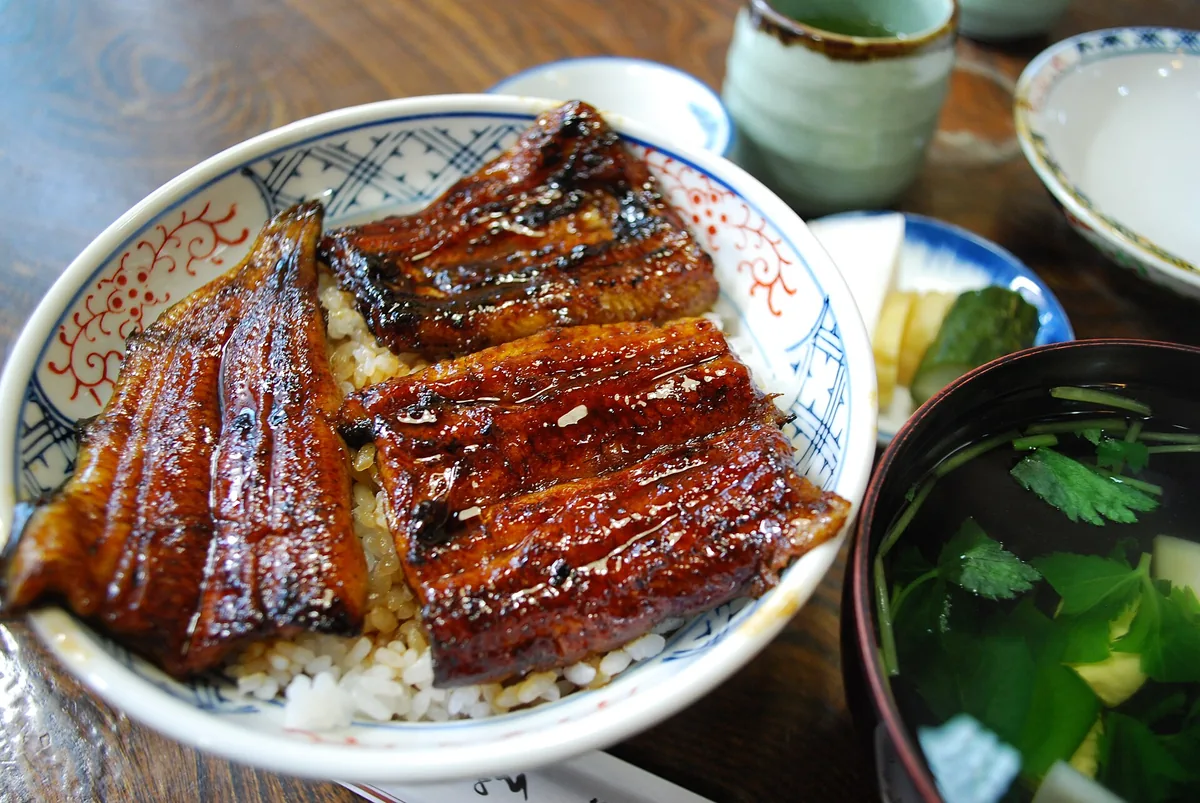
Unagi kabayaki
Writes the route pages and owns the fare data behind them. Re-checks every segment on a quarterly sweep.
UpdatedThis page carries dated prices or seasonal forecasts checked on the date above, and that window has now passed. Re-check the sources at the foot of the page before you book anything.
Grilled eel is cooked differently in eastern and western Japan, and the difference starts with the knife. Tokyo splits the eel along the back. Osaka splits it along the belly.
The usual explanation is cultural rather than culinary, and it is a good one. Edo was a samurai city, and cutting open a belly was an unmistakable reference to seppuku – not something to put in front of a customer. Osaka was a merchant city where hara o waru, to open one’s belly, meant to speak frankly, and carried no such freight. From that one decision, two whole methods follow.
At a glance
- Kanto method
- Split down the back, head removed, grilled, then steamed, then grilled again with the sauce
- Kansai method
- Split down the belly, head often left on during cooking, grilled straight through with no steaming
- Why
- Edo was a samurai city and cutting the belly evoked seppuku. Osaka was a merchant city where ‘opening the belly’ meant speaking frankly
- Result
- Kanto eel is soft and fat-rendered; Kansai eel is firmer, crisper and more directly smoky
- When
- Traditionally eaten on the midsummer Day of the Ox, when prices and queues both rise
In this guide
The two methods, and what they do to the fish
Kanto, the Tokyo method. Split along the back and the head removed. The fillets are skewered and grilled plain, then steamed, then grilled again while being repeatedly dipped in tare, a sweet soy glaze. The steaming step is the distinguishing one: it renders out a large part of the fat and collapses the connective tissue, producing eel so soft it can be eaten without much chewing.
Kansai, the Osaka method. Split along the belly, the head often kept on during cooking to hold the fillet straight and removed at the end. Grilled from raw straight through over charcoal with no steaming, so the skin crisps and the flesh stays firm, oilier and more directly smoky.
Neither is better and people have preferences the way they have preferences about barbecue. If you have only eaten unagi in Tokyo you have eaten the soft version, and the Osaka one will surprise you.
The tare itself is worth knowing about. Long-established restaurants keep a master sauce, topped up rather than replaced, which in some houses is claimed to descend from a batch started generations ago. Whatever the provenance, the sauce is the restaurant’s signature and is not bought in.
How to order it
Unaju is eel over rice in a lacquered box, and it is the standard order. Unadon is the same thing in a bowl, usually cheaper and slightly less ceremonial. Grades – often matsu, take, ume, pine, bamboo and plum – indicate the quantity of eel rather than the quality, so the cheapest grade is the same fish in a smaller portion.
Kimosui, a clear soup with the eel liver in it, is the traditional accompaniment and is usually ordered separately. Sansho pepper comes on the table: it is not chilli heat but a citrus-numbing spice that cuts the fat, and a proper pinch improves the dish considerably.
In Nagoya there is a third format, hitsumabushi, in which you eat the box in quarters – plain, with condiments, with dashi poured over as tea-rice, and then whichever way you liked best. Some Tokyo restaurants offer it.
Expect to pay. Unagi is one of the most expensive everyday dishes in Japan and prices have risen with declining eel stocks. A good unaju in Tokyo is a several-thousand-yen lunch, and a specialist house is more.
When to eat it, and the awkward part
The traditional day is Doyo no Ushi no Hi, the midsummer Day of the Ox, when eel is eaten for stamina in the heat. Restaurants queue out of the door and prices go up. It is a genuine custom and a poor day to try it for the first time.
Asakusa and the old low city are the traditional Tokyo districts for it and the Asakusa page covers the neighbourhood. Many specialist houses are small, open for a lunch and a dinner service, and take bookings; eel is cooked to order and takes thirty to forty minutes, so this is not a quick meal.
The awkward part is conservation. The Japanese eel is listed as endangered and stocks have fallen sharply; almost all farmed eel is raised from wild-caught juveniles rather than bred in captivity, so farming does not currently relieve the pressure. That is a reason to eat it thoughtfully at a good restaurant rather than casually from a supermarket, and it is a reason some people decline it altogether. Both positions are defensible and we are not going to pretend the question does not exist.
Frequently asked questions
Why does Tokyo cut eel down the back?
Because Edo was a samurai city and cutting open a belly evoked seppuku. Osaka, a merchant city where opening one's belly meant speaking frankly, splits it down the belly instead.
What is the difference between Kanto and Kansai unagi?
Kanto eel is split down the back, grilled, steamed and then grilled again with sauce, which makes it very soft. Kansai eel is split down the belly and grilled straight through without steaming, so it is firmer and crisper.
What is the difference between unaju and unadon?
Unaju is eel over rice served in a lacquered box; unadon is the same thing in a bowl. The grades usually refer to the amount of eel rather than its quality.
What is the powder served with eel?
Sansho pepper. It is citrusy and slightly numbing rather than hot, and it is there to cut the fat. Use a proper pinch.
Is eating unagi a conservation problem?
The Japanese eel is listed as endangered and almost all farmed eel is raised from wild-caught juveniles, so farming does not currently ease the pressure. It is a fair reason to eat it rarely and carefully, or not at all.
Further reading
Official sources
- GO TOKYO – spot directory – Official Tokyo Convention and Visitors Bureau listings
- GO TOKYO – Asakusa – The traditional district for Edo-style eel restaurants
- MICHELIN Guide – Tokyo restaurants – Selection including specialist unagi houses