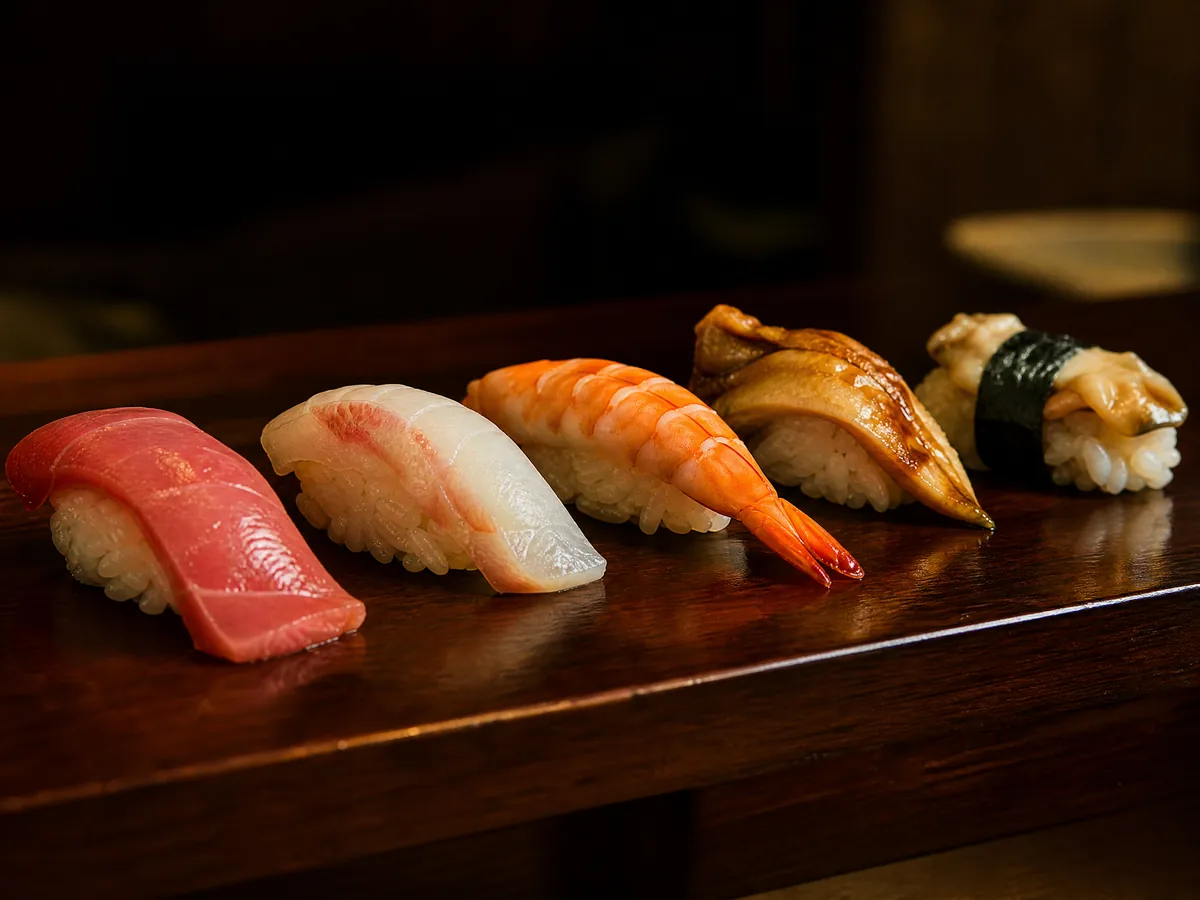
Edomae sushi
Writes the route pages and owns the fare data behind them. Re-checks every segment on a quarterly sweep.
UpdatedThis page carries dated prices or seasonal forecasts checked on the date above, and that window has now passed. Re-check the sources at the foot of the page before you book anything.
Edomae means ‘in front of Edo’ – the fishing grounds of Tokyo Bay, directly in front of the city. Sushi as the rest of the world eats it was invented here in the early nineteenth century as street food, sold from stalls, eaten standing, in a couple of mouthfuls.
The part that gets lost in translation is what the chef is doing to the fish. There was no refrigeration in Edo, so every topping was treated – cured in salt, marinated in soy, simmered, aged, brushed with reduced sauce – to make it safe and to make it taste better. Those techniques are the craft. Raw, untouched fish is the modern exception, not the tradition.
At a glance
- What it is
- The Tokyo style of nigiri: a hand-pressed finger of vinegared rice with a topping that has usually been cured, marinated, simmered or aged
- Where it came from
- Edo in the early nineteenth century, as fast street food made from fish caught in the bay in front of the city
- How to eat it
- Fish side down onto the tongue, one piece at a time, immediately; do not dip the rice in soy
- Where to try it
- Toyosu market’s upstairs restaurants for value, Ginza counters for the high end
- Price range
- From a few hundred yen a plate at a conveyor belt to five figures at a Ginza counter
In this guide
What the chef is actually doing
Zuke. Lean tuna marinated in soy sauce and mirin, which firms the flesh and deepens the colour to near-black. This was how tuna was kept before ice, and it is still the better version of a piece of lean maguro.
Shime. Oily silver fish – mackerel, gizzard shad, horse mackerel – cured in salt and then in rice vinegar. The gizzard shad, kohada, is the traditional test of a sushi chef: it is small, bony, strongly flavoured and impossible to hide behind, and a good one tells you everything about the counter you are sitting at.
Nimono. Simmered toppings – conger eel, octopus, clam – usually brushed with nitsume, a sweet reduction of the cooking liquid. Conger eel done this way should collapse on the tongue.
Nekase. Ageing. White fish held for a day or several, which breaks down protein into amino acids and increases savoury depth. A serious counter will tell you how long a particular fish has been rested, and it is not a sign of age but of intention.
The rice matters as much as any of it. Edomae rice is seasoned with red vinegar, served at close to body temperature, and pressed loosely enough to fall apart in the mouth. If the rice is cold and dense, the fish is beside the point.
How to eat it at a counter
Eat it immediately. The chef places a piece in front of you at the moment it is ready, at the temperature it is meant to be eaten at. Talking for ninety seconds first is the one genuine discourtesy.
Fingers are fine. Nigiri was street food and eating it with your hands is traditional, not crude. Chopsticks are also fine. Do whichever you can do without dropping it.
Do not dip the rice. If soy is on the counter, turn the piece and touch the fish to it. Rice dipped in soy disintegrates and oversalts. At a good counter the chef will already have brushed each piece with what it needs and there will be no soy on the table at all, which is the answer to the question.
Do not add wasabi. It is already between the rice and the fish, in the quantity the chef judged that fish needs.
Ginger is a palate cleanser, eaten between pieces, not a topping.
At an omakase counter the chef chooses the sequence, which generally runs from lean and light to rich and finishes with egg. Say what you dislike at the start; the chef will simply route around it.
Where to eat it and what it costs
The range is enormous. A conveyor-belt shop is a few hundred yen a plate and is perfectly decent food. A Toyosu market restaurant does a sushi breakfast for a few thousand yen with fish that arrived downstairs that morning. A Ginza counter runs into five figures per person, and at the top of the market bookings are as difficult as Den.
The value sweet spot for most visitors is the Toyosu market restaurants, upstairs from the auction floors. You can watch the tuna auction free from the upper walkway and then eat what was sold, which is a better sequence than most paid experiences in Tokyo.
A note on tuna. The auction prices that make the news are for a few exceptional fish and are publicity as much as commerce; they do not set what you pay for lunch. And the fish at a good counter is chosen for what is in season, not for what is famous – which is why kohada, a cheap small fish, is the one chefs are judged on.
Frequently asked questions
What does Edomae mean?
In front of Edo – the fishing grounds of Tokyo Bay directly in front of the city. It is the Tokyo style of nigiri sushi, invented there in the early nineteenth century as street food.
Is Edomae sushi raw?
Often not. Because Edo had no refrigeration, toppings were cured, marinated, simmered or aged, and those techniques are the craft. Untreated raw fish is the modern exception rather than the tradition.
Should I dip sushi in soy sauce?
Touch the fish to the soy, never the rice, which falls apart and oversalts. At a good counter each piece is already seasoned and there will be no soy on the table.
Can I eat sushi with my fingers?
Yes. Nigiri began as street food and eating it by hand is traditional. Chopsticks are equally acceptable.
Where should I eat sushi in Tokyo on a budget?
The restaurants upstairs at Toyosu market, where a sushi breakfast costs a few thousand yen and the fish was sold downstairs that morning.
Further reading
Official sources
- GO TOKYO – spot directory – Official Tokyo Convention and Visitors Bureau listings, including Toyosu
- Toyosu Market (official) – Market facilities, restaurants and auction viewing
- MICHELIN Guide – Tokyo restaurants – The high end of the Tokyo sushi market