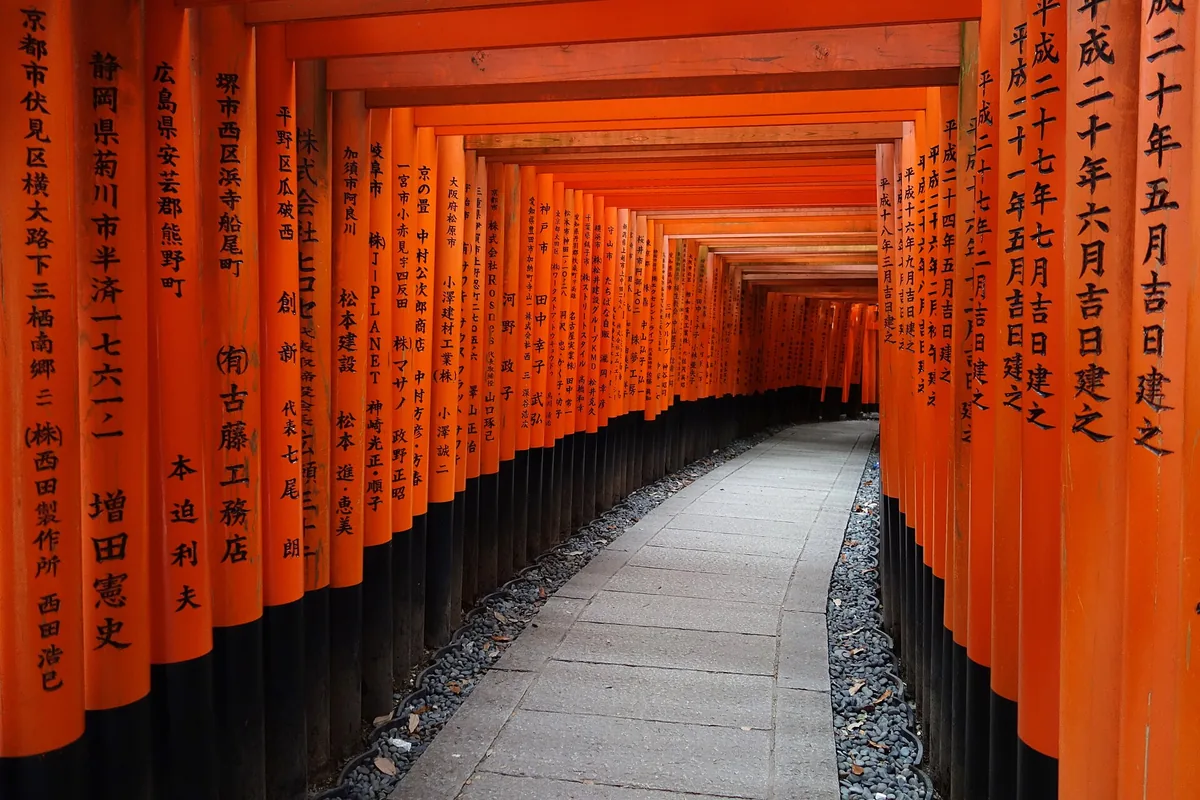
Fushimi Inari Taisha

Writes the autumn colour pages and follows the forecasts as they are issued, which is more than one forecast.
UpdatedFushimi Inari is free, has no closing time, and sits directly outside JR Inari station – two stops and about five minutes from Kyoto Station on the Nara Line. There is no combination of those three facts anywhere else in the city.
The thing worth knowing before you go is how short the famous part is. The dense, shoulder-width tunnel of vermilion gates that appears in every photograph – the Senbon Torii – is roughly the first ten minutes of the climb. Above the Yotsutsuji junction, perhaps half an hour up, the crowd thins to almost nothing and stays that way for the rest of the mountain.
At a glance
- Admission
- Free, with no ticket office and no gate to close
- Hours
- The grounds are open at all hours, all year
- Getting there
- JR Nara Line to Inari – the shrine approach starts directly outside the exit. Keihan Fushimi-Inari is a five-minute walk
- Time needed
- 40 minutes to the Yotsutsuji junction and back; two to three hours for the full mountain loop
In this guide
The famous stretch is ten minutes long
From the main hall the path enters the Senbon Torii, where the gates stand so close together that the daylight turns orange. It splits into two parallel lanes for a stretch – walk up the right-hand one, which is the signed direction – and then it opens out at Okusha Hohaisho, the inner shrine, where the votive plaques are shaped like fox faces.
That is the bit everyone comes for, and it is busy from about nine in the morning until dusk. It is also over quickly. The gates do continue above it, but in loose runs with gaps of open hillside and sub-shrines between them, which is a different and better experience than the tunnel.
If all you want is the photograph, you need thirty minutes at the shrine and you need to be there before eight or after seven in the evening. The site is lit and genuinely walkable at night, and after dark the lower gates are close to empty.
Past Yotsutsuji, the crowds collapse
Yotsutsuji is a four-way junction about thirty to forty minutes up, with a clearing, a bench, a couple of tea stalls and the one genuine view – southern Kyoto laid out below, best in late afternoon. The overwhelming majority of visitors reach it, sit down, and go back the way they came.
Above it the path forms a loop around the summit of Mount Inari, and the character of the place changes entirely. The gates keep coming, but so do hundreds of small stone altars, mossed and stacked in clearings, left by worshippers over a century and a half. It is quiet, slightly strange, and the part of Fushimi Inari that is actually a working religious mountain rather than a photograph.
The full loop takes about two hours at a steady pace. It is a real climb – stone steps, roughly 230 metres of ascent – and there is no shortcut down from the top, so commit at Yotsutsuji or turn back there.
When to come
Because there is no gate, Fushimi Inari absorbs the hours no other sight can use. Before 7:00 it is nearly empty and the light through the gates is at its best. After 19:00 it is empty again and lit. In between, from about 9:30, the lower section is a moving queue.
This makes it the natural first or last item on a Kyoto day, and a good answer to an awkward evening. It also pairs neatly with the Fushimi sake district, which is a few stops further south on the Keihan line and closes in the late afternoon – sake breweries first, shrine after dark.
One practical warning: the summit loop is genuinely dark at night away from the lower gates, the lighting is patchy above Yotsutsuji, and there is wildlife on the mountain. The night visit is for the lower section.
Frequently asked questions
How much does Fushimi Inari cost?
Nothing. There is no admission charge and no ticket office, at any hour.
What time does Fushimi Inari open and close?
It does not close. The grounds are open all day and all night, all year. The shrine office and the stalls keep normal daytime hours, but the paths and the gates are always accessible.
How long is the walk to the top?
About two hours for the full summit loop, or forty minutes there and back if you stop at the Yotsutsuji junction. The climb is roughly 230 metres of stone steps.
How do I get to Fushimi Inari from Kyoto Station?
JR Nara Line to Inari, two stops and about five minutes. The shrine approach begins directly outside the station exit. The Keihan line stops at Fushimi-Inari, five minutes' walk away.
Is it possible to avoid the crowds?
Yes, in two ways. Come before seven in the morning or after seven in the evening, or simply keep walking – above the Yotsutsuji junction the numbers fall away and stay low for the rest of the loop.
Further reading
Official sources
- Fushimi Inari Taisha – access (official) – JR Inari and Keihan Fushimi-Inari access; no admission charge
- Fushimi Inari Taisha (official English site) – Shrine precinct information and the Mount Inari paths